
Let's be honest. You’re a small business owner, not a marketing professor. You hear 'PPC' and probably see one of two things: dollar signs flying out the window, or your eyes glazing over. Both are completely valid reactions.
Most guides on PPC for small business are either so basic they’re useless or so packed with jargon they might as well be written in another language.
Let's get real about PPC
I’m an entrepreneur who builds tech and scales businesses, and I’ve seen firsthand how PPC can be a complete game-changer... or a money pit.
The truth is, PPC isn't magic. It's a tool. Used correctly, it puts your business directly in front of people actively searching for exactly what you sell.

Used poorly, it’s like setting a pile of cash on fire just to watch it burn. You’re not alone if you’re skeptical. The good news? You’re right to be. A healthy dose of skepticism is what separates the campaigns that work from the ones that just drain your bank account.
This guide is different. We're going to break down how to use PPC right—no fluff, no buzzwords, just practical advice for getting actual results.
Why you can't afford to ignore it
The conversation is no longer about if small businesses should use PPC, but how. Did you know that 65% of small-to-medium businesses are already running PPC campaigns? This isn’t just a trend; it's how smaller companies are fighting for and winning attention.
And it works. On average, businesses make $2 for every $1 spent on Google Ads. When it’s done right, it’s one of the highest-return channels you can find. You can discover more about these PPC statistics to see why it's such a key driver for growth.
The core idea is simple: you pay to put your business in front of customers at the exact moment they’re looking for a solution. It's direct-response marketing for the modern era.
In this post, we'll cover what actually matters and where to begin. We’ll also dig into the common mistakes that sink most small business campaigns before they even get started.
Think of this as your field guide to making PPC work without a massive budget or a dedicated marketing team. We'll focus on:
- Smart Budgeting: How to start small and scale without getting burned.
- Effective Targeting: Reaching the right people and avoiding wasted clicks.
- High-Impact Ads: Writing messages that actually get noticed and clicked.
- Landing Page Essentials: Turning those expensive clicks into real customers.
Choosing your battleground: where to spend your first dollar
Not all PPC channels are created equal, and as a small business owner, you can’t afford to be everywhere at once. Your first decision is your most important: where do you put your money?
For 90% of small businesses, the answer is brutally simple: Google Ads.
Why? Because it’s all about intent. People are literally typing their problems and needs into a search bar, and you get to show up with the solution at that exact moment. It doesn't get more direct than that. You’re being a helpful answer, not an interruption.
Social media ads on platforms like Facebook or Instagram are great for building awareness, but you're breaking into someone's feed of cat videos and family photos. On Google, you're answering a direct request for help. For generating leads and getting your first dollar of profit, that's a massive advantage.
The king of intent: google search
Sure, other platforms have their place. LinkedIn can be a goldmine for B2B but it’s expensive, and Bing has a smaller, often older audience. But your first focus should be on mastering the king. Google Search is where your initial marketing budget should go. It has the volume, the tools, and the highest probability of delivering a positive return when you’re just starting your PPC journey.
To make a smart choice from day one, you need to understand the fundamental difference between the main Google campaign types. Let's cut through the jargon.
- Search Campaigns: These are the classic text ads you see at the top of Google’s search results. You bid on keywords, and your ad appears when someone searches for them. This is pure, intent-driven marketing and the best place to start. Someone needs a plumber, they search 'emergency plumber near me', and your ad shows up. Perfect.
- Display Campaigns: Think of these as digital billboards. They’re visual banner ads that appear across a network of millions of websites, apps, and videos. They're much better for building brand awareness than for driving immediate sales because you’re showing your ad to people based on their interests, not their immediate needs.
- Shopping Campaigns: For any e-commerce business, these are non-negotiable. They are the product listings with images and prices that appear at the top of search results. If you sell physical products online, you absolutely have to be using these.
PPC channel quick comparison for small businesses
Here’s a no-nonsense breakdown of the top PPC channels to help you decide where to invest your initial budget based on your business goals.
| Channel | Best For | Typical Cost | Key Advantage |
|---|---|---|---|
| Google Search Ads | Capturing immediate, high-intent demand. Perfect for lead generation and e-commerce sales. | Medium to High | Pure Intent: You reach people actively searching for your solution. |
| Google Shopping Ads | E-commerce businesses selling physical products. | Medium | Visual & High-Intent: Shows your product, price, and image directly in search results. |
| Facebook/Instagram Ads | Building brand awareness, retargeting, and demand generation. Great for visual products. | Low to Medium | Audience Targeting: Unmatched ability to target users based on demographics, interests, and behavior. |
| LinkedIn Ads | B2B lead generation, targeting specific job titles, industries, and company sizes. | High to Very High | Professional Targeting: Hyper-specific targeting for B2B audiences. |
| Bing Ads | Reaching a slightly older, often more affluent demographic with less competition. | Low to Medium | Lower CPC: Often cheaper clicks and less competition than Google. |
While other channels have their strengths, the message for a small business just starting out is clear: focus your firepower where you have the highest chance of winning.
The bottom line is this: Start with Google Search. It is the most direct path from a potential customer's problem to your solution. Don't spread your small budget thin across multiple platforms. Win this battle first, then expand your territory. You can learn more about the specifics in our guide to paid search marketing.
Structuring your campaigns like a pro, not an amateur
This is where most small businesses get it completely, disastrously wrong. They dump hundreds of keywords into a single ad group, cross their fingers, and hope for the best. Let me be direct: that’s a dumb way to do PPC and a guaranteed method for burning through your budget with nothing to show for it.
A well-structured campaign is the foundation for everything that follows. Think of it like organizing a warehouse. You wouldn't just throw all your different products into one giant, chaotic bin. You’d have dedicated aisles, shelves, and labels so you could find exactly what you need, fast. It’s the same with PPC.
Your account structure is a simple hierarchy, but getting it right is crucial. It flows from the top down.
- Campaign: This is the highest level, like the entire warehouse. Here you control the big-picture settings: your total budget, the geographic locations you’re targeting, and the ad network you’re using (e.g., Google Search).
- Ad Group: These are the individual aisles in your warehouse. Each ad group should contain a small, tightly-themed cluster of keywords that all relate to one specific product or service you offer.
- Keywords & Ads: These are the products on the shelves. Inside each ad group, you have the specific keywords you’re bidding on and the ads that will show when someone searches for those terms.
The golden rule here is granularity. Each ad group must be hyper-focused on a tiny, closely related set of keywords. Don't mix 'emergency plumbing services' with 'DIY faucet repair tips' in the same ad group. It makes no sense.
Why granularity is your secret weapon
Why does this matter so much? Because a granular structure allows you to write incredibly relevant ads and send traffic to specific, tailored landing pages. This is the magic formula.
When a user's search query, your ad's headline, and the landing page’s content are all perfectly aligned, something beautiful happens. Google sees this intense relevance and rewards you with a higher Quality Score.
A high Quality Score is not just a vanity metric. It's a direct discount on your advertising costs. It means Google sees your ads as highly relevant and useful, so they will literally charge you less per click than your disorganized competitors for the same ad position.
This is how a small business with a tiny budget can outmaneuver a bigger, lazier competitor. You win on relevance, not just on having the deepest pockets.
Grouping keywords by user intent
The most practical way to achieve this is by grouping keywords based on user intent. You need to get inside the head of the person searching. What are they really looking for?
For example, a local plumbing business could structure their ad groups like this:
Ad Group 1: Emergency Services
- Keywords: 'emergency plumber near me', '24/7 plumbing repair', 'burst pipe help'
- Ad Headline: 24/7 Emergency Plumber - Fast Response
- Landing Page: A page focused entirely on emergency services with a big Call Now button.
Ad Group 2: Drain Cleaning
- Keywords: 'clogged drain service', 'drain cleaning boulder', 'unclog shower drain'
- Ad Headline: Expert Drain Cleaning in Boulder
- Landing Page: A page that talks exclusively about their drain cleaning expertise and pricing.
Ad Group 3: Informational How-To
- Keywords: 'how to fix leaky faucet', 'why is my toilet running'
- Ad Headline: DIY Plumbing Tips from the Pros
- Landing Page: A blog post or guide answering that specific question.
See the difference? Each ad group matches the user’s immediate need. You’re not showing an ad for DIY Tips to someone with a flooded basement. That's the core of a professional structure. For a deeper dive, check out our guide on choosing the right keywords for your PPC campaigns to get this part perfect.
Why your landing page is 90% of the battle
Let's get brutally honest for a second. Your ads don't make you money. Not a single cent.
It’s a hard truth, but your landing pages do all the heavy lifting. You can write the most brilliant, compelling ad in the world, but if the page it clicks through to is slow, confusing, or totally irrelevant, you’ve just paid good money to disappoint a potential customer.
This is, without a doubt, the single biggest point of failure in PPC for small businesses. It’s where most of the money gets burned.
Your ad makes a promise. Your landing page has one job: to deliver on that promise, instantly. We’re talking about something called message match, and it’s non-negotiable. The headline on your landing page has to mirror the headline of your ad. A user needs to land on your page and know—within three seconds—that they are in exactly the right place.
Anything less is a failed click.
The anatomy of a high-converting landing page
A PPC landing page isn't your homepage. It's a specialist, a sniper rifle, not a shotgun. It has one goal and one goal only: to convert the click. Forget navigation bars, links to your blog, or anything else that could distract the user. Focus is everything. Every element must support the single, desired action.
A page that actually converts has a few core components that you absolutely must get right.
- A Clear Value Proposition: What do you do, and why should I care? This needs to be communicated above the fold, instantly. No one is going to scroll to figure out what you’re selling.
- Compelling, Focused Copy: Your copy should speak to a single problem and present your solution clearly. Use bullets and short paragraphs to make it scannable.
- Powerful Social Proof: People trust other people. Testimonials, reviews, case studies, or logos of clients you've worked with are incredibly powerful. This builds instant credibility.
- A Single, Unmissable Call-to-Action (CTA): This is the most important part. One big, obvious button that tells the user exactly what to do next. 'Get Your Free Quote', 'Download the Guide', 'Book a Demo'. Don't give them options; give them a command.
The structure of your PPC account, as we discussed, sets the stage for this. The diagram below shows how each campaign and ad group creates a focused path for the user.
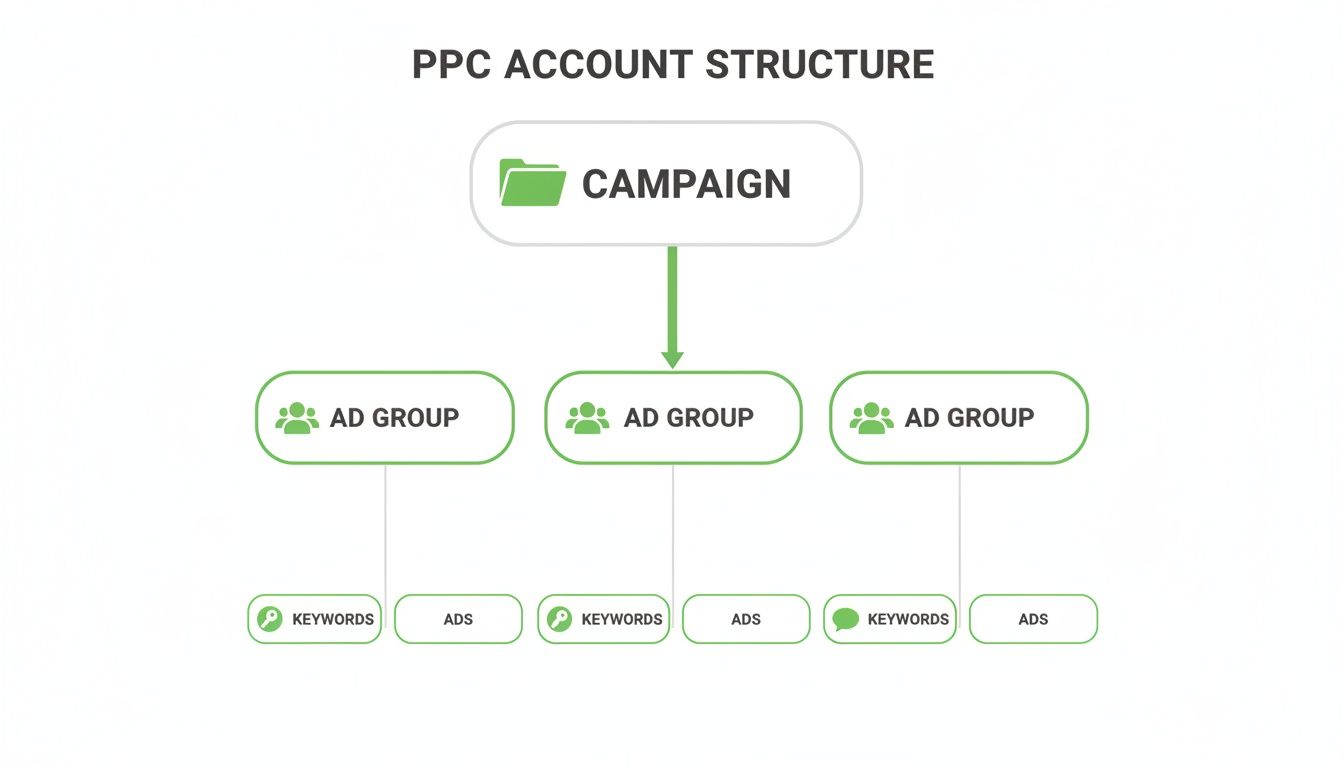
This tight organization is what makes it possible to achieve perfect message match between your ads and your landing pages—the real key to turning clicks into customers.
The future is automated landing pages
Manually building a unique landing page for every single ad group is a nightmare. It’s tedious, slow, and simply doesn't scale. This is where AI is fundamentally changing the game for small businesses.
Imagine a system that automatically generates a unique, high-intent landing page for every one of your keyword groups. That’s what’s possible now. Platforms like dynares can create thousands of coordinated ads and perfectly matched landing pages in minutes, ensuring perfect message match at a scale that was previously impossible for a small team. This is a massive competitive advantage.
Your goal isn't just to get clicks; it's to get profitable conversions. The landing page is the bridge between a click and a customer. Don't let it be a rickety, broken-down bridge.
Given that your landing page is 90% of the battle, learning how to effectively create landing pages that actually convert is paramount for your PPC success. It's a skill that pays dividends across all your marketing efforts.
The data backs this up completely. Targeted PPC traffic drives 35% higher conversion rates compared to organic search visits, and audiences built from customer lists can convert 2–6x higher. This is the power of sending the right people to the right page. Simple things like location targeting can cut your cost per lead by 18–34%, while smart audience segmentation can boost ROAS in 81% of campaigns. This efficiency is why the PPC market is exploding.
Ultimately, you can't have a successful PPC campaign without a great landing page. It's the engine of your entire paid acquisition strategy. If you're serious about making PPC work, invest your time here first.
Common pitfalls and how to dodge them
Let’s be real: it’s incredibly easy to burn money on PPC. It's like a slot machine that happily takes your cash whether you win or lose.
The good news? Most people make the same classic mistakes. If you know what they are, you can sidestep them entirely.
Let's talk about the dumb ways people torch their ad budget so you can be smarter. Avoiding these traps is half the battle.
Forgetting the bouncer for your keyword club
The first and most non-negotiable mistake is ignoring negative keywords. This is like throwing a party and not having a bouncer at the door—you’re letting everyone in, even the people who are just going to cause trouble and drink all your expensive booze.
If you sell ‘high-end men’s shoes,’ you absolutely must add words like ‘free,’ ‘cheap,’ ‘used,’ and ‘repair’ as negative keywords. Don't, and you'll pay for clicks from people searching for shoe repair or bargain hunters you can't possibly help. This isn’t a small tweak; it’s fundamental.
Wasted clicks are the silent killer of a small business PPC budget. Negative keywords are your shield. Use them aggressively to protect your spend from irrelevant searches.
Think of it this way: every irrelevant click you prevent is money you can spend on a click that might actually become a customer. It's that simple.
The set it and forget it delusion
This one drives me nuts. Some people treat PPC like a slow cooker. They set it up, walk away, and expect a perfectly cooked meal three months later. That’s not how this works. PPC is an active, dynamic system that demands your attention.
You need to be in your account at least weekly. No excuses. If you just let it run on autopilot, you're basically handing Google your credit card and saying, 'Here, just do whatever'. It's a terrible idea.
Here’s what you should be doing regularly:
- Reviewing Search Term Reports: This is where you find gold. You’ll see the actual queries people typed that triggered your ads. It's the best place to find new negative keywords and discover profitable keywords you hadn't thought of.
- Pausing Bad Keywords and Ads: If a keyword is spending money but not converting, pause it. If an ad has a terrible click-through rate, pause it and test a new one. Don't be sentimental.
- Testing New Ad Copy: Always be testing. A small change in a headline can dramatically improve performance. You should always have at least two ads running against each other in every ad group.
This active management is what separates businesses that get a positive ROI from those that just complain PPC doesn't work.
Flying blind without conversion tracking
Finally, the most critical mistake of all: not tracking conversions correctly. This is like trying to fly a plane without any instruments. You might be moving, but you have no idea if you’re heading in the right direction or about to fly straight into a mountain. 🏔️
If you don't know which keywords, ads, and campaigns are driving actual leads or sales, you are completely blind. You can't make smart decisions. You can't optimize your budget. You’re just guessing.
Proper conversion tracking isn't optional; it is the entire point of the exercise. You need to know that a specific keyword generated a form submission or a phone call. Without that data, you might as well be gambling. Setting this up correctly from day one is the single most important technical step you will take. Don't skip it.
Scaling with sanity and the role of AI
Once you’ve got a few campaigns humming along and making you money, the big question always pops up: how do we scale this thing?
Your first thought might be to just crank up the budget. And sometimes, that works for a bit. But it’s a blunt instrument—like using a sledgehammer when you really need a scalpel.
True scaling isn’t about just spending more. It’s about smart expansion. It’s about methodically finding new keyword pockets, pushing into different cities or countries, and testing out entirely new ad platforms to see what sticks. It’s about growing smarter, not just louder.
This is also the exact moment where trying to do everything by hand completely falls apart. You simply can’t manually build, test, and tweak thousands of ad variations and all the landing pages that go with them. It’s a logistical nightmare that would require a whole team.
This is where technology becomes your unfair advantage. 🚀
Automation as your unfair advantage
Modern AI platforms are built to solve this exact scaling problem. Picture this: you give the system your brand guidelines, your core offer, and a list of keywords you want to target. In minutes, it generates thousands of coordinated ads and perfectly matched landing pages, each one tailored to a specific search.
This isn't science fiction anymore. It's how lean, hungry teams are now competing with—and often outmaneuvering—massive agencies with huge overheads.
This kind of system handles the grunt work that used to eat up hundreds of hours:
- Continuous A/B Testing: It’s constantly running tests on headlines, ad copy, and calls-to-action, automatically shifting your budget to the winners without you having to lift a finger.
- Perfect Message Match: For every single ad group, there’s a perfectly synced landing page. This makes the journey from click to conversion feel seamless, which directly boosts your Quality Scores and lowers your ad costs.
- Profit-Driven Optimization: The best platforms even handle uploading conversion data back into Google Ads with actual revenue attached. This means you stop optimizing for cheap leads and start optimizing for actual profit.
Optimizing for what really matters: profit
The businesses that nail this aren't just spending money; they're printing it. The data shows that, on average, businesses see a return of $2 for every $1 invested in Google Ads, and some e-commerce campaigns hit a wild ROAS of 400–800%. That performance gets even better with the kind of sharp optimization that AI delivers.
The whole point of scaling with technology is to get yourself out of the weeds so you can think about high-level strategy. Let the machines handle the tedious, repetitive jobs of testing and tweaking. Your time is better spent thinking about new markets, new offers, and the next big move for your business.
This shift from manual campaign management to automated funnels is a huge leap in efficiency. It's about using smart automation to do the slow, painful work so you can focus on the strategic thinking that actually grows your business. For anyone tired of wrestling with spreadsheets, the next logical step is learning how to move from spreadsheet hell to automated PPC funnels with AI.
Your top PPC questions, answered
Alright, let's get into the questions I hear most often from other small business owners. No jargon, just straight answers to the things that usually stop people from getting started.
Think of this as clearing the last few hurdles before you can confidently launch your first campaign.
How much should we actually spend on PPC?
This is always question number one, and my answer is always the same: start with a budget you are mentally okay with losing. Every cent of it.
Seriously. Your first month's ad spend is tuition, not an investment. You're paying to learn.
For most businesses dipping their toes in, this is somewhere in the €500–€1,000 per month range. The goal isn't to strike gold on day one. It's to buy data. You're paying to discover what your customers actually search for, which ad copy gets their attention, and what kind of landing page makes them convert.
Once you find a profitable formula, you can pour fuel on the fire by reinvesting the returns. But don't bet the farm right out of the gate.
How long does it take for PPC to actually work?
You'll see traffic the minute your campaigns go live—that part is instant. But traffic and results are two very different things.
Realistically, it takes a solid two to three months to gather enough data to start making smart optimizations. Don't freak out if you're not swimming in cash after the first few weeks. That’s not how this works.
Your only job in the first 90 days is to learn. Find what works, find what doesn't, kill the losers, and pour your budget into the winners. Profitability always follows data.
This initial phase is about building the foundation. You're not just running ads; you're building a scalable machine for acquiring customers.
Should I do this myself or hire someone?
My advice? You absolutely can and should get your hands dirty with the basics first.
Even if your long-term plan is to hire an expert, understanding the fundamentals of how your business buys customers is too important to completely hand off from the start. Running the campaigns yourself gives you an intuition for your business that you just can't get from a report.
Once you have a profitable campaign humming along and you get the mechanics, then you have a choice:
- Hire an agency or freelancer: This is a great move when you want an expert to manage the day-to-day so you can get back to running the rest of your business.
- Use AI-powered tools: This is the modern way to get scale without adding headcount. A platform can automate the brutal, tedious work—campaign creation, A/B testing, optimization—letting a single person manage a system that would have required a whole team just a few years ago.
The bottom line: learn it yourself first. Once it's proven, you can decide if you want to delegate the work to a human or to technology.
Ready to stop wrestling with spreadsheets and start scaling your paid acquisition the smart way? At dynares, we built the AI platform that automates the entire process—from generating thousands of high-intent ads and landing pages to optimizing for actual revenue. See how you can build a scalable PPC machine without the agency price tag. Get your demo of dynares today.


