
PPC can feel like a direct line to customers who are actively searching for what you sell. But let's be clear: it's not a magic money machine. It’s a performance-driven channel where a smart strategy gets you leads, and a sloppy one just drains your bank account.
Is your business actually ready for PPC?
Let’s be brutally honest. PPC isn’t for everyone.
I learned this the hard way early in my career, burning through thousands of euros on untargeted keywords, just hoping something would stick. It was a dumb, expensive mistake. The allure of instant traffic is strong, but without the right foundations, you’re just paying Google to learn you weren’t ready.
PPC works best when you have a clear, validated offer and you genuinely understand what your customers need. If your product isn't quite there or your website is terrible at converting visitors, paying for traffic is like pouring water into a leaky bucket. You’re fixing the wrong problem.

A quick PPC reality check
Before you even think about setting a budget, run through this quick self-assessment. Your answers will tell you whether to hit the gas or pump the brakes. There’s no shame in waiting until the fundamentals are solid; in fact, it’s the smart play.
| Readiness factor | Why it matters | Action if 'No' |
|---|---|---|
| Do you have a clear conversion goal (e.g., form fill, demo request)? | If you don't know what success looks like, you can't measure it. You're just buying clicks. | Define the single most valuable action a user can take on your site. |
| Is your website or landing page ready to convert? | A confusing, slow, or broken page will kill the conversion. You'll lose the click you just paid for. | Fix the user experience. Ensure your page is fast, mobile-friendly, and clearly communicates your offer. |
| Do you understand your unit economics (LTV, what you can pay for a lead)? | Without knowing your numbers, you're just guessing with your budget and can easily become unprofitable. | Calculate your customer lifetime value (LTV) and determine an acceptable customer acquisition cost (CAC). |
If you answered ‘no’ to any of these, pause. Seriously. Fix those issues first. Pouring money into ads will only amplify existing problems.
But if you're confident in your foundation? Then it's time to dig into the mechanics.
A common misconception is that PPC is just about bidding on keywords. The reality is that it's a system where your ad's relevance and your landing page experience are just as important as your bid. Google rewards businesses that provide a great user experience, not just those with the deepest pockets.
A foundational metric you'll need to get comfortable with is the Cost Per Click (CPC), which is the core unit of your advertising cost and a key signal of campaign efficiency.
The platform is undeniably powerful. Over 1.2 million businesses use Google Ads, and about 65% of small and mid-sized companies rely on it for growth. Its pay-per-click model makes it accessible, since you only spend when someone shows real interest by clicking your ad.
This model is exactly what makes PPC for small businesses such a viable channel—provided you’re truly ready to execute. If you want a deeper dive on the basics, check out our guide on what paid search marketing is.
Building a solid account structure
Let’s get one thing straight: if your Google Ads account structure is a mess, your campaigns are dead on arrival.
It doesn't matter how great your ads or landing pages are. A weak foundation will sabotage your performance, waste your budget, and leave you wondering why PPC feels so impossible for small businesses.
A lot of theory out there overcomplicates this. The goal is simple: group things logically so you can control your budget and show the most relevant ad to the right person. Think of it like organizing a warehouse. You wouldn't just throw all your products into one giant pile, right? You’d have aisles for different categories to find things quickly. Same idea here.
I’ve seen inside hundreds of small business ad accounts, and the most common mistake is creating one massive campaign with a sprawling list of disconnected keywords. It’s lazy, and it’s a fast way to burn cash. You end up showing an ad for emergency plumbing services to someone searching for how to fix a leaky faucet DIY. The intent is completely different, and you just paid for a worthless click.

From chaos to clarity: the modern approach
For years, the gold standard was something called Single Keyword Ad Groups (SKAGs). The idea was to create one ad group for every single keyword. While it offered ultimate control, it’s now an outdated and unnecessarily complicated approach, especially with Google's AI getting smarter. Managing thousands of ad groups is a nightmare no small business owner has time for.
Today, the winning strategy is building tight, thematic ad groups. You group a small cluster of closely related keywords together, all sharing the same commercial intent. This structure is efficient, easier to manage, and plays nicely with Google’s machine learning.
Let’s use a local plumbing business as a real-world example. Here's how you’d map their services into a clean, performance-driven structure:
- Ad Group A: Hot water heaters (Keywords: emergency hot water repair, no hot water, water heater replacement)
- Ad Group B: Blocked drains (Keywords: blocked drain plumber, drain unblocking service, emergency drain cleaning)
- Ad Group C: Leaky faucets (Keywords: fix leaky tap, dripping faucet repair, kitchen sink leak)
- Ad Group D: Toilet repair (Keywords: toilet repair service, running toilet fix, plumber for toilet)
See how logical that is? Each campaign targets a distinct service category, and each ad group contains keywords with nearly identical user needs. This allows you to write hyper-relevant ads and send traffic to specific landing pages, which is exactly what Google wants to see.
A well-structured account isn’t just about being organized. It directly impacts your Quality Score—Google's rating of the relevance of your keywords, ads, and landing pages. A higher Quality Score means Google sees your ads as more helpful to users, rewarding you with better ad positions and, most importantly, a lower cost per click.
Why this structure works
This thematic approach sets you up for success because it enforces discipline and relevance at every level. Your ad for emergency hot water repair will only show to people in a panic, not those casually browsing DIY solutions. This precision is the secret to a profitable PPC campaign.
Building a solid structure is the most critical upfront work you'll do. It's not glamorous, but getting it right means your budget works harder, your ads perform better, and you’re not just burning cash. You're building a predictable lead-generation machine.
If you want to dive deeper into ongoing optimization, you can read our guide on how to effectively manage PPC campaigns.
Matching keywords with user intent
Getting your account structure right is the engineering, but your keywords are the fuel. This is where most small businesses go wrong. They either bid on super generic, expensive terms or they get lost chasing obscure long-tail phrases that get zero traffic. Both are fast ways to burn cash.
The secret isn't about finding more keywords; it's about decoding user intent. You have to stop thinking like a business owner and start thinking like your customer. What problem are they trying to solve right now? The words they type into Google are a direct window into their mindset. Your job is to match it perfectly.
Think of it as a spectrum of urgency. Someone searching how to fix a leaky pipe is in a completely different universe than someone searching emergency plumber near me. The first is a browser looking for information; the second is a buyer with a credit card in hand, probably standing in a puddle. Wasting ad spend on the browser is a classic rookie mistake.
The three stages of search intent
To get this right, you need a simple framework. I map all my keywords to three core stages of intent. This ensures my ad copy and landing pages are perfectly aligned with what the searcher actually wants. It’s not rocket science—it’s just being empathetic to your customer's journey.
- Problem awareness (Top of funnel): These are informational queries. Think why is my website so slow? or signs of a bad water heater. While these users aren't ready to buy, targeting them with helpful content can build trust. However, for a small business with a tight budget, I’d advise you to avoid bidding on these keywords initially. You'll get clicks, but very few leads.
- Comparison & consideration (Middle of funnel): Here, the user knows they have a problem and is actively looking for solutions. Keywords might include best CRM for small business or plumber reviews in Berlin. They are evaluating options. Your ad needs to highlight why you're the better choice.
- Purchase intent (Bottom of funnel): This is the money zone. These are high-intent, commercial keywords like hire a freelance copywriter or emergency AC repair. The user has their wallet out. These keywords should get the bulk of your budget because they signal an immediate need.
Your primary focus, especially when you're starting out, must be on those bottom-of-funnel, high-purchase-intent keywords. Nail this, and you'll have a profitable campaign. Once you have a steady flow of leads, you can strategically expand into the mid-funnel. For a more detailed look at keyword types, check out our guide on choosing keywords for PPC.
The magic of PPC happens when your keyword, ad headline, and landing page tell one seamless, coherent story. This is called message match. If a user clicks an ad for emergency hot water repair, the landing page better scream Emergency Hot Water Repair—not your generic homepage. Mismatched messages kill conversions and signal to Google that your user experience is poor, which hurts your Quality Score.
Putting it into practice
Let's stick with our local plumber example. A high-intent keyword is 24-hour plumber Hamburg.
The ad headline must mirror this: 24/7 Emergency Plumber in Hamburg. The landing page headline should be identical: Need a 24/7 Emergency Plumber in Hamburg? We're on our way. The copy should immediately address the user's panic with phrases like 30-minute response time and a massive click-to-call button.
This isn't just good practice; it’s the core principle of conversion. You're confirming to the user, at every single step, that they are in the right place and you have the immediate solution to their urgent problem.
Mastering this manually is crucial. You need to understand the psychology behind it. Once you do, you can start thinking about scale. This is where technology becomes a massive advantage. For instance, platforms like dynares can automate the creation of thousands of perfectly matched ad and landing page variations, but that efficiency only works if you’ve first mastered the core principles of intent yourself. Get the fundamentals right, then let tech amplify your efforts.
Crafting landing pages that actually convert
So you’ve done the hard work. Your account is structured, you’ve nailed your keywords, and your ads are live. But here’s the cold, hard truth: all of that means absolutely nothing if your landing page is trash. Driving traffic to a page that doesn’t convert is the fastest way to set your marketing budget on fire. 🔥
An ad's only job is to earn a click. The landing page has to do the rest. Too many small businesses just dump paid traffic onto their homepage, and it’s a catastrophically bad move. A homepage is a jack-of-all-trades, designed for browsing. A landing page is a specialist, built with a single, obsessive purpose: get the user to take one specific action.
Think of it this way: the click is a promise your ad makes, and your landing page must fulfill that promise instantly. This is all about psychology and momentum. You have about three seconds to convince a visitor they're in the right place before they hit the back button—and you lose that money forever.
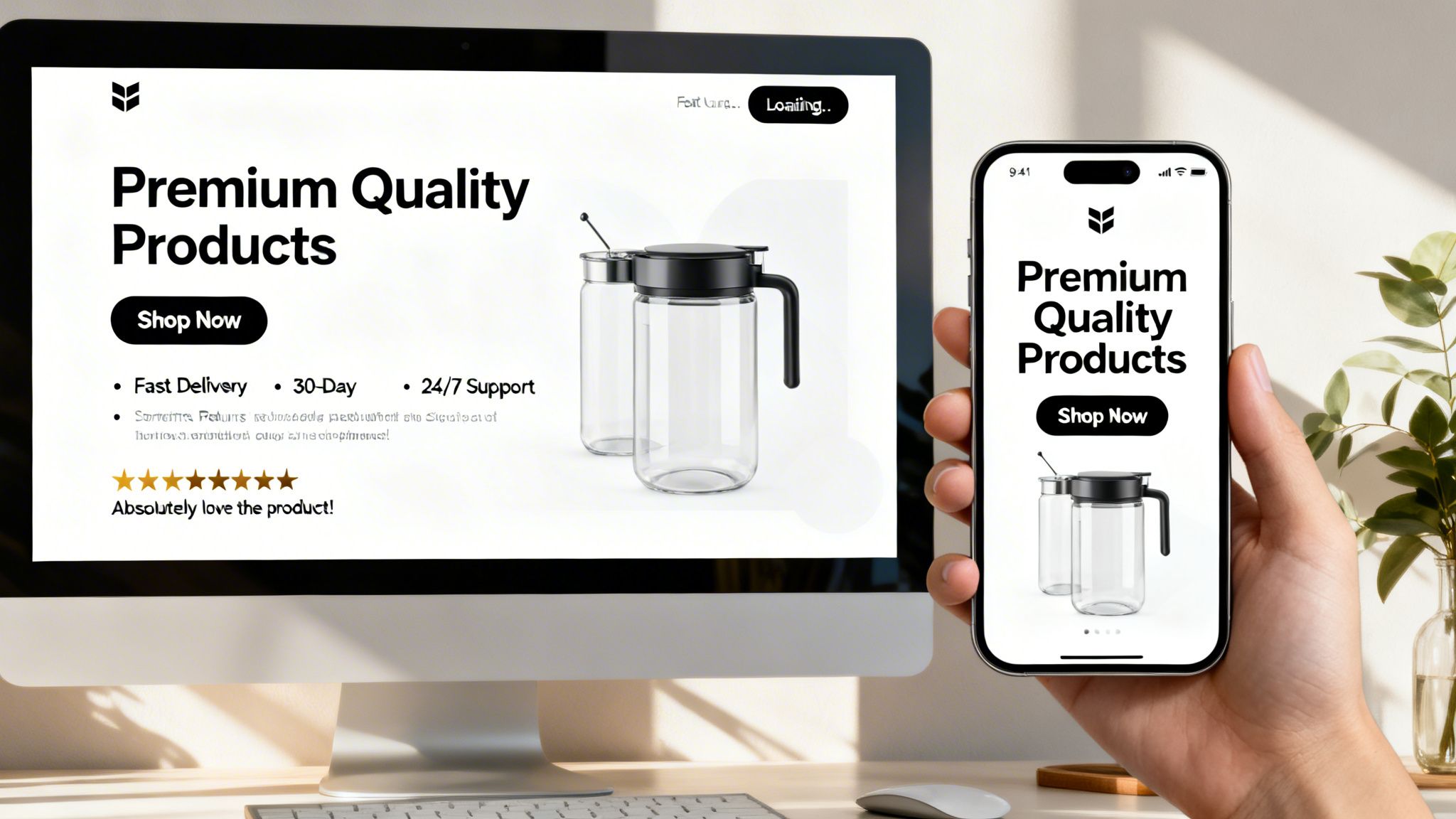
The anatomy of a winning landing page
Don’t overthink this. A high-converting page isn't about flashy design; it’s about clarity and persuasion. It needs to answer the user's question—Am I in the right place?—immediately and guide them toward a single goal. Every single element on the page has to support that one action.
Here’s a no-fluff breakdown of the essential components:
- A powerful headline that mirrors your ad. If your ad says Emergency Plumber in Berlin, your landing page headline must say exactly that. This is the core of message match and reassures the user they’ve landed correctly.
- Benefit-driven bullet points or a concise sub-headline. Forget listing features. Tell them what’s in it for them. Instead of We use hydro-jetting technology, say We clear any blockage in under an hour, guaranteed.
- Genuine social proof. Real testimonials, case study snippets, or logos of clients you’ve worked with build instant trust. Vague, anonymous quotes are useless. Specificity sells. They fixed our burst pipe in 30 minutes on a Sunday! is a thousand times better than Great service.
- One bold, unmissable Call to Action (CTA). Don’t give people a menu of options. One page, one goal. Whether it's Get a Free Quote, Book a Demo, or Download the Guide, make the button big, clear, and action-oriented. Remove all other distractions, including the main navigation menu from your website.
Performance is a feature, not a bonus
Let’s talk about something non-negotiable: speed. In 2024, a slow-loading landing page is the digital equivalent of a shop with a broken door. People will simply leave. Nearly 70% of consumers admit that page speed impacts their willingness to buy.
More importantly, Google cares deeply about it. A slow page tanks your landing page experience, a key component of Quality Score. A poor score means you pay more for each click. Optimizing your web hosting with CDN for faster WordPress sites is a critical piece of the puzzle, directly improving both user experience and your Quality Scores.
Your page has to be blazing fast, especially on mobile, where the majority of searches happen now. Test your pages, compress your images, and do whatever it takes to get that load time down.
Remember, the goal of PPC for small businesses is profitable customer acquisition, not just traffic. A beautiful landing page that takes five seconds to load will convert worse than a simple, ugly page that loads in one. Don't let your design ego get in the way of performance.
Ultimately, you should aim to create a unique landing page for each thematic ad group. I know, this sounds like a lot of work, but it’s how you achieve hyper-relevance at scale. It ensures the message match is perfect every single time, which is exactly what leads to higher conversion rates and a better return on your ad spend.
Tracking conversions and scaling with AI
Let's get real for a minute. Everything we've covered so far—account structure, keywords, landing pages—is a complete waste of time if you don't track what's actually working.
Running PPC without proper conversion tracking is like flying a plane blindfolded. You're burning fuel and making noise, but you have no clue if you're heading toward your destination or a mountain. It’s dumb, and it’s where most small businesses completely fumble the ball.
They get hung up on vanity metrics like clicks and impressions. Who cares? A click doesn't pay the bills. A lead, a sale, or a booked demo—that's what actually matters. If you're not measuring the actions that generate revenue, you're just gambling. This isn't marketing.
And this isn’t just about slapping a simple tracker on your thank you page. We need to go much deeper. The goal is to capture every single touchpoint that shows a potential customer is getting closer to buying.
Going beyond the obvious form fill
A modern PPC campaign tracks everything. Seriously. The whole point is to build a complete picture of user behavior so you can feed Google’s AI the right signals. A simple form submission is a great start, but what about all the other valuable interactions happening on your site?
- Phone call tracking: For any service business, a phone call is often way more valuable than a form fill. Tools can dynamically swap the number on your site to trace calls directly back to a specific ad click.
- Key button clicks: What if someone clicks your View Pricing button but doesn't fill out the form? That's a huge signal of interest—a micro-conversion—and you should be tracking it.
- Chat engagements: When a user starts a live chat, that's a hot lead. Track it.
- Video views or PDF downloads: These actions show engagement and help you build powerful audiences for retargeting later on.
Trying to set all this up manually can be a massive headache, which is where tools like Google Tag Manager (GTM) come in. GTM is basically a container that holds all your tracking scripts, letting you deploy them without having to bug a developer every five minutes. Mastering the basics of GTM is a non-negotiable skill for anyone serious about PPC.
The game changed the moment Google’s AI got smart enough to optimize for conversions, not just clicks. But its AI is only as good as the data you feed it. If you only tell it about one type of lead, it will blindly chase that one, even if other, untracked leads are far more valuable. Garbage in, garbage out.
From leads to revenue: the final boss of PPC
Tracking leads is level one. The real pros track revenue.
Why? Because not all leads are created equal. A lead for a €20,000 enterprise project is infinitely more valuable than a lead for a €500 one-off job. If you treat them the same in Google Ads, the algorithm will just optimize for the easiest conversion, not the most profitable one.
This is the part where you connect your ad spend directly to actual business results. You need to assign a real monetary value to each conversion type. For e-commerce, it's easy—it's the transaction value. For lead gen, you’ll need to do a little math based on your lead-to-close rate and average deal size.
For example:
- Conversion A: Request a Demo form. You know 1 in 10 of these leads becomes a customer with an average value of €5,000. The value of this conversion is €500.
- Conversion B: Download eBook form. You know 1 in 100 of these leads eventually becomes a customer. The value here is only €50.
When you upload these values back into Google Ads, you unlock incredibly powerful bidding strategies like Target ROAS (Return On Ad Spend). You’re no longer telling Google, get me cheap leads. You're telling it, for every euro I give you, I want five back. This completely transforms your approach from just managing costs to actively generating profit.
This data-driven foundation is what makes true scale possible. It’s the tipping point where you can confidently pour more money into your campaigns because you have a predictable, data-backed growth engine.
This is also where tools like dynares become insanely powerful, automatically running continuous A/B tests on your ads and landing pages based on this granular performance data. It doesn't replace the strategist; it gives the strategist superpowers to test thousands of variations and let the data pick the winners. Your budget always flows to the most profitable combinations.
This is how you stop guessing and start building a real, scalable acquisition machine. 🚀
Your first 90 days roadmap
Theory is great, but let's be honest, we're in this for results. Talking about strategy is easy; executing it is what separates the winners from the people who complain PPC doesn't work.
Here’s a no-fluff, 90-day roadmap to get you from a fresh launch to a repeatable growth process.
Days 1–30: launch and learn
Your mission for the first month is brutally simple: set everything up correctly and then keep your hands off. Let Google's algorithm do its initial learning without you messing with the variables.
Think of this month as pure data collection. Don't touch anything. I know it's tempting to jump in and start tweaking bids every five minutes, but that's a dumb, rookie move that poisons your data before it's even useful. Your only job is to let the campaigns run, gather a clean baseline, and resist the urge to make knee-jerk changes based on one bad day.
Patience is your biggest asset here.
- Clean setup: Double-check that all your tracking is firing correctly. Bad data is worse than no data.
- Don't panic: Expect fluctuations. Your cost per lead might be high, and your click-through rates might be low. This is normal.
- Gather data: Your goal is to get enough clicks and impressions to make informed decisions later. Don't make changes based on a handful of clicks.
Days 31–60: refine and optimize
Alright, now you have some real-world data to work with. This is where the real work begins. Month two is all about cutting the fat and doubling down on what's actually working.
You'll be looking at your search term reports like a hawk, adding negative keywords to stop wasting money on irrelevant searches. This is also the time to pause underperforming ad groups or keywords—the ones burning cash without delivering leads.
Conversely, you'll start shifting more budget toward the campaigns and keywords that are clear winners.
The biggest mistake I see here is emotional decision-making. The data tells the story, not your gut. If a keyword you thought would be a home run is a dud, kill it. Be ruthless.
Days 61–90: test and scale
With a leaner, more efficient account, it's time to grow. Month three is about intelligent scaling and experimentation. You’ve earned the right to get more ambitious.
This is where you start pouring fuel on the fire, but carefully.
- Scale budgets: Gradually increase the daily budget on your top-performing campaigns. A 15-20% increase per week is a safe bet to avoid shocking the algorithm.
- Test new campaign types: Now is the time to explore. Maybe a Performance Max campaign makes sense, or perhaps you want to test a display retargeting campaign to bring back visitors who didn't convert.
- Expand keywords: Cautiously add new, related ad groups based on the high-performing themes you've already identified.
By the end of these 90 days, you’ll have moved from guessing to knowing. You'll have a battle-tested process for managing your PPC spend and a solid foundation for consistent, predictable growth. This isn't magic; it's just disciplined execution. 🚀
Frequently asked questions
PPC can feel like a maze when you're just starting out. Everyone has questions, and there's a ton of conflicting advice floating around. Let's cut through the noise and tackle some of the most common questions I hear from other small business owners.
How much should I actually spend?
Forget the idea of a magic number. Start small and smart.
A daily budget of €10–€20 is plenty to begin with. Your initial goal isn't to get a flood of leads; it's to gather clean data. Once you find a keyword and ad combination that consistently brings in leads at a cost you're happy with, then you can confidently scale up.
Think of it as buying data, not just clicks.
Should I do this myself or hire someone?
This is the classic build-vs-buy decision, and the right answer depends entirely on you.
If you have the time to learn and a modest budget, managing it yourself is a fantastic way to understand your customers and your market at a granular level. But if you need to scale fast or your campaigns are getting complex, a good specialist can shortcut months of painful learning.
Be honest about your own bandwidth and expertise. There's no wrong answer, only the one that fits your business right now.
Here’s a simple visual to help you map out your first three months.
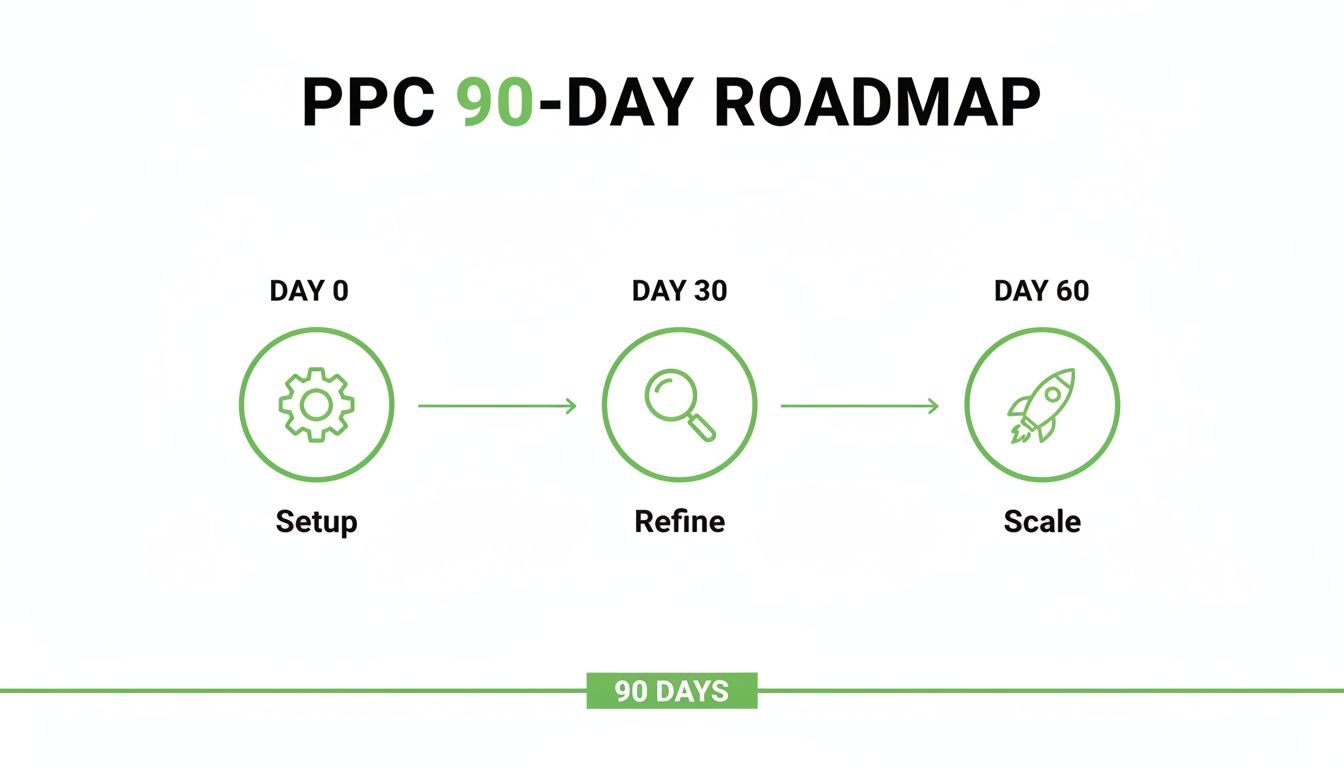
This roadmap shows the essential phases of launching a PPC campaign. The key is to focus on a solid setup first, then refine based on data, and finally scale what actually works.


