
Let's be direct. Most founders run PPC campaigns by shoveling money into the Google machine and hoping for the best. It's a chaotic, reactive, and brutally expensive way to do business.
The hard truth is this approach treats paid advertising like a lottery ticket, not what it should be: a predictable, scalable growth engine.
The brutal truth about most PPC campaigns
I've been there. I've watched cash burn on vanity metrics that had zero impact on the bottom line, all while wondering why our cost-per-acquisition was through the roof. It’s a classic trap for entrepreneurs. We get so wrapped up in the product and the big picture that we outsource our thinking to Google's "smart" campaigns and just cross our fingers.
It's a dumb strategy, and it's the fastest way to torch your marketing budget with nothing to show for it.
This guide isn't about tweaking a few bids or finding some mythical keyword. This is about building a system. We're getting rid of the hope-and-pray method and replacing it with a concrete framework to build, manage, and scale campaigns that actually make you money. It's about shifting from just running ads to building a growth machine. 🚀
Why your foundation matters more than your bids
Everyone loves to talk about ad copy and landing pages, but the real wins—and the most painful losses—are decided before you spend a single euro. Your account structure is everything. It’s the unsexy foundation that quietly determines whether you succeed or fail.
A messy account structure inevitably leads to low Quality Scores, wasted ad spend, and makes scaling impossible. You end up paying more for every single click. It's a quiet tax on laziness. You can't build a skyscraper on a shaky foundation. Trying to increase your budget just pours fuel on the fire, amplifying the chaos and the waste.
The core philosophy is simple: a solid foundation built on account structure, precise keyword intent, and perfect message match is the only thing separating profitable campaigns from expensive hobbies.
This is the stuff I wish someone had laid out for me years ago, without any of the fluff. To really understand the potential here, digging into effective Ecommerce PPC marketing strategies is a great place to start, because the principles apply way beyond just selling physical goods.
It's all about creating a coherent system where every piece works together, from the search query to the final conversion. Let's get into it.
Build your foundation before spending a single euro
Most people who try to manage PPC campaigns jump straight into writing ads and setting bids. That’s a rookie move, and it’s a guaranteed way to burn through your cash with nothing to show for it.
The success or failure of your campaign is decided long before you ever hit the launch button. It’s the unsexy, foundational work that nobody wants to do, but it’s the only thing that actually matters.
If you get this part wrong, no amount of clever ad copy or aggressive bidding will save you. You'll just be amplifying a broken system. Let's get the groundwork right from the start.
This hierarchy is how I approach every PPC account—it’s about building a solid foundation first, then executing campaigns, and only then thinking about scale.
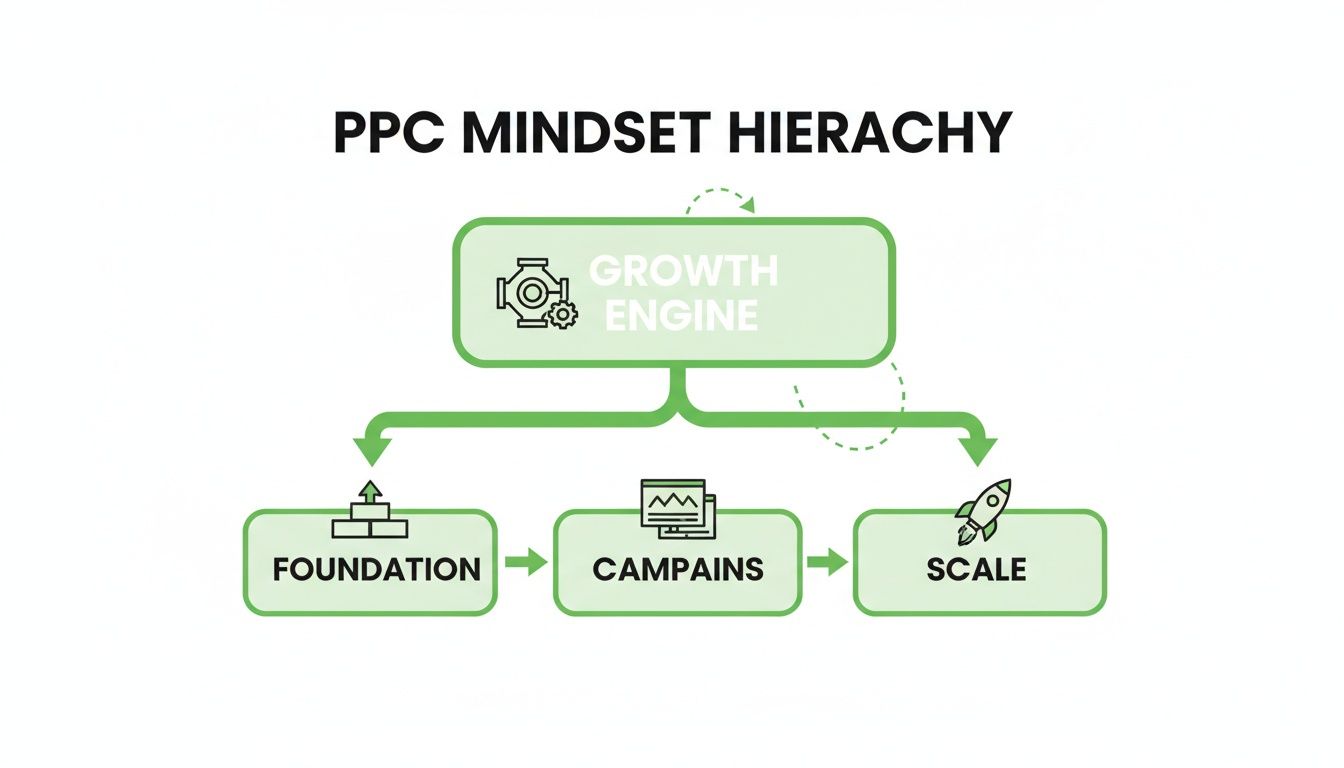
The key takeaway here is that scaling is the final step, not the first. You can't build a growth engine without first laying the foundational bricks and running disciplined campaigns.
Get your account structure right
Your Google Ads account structure is the blueprint for everything. Mess it up, and you’ll pay for it in the form of higher costs and lower relevance. A clean structure isn't just about being tidy; it's a direct signal to Google that you know what you're doing.
I organize my campaigns and ad groups around one thing: user intent.
Forget about dumping hundreds of random keywords into a single ad group. That’s just lazy. Instead, think about what the user is actually trying to accomplish with their search. Are they researching? Comparing options? Ready to buy right now?
Each of these intents requires a different message, a different ad, and a different landing page.
A simple, intent-based structure might look like this:
- Top-of-funnel (research intent): For keywords like "what is CRM software" or "how to manage sales leads." The goal here is to educate and capture awareness, not push for a hard sale.
- Mid-funnel (comparison intent): Targeting keywords such as "hubspot vs salesforce" or "best crm for small business." Your goal is to position your product as the superior solution.
- Bottom-of-funnel (purchase intent): This is for high-intent keywords like "hubspot pricing" or "get a dynares demo" where you want to drive immediate action.
This approach keeps your ad groups tight and your messaging hyper-relevant, which directly improves your Quality Score and lowers your cost-per-click. It's more work upfront, but it pays off massively in the long run.
Thinking about user intent helps you organize campaigns logically, moving people from broad discovery to high-value actions.
Of course, none of this structure matters if you can't measure the results. That’s why a flawless technical setup is non-negotiable. You can learn more by checking out our guide on the Google Ads conversion tracking setup.
Be surgical with your keyword strategy
Once your structure is planned, it's time to get surgical with keywords. Your goal is not to build the biggest keyword list. The goal is to find the right keywords that signal high intent.
I'd rather have ten perfect, long-tail keywords than a thousand broad, useless ones. Long-tail keywords—phrases of three or more words—are a goldmine because they reveal exactly what a user is looking for.
Someone searching for "shoes" is just browsing. Someone searching for "men's black leather running shoes size 11" is ready to buy.
Forget massive keyword lists. Focus on precision. High-intent, long-tail keywords are where the conversions happen. They filter out the noise and connect you with users who are problem-aware and solution-seeking.
You also need to master match types. Don't just throw everything in as broad match and hope for the best. That’s how you end up paying for clicks on searches like "pictures of expensive cars" when you're trying to sell car insurance.
Finally, be aggressive with negative keywords. This is the single most effective tool you have to stop wasting money. Every week, you should be digging through your Search Terms Report to find irrelevant queries that triggered your ads and adding them as negatives. It’s not a one-time task; it's a constant process of refinement.
This discipline is what separates a profitable campaign from a money pit.
The ad and landing page connection people ignore

This is where at least 90% of PPC campaigns completely fall apart.
It’s the embarrassing gap between a great ad and a terrible landing page. You can spend days crafting brilliant ad copy, but if the page you send people to doesn't instantly deliver on that ad's promise, you’ve lost. The click is worthless.
This isn’t some minor detail; it’s the entire game. People click an ad because it promises a solution. If the landing page is slow, confusing, or talks about something else entirely, they will bounce so fast it'll make your head spin. And you just paid for that bounce. Congrats.
The fix is a simple concept: message match. The promise you make in your ad must be the very first thing a user sees and confirms on your landing page. If your ad says "50% Off Blue Running Shoes," your landing page headline better scream "50% Off Blue Running Shoes." It's not rocket science, yet you'd be shocked how many accounts get this wrong.
Beyond the basics of message match
True message match goes deeper than just repeating a headline. It's about creating a completely seamless journey from intent to conversion. This is how you move from just running ads to building a real conversion machine.
It’s also a massive lever for your quality score. Google sees this consistency and rewards you with a lower cost-per-click.
Here’s what a rock-solid connection looks like:
- Headline consistency: The ad headline and landing page H1 should be near-identical twins. Don't make the user think for a single millisecond.
- Visual cohesion: Your display ad's imagery, colors, and branding should carry right over to the landing page. This builds subconscious trust.
- Offer clarity: The exact offer or call-to-action (CTA) from the ad needs to be front and center on the page. No hunting, no scrolling required.
This level of alignment tells the user, "Yep, you're in the right place," and it tells Google your ad is highly relevant. Both are critical to managing PPC campaigns that actually make money.
A click without a conversion is just a donation to Google. The bridge between your ad and your bank account is a high-converting, perfectly aligned landing page. Don't leave it half-built.
This connection is so critical because it directly impacts user trust. A disjointed experience feels unprofessional and, frankly, a bit sketchy. A smooth one feels like you understand the user's problem and have the exact solution ready for them. For a deeper dive, check out our guide on essential landing page design best practices.
From A/B testing to real insights
Okay, so you've nailed message match. Now what? You test. Relentlessly. A/B testing isn't just a buzzword; it's the engine of optimization. And I'm not just talking about ad copy—you need to be testing your landing pages with the same intensity.
Most advertisers either don't test at all or they test trivial things like the shade of a button color. Let's be practical and focus on elements that actually move the needle.
Start by testing these big-impact elements:
- The headline: This is your most powerful weapon. Test a benefit-driven headline against a feature-driven one.
- The call-to-action: Experiment with the CTA text. "Get a Demo" vs. "See it in Action" can have a huge impact.
- The form: Test the number of fields. Can you get away with just an email? Every additional field you require will cause some people to drop off.
This process isn't about finding a perfect page. It's about a continuous cycle of learning and improvement. Set up a simple test, let it run until you have statistically significant data, implement the winner, and then pick your next battle. This is how you compound gains over time.
Platforms like dynares bake this in, running Auto A/B tests to keep the winning variants live, but the principle is what matters. This is where small, consistent efforts lead to massive results. Don't just set and forget; always be testing.
Bidding and budgeting like a pro, not a gambler
Let's get into bidding and budgeting. This is the part where most founders feel like they're playing roulette with their marketing spend. It can feel like a total black box, especially with Google pushing its automated strategies on you at every single turn.
But just handing the keys over to the algorithm without understanding the engine is a terrible idea. You need to stay in the driver's seat. You have to know when to let the machine do its job and when to grab the wheel yourself.
This isn't about blindly trusting AI; it's about feeding the AI the right data so it can make smart decisions for you. Simply setting it and forgetting it is a surefire way to end up with a high-performing campaign that drives zero actual business value. Let's pull back the curtain on this.
Manual bidding vs. the rise of the machines
The big debate is always: manual CPC or automated bidding? Honestly, framing it as one being better than the other is the wrong way to look at it. They're just different tools for different jobs.
Manual CPC gives you absolute control. You set the maximum you're willing to pay for a click, and that’s that. For a brand-new campaign with zero conversion data, this is my go-to. It lets you get a feel for the auction, establish a baseline cost, and gather that crucial initial data without letting an algorithm go wild with your budget.
Automated strategies like target CPA (tCPA) or target ROAS (tROAS) are incredibly powerful, but only when they have enough high-quality data to work with. Think of it like a self-driving car—you wouldn't just send it onto the motorway without a map. You need at least 20-30 conversions within a 30-day period for a specific campaign before you should even think about switching.
The secret to making automated bidding work isn't to trust it blindly, but to feed it clean, consistent conversion data. Garbage in, garbage out. Your job is to be the AI's data quality controller.
The goal is to eventually transition from manual control to smart automation as your campaigns mature. It frees you up to focus on high-level strategy instead of micromanaging bids. This is why having the right tech stack is so important; you can find great options in our overview of top-tier Google Ads optimization tools.
Budgeting for profit, not just clicks
Now for the budget. How much should you spend? How do you allocate it across campaigns? When do you increase spend versus pull back? This is where a lot of people just guess.
Stop guessing. Your budget should be a direct reflection of your performance data.
Don’t just set a random monthly budget and divide it by 30.4 (the average number of days in a month). Look at your campaigns individually. A campaign driving high-value leads with a great conversion rate deserves more fuel than a top-of-funnel campaign that's still in its learning phase.
Here’s a practical system for managing your daily budgets:
- Start small and validate: For new campaigns, start with a modest daily budget you're comfortable losing entirely while you gather data. The goal here is learning, not immediate profit.
- Monitor cost per conversion: This is your north star metric. A low cost-per-click is a vanity metric if those clicks never convert. Focus on the cost to acquire an actual customer or lead.
- Scale winners aggressively: Once a campaign proves it can generate conversions at a profitable CPA, don't be afraid to increase its budget. If you can spend €100 to make €500, why wouldn't you spend €1,000 to make €5,000? Scale it until the CPA starts to rise, then find the new ceiling.
- Cut losers mercilessly: If a campaign consistently fails to hit your target CPA after you've optimized it, pause it. Don't fall into the sunk cost fallacy. That budget is better spent elsewhere.
Understanding all the different cost metrics is crucial here. For instance, a key metric for gauging the cost of visibility even before the click is the Cost Per Mille (CPM) in advertising.
Ultimately, this entire process is about shifting your mindset. You're not just managing PPC campaigns; you're investing in a system designed to generate a predictable return. It’s not gambling; it's data-driven finance. Make your decisions like a CFO, not a slot machine player.
How to optimize and scale your winning campaigns
Launching a campaign is the easy part. The real work—the part that separates the pros from the amateurs—is the daily and weekly grind of optimization. This is where you actually start making money.
If you’ve built a solid foundation, this isn't some frantic scramble to plug leaks. It’s more like being a scientist in your own account: you observe, hypothesize, test, and repeat.
This ongoing discipline is what turns a decent campaign into a predictable growth engine. Let's get into the weeds of how to manage PPC campaigns for the long haul.
The weekly optimization checklist
Every single week, I block out time for a non-negotiable checklist on my key campaigns. This isn’t about making massive, sweeping changes. It’s about small, consistent adjustments that compound over time. Think of it as routine maintenance that keeps the engine running smoothly.
This simple routine is your best defense against wasted ad spend and your sharpest tool for uncovering hidden opportunities.
- Dive into the search term report: This is your goldmine. Seriously. I spend most of my optimization time right here, hunting for two things. First, irrelevant search terms that are just burning cash—add them as negative keywords immediately. Second, high-intent search terms you aren't bidding on directly. Pull these gems out and add them as exact match keywords to the right ad group. This one habit is probably the highest-leverage activity in all of PPC.
- Review ad copy performance: Which ads are getting clicks? More importantly, which ones are getting conversions? Pause the losers, especially those with high clicks but zero conversions. Then, duplicate the winners and start a new A/B test with a fresh variation. Always be testing.
- Check device and location performance: Is mobile traffic converting as well as desktop? Is one city blowing all the others out of the water? You might need to apply negative bid adjustments for mobile if it's eating your budget, or maybe spin off a location-specific campaign to double down on a winning region. Never treat all traffic as equal.
Scaling is a science, not an art
Scaling a winning campaign is a delicate process. Most people hear "scaling" and immediately think "crank up the budget." That’s the fastest way to kill your performance. The moment you increase spend, you enter more competitive auctions, your cost-per-acquisition (CPA) climbs, and your efficiency tanks.
Real scaling is strategic. It’s about expanding your reach without destroying your economic model. Pouring more money in should be the last step you take, not the first.
Scaling isn't about just increasing your budget. It’s about methodically expanding your footprint by duplicating what works into new areas. Think horizontal expansion, not just vertical spending.
Before you even think about touching that budget slider, you need to exhaust other growth avenues first. This methodical approach ensures you're growing intelligently and sustainably—a critical skill for mastering the various PPC advertising strategies that deliver real, long-term value.
Smart ways to scale your winners
Once a campaign is consistently hitting its targets, it's time to think bigger. Instead of just throwing more money at it, I follow a more structured approach that protects my core performer while I explore new territory.
Here are the levers I pull to scale intelligently:
- Expand winning ad groups: Look inside your best campaign. Pinpoint the ad group with the best CPA and conversion volume. My next move is often to pull that ad group out and give it its own dedicated campaign. This provides granular control over its budget and bidding, letting you scale it independently without messing with the rest of the original campaign.
- Duplicate and target new markets: Is your campaign crushing it in the UK? Duplicate the entire thing, switch the location targeting to the US or Australia, and tweak the ad copy for local language and currency. This is one of the fastest ways to enter new markets with a proven concept.
- Test new ad formats and channels: If your Search ads are working, could Performance Max reach a new audience? If your text ads are solid, could Display remarketing capture users who didn't convert? Use your winning campaigns as a launchpad to test adjacent channels and formats.
This entire process—from weekly tweaks to strategic scaling—is about freeing up your time to think bigger. Lean on automation wherever you can. Use tools to handle the repetitive tasks so you can stop getting buried in spreadsheets and start focusing on what really matters: building a true growth engine. 🚀
Got questions about managing PPC? I've got answers
I talk to a lot of founders trying to get their heads around PPC. There's so much noise and genuinely bad advice out there, so let's cut through it. Here are my straight-up answers to the questions I hear most often.
How long until I see real results from a new PPC campaign?
Honestly? Plan for at least 30-90 days.
You'll see clicks and impressions almost immediately, but that's just raw data, not business results. It takes time to gather enough information to mean anything.
Think of your first month as pure data collection. You're learning what works, killing what doesn't, and giving Google's algorithm enough runway to figure things out. Please don't make knee-jerk changes after a couple of bad days. You need enough data to make smart decisions, not emotional ones.
Anyone promising you instant riches from PPC is selling a fantasy. This is a marathon of testing and refining, not a sprint.
Should I use automated bidding from day one?
No. Absolutely not. That’s just lighting your money on fire.
For a brand-new campaign with zero conversion history, starting with Manual or Enhanced CPC is non-negotiable. It gives you crucial control and helps you develop a feel for the auction dynamics to establish a baseline cost-per-click.
Once you have a steady stream of conversions—and I mean at least 20-30 in a 30-day period for a specific campaign—then you can start carefully testing automated strategies like Target CPA.
You have to feed the algorithm good data for it to work. Starting cold with automation isn't smart; it's just gambling with your budget and hoping for the best.
What is the biggest mistake founders make with Google Ads?
The single biggest mistake is confusing keywords with search terms. It sounds simple, but this confusion is the root of so much wasted spend.
Founders will load up their ad groups with broad keywords and then never, ever look at the Search Terms Report. This is a fatal error. They end up paying for tons of completely irrelevant clicks from people who have zero chance of ever converting. I’ve seen this happen hundreds of times.
You have to be ruthless with your negative keywords. Your weekly routine must include this: dig through your search terms, find anything irrelevant or low-intent, and add it as a negative keyword immediately.
It is the fastest, most effective way to stop wasting money and improve your campaign performance. Period.
Is a high click-through rate always a good thing?
Not necessarily, and getting obsessed with it is a classic rookie mistake.
A high Click-Through Rate (CTR) is a positive signal because it helps your Quality Score. But if those clicks aren't turning into customers, it’s just a vanity metric that makes you feel good while your bank account shrinks.
I would take a 3% CTR with a 10% conversion rate over a 10% CTR with a 1% conversion rate any day of the week.
The goal isn't to get the most clicks; it's to get the most valuable conversions. Always analyze your CTR in the context of your conversion rate and cost-per-acquisition. Focus on what actually impacts your bottom line.
Ready to stop gambling and start building a real growth engine with Google Ads? dynares uses AI to automatically create thousands of perfectly matched ads and landing pages, running A/B tests and optimizing your campaigns for revenue, not just clicks. See how it works at https://dynares.ai.


