
Alright, let's cut the crap. 'Automatic content creation' sounds like either a magic button or a marketing scam. It’s neither.
It’s about using smart tech—from simple data merging to actual AI—to produce targeted content at a scale that's physically impossible for humans. Think of it as giving your team a jetpack instead of just more work.
Let’s have an honest talk about automatic content creation
For anyone running PPC campaigns, this is the difference between building 10 landing pages a week and generating 1,000 hyper-targeted ones overnight. Each page can perfectly match a user's specific search query, creating a seamless experience from ad to conversion.
This isn't just about going faster; it’s about being smarter and far more relevant.
Frankly, trying to keep up with the demand for personalized content manually is a guaranteed path to burnout and mediocrity. Automatic content creation isn't here to replace marketers. It’s here to augment them, freeing us from soul-crushing, repetitive work so we can focus on what humans do best: strategy, creativity, and deep customer understanding.
Why this is no longer optional
The market is moving at an insane speed, and the numbers don't lie.
We're seeing explosive growth in this space, with the global AI-powered content creation market valued at USD 2.15 billion in 2024 and projected to hit USD 10.59 billion by 2033. That's a compound annual growth rate of 19.4%, completely dwarfing the broader content market's expansion.
If you're ignoring this shift, you're willingly falling behind. The data on the AI content market's rapid growth makes it clear this isn't just a trend; it's a fundamental shift in how scalable businesses are built. It's about achieving a level of precision and efficiency that was unthinkable just a few years ago.
The goal isn’t to fire your writers and let a robot do everything. The goal is to give your team a force multiplier that allows you to operate at a scale and relevance your competitors can’t touch.
To make this crystal clear, let's break down the difference between the old, manual grind and the new, automated workflow.
Manual vs automatic content creation at a glance
The table below contrasts the day-to-day reality of each approach for a typical PPC campaign. It’s not just about speed; it's a complete change in capability.
AspectThe Old Way (Manual Approach)The New Way (Automatic Approach)PPC Funnel BuildManually building landing pages one by one for top keywords. Everyone else gets a generic page.Generating on-brand pages and ads for every high-intent keyword or cluster.Speed & ScaleSlow. A single new landing page can take days or weeks with dev and design backlogs.Fast. Launch hundreds of tailored experiences in minutes or hours, not weeks.Relevance & Message MatchPoor. Dozens of different user intents are funneled to the same generic page, hurting Quality Score.Excellent. Keyword, ad, and landing page are tightly aligned, boosting Quality Score and conversions.Testing & OptimizationPainfully slow. A/B testing is a major project, so most ideas never get tested.Rapid. New angles, copy, and offers can be tested across segments continuously.Human EffortHigh. Marketers spend their time on repetitive tasks, project management, and spreadsheet wrangling.Low. Marketers focus on strategy and creative, while the system handles the repetitive execution.Cost Per FunnelHigh. Every new page or ad set requires significant human time and resources.Low. The cost to launch a new, targeted funnel is marginal once the system is in place.
The takeaway is simple: the manual way hits a wall. You can’t achieve true relevance at scale by throwing more people at the problem. Automation changes the entire equation.
What real automation looks like
True automatic content creation is about building a system, not just using a single tool. It’s the seamless integration of your data, brand templates, and intelligence to produce cohesive campaign assets that work together.
Here’s an example from a platform like dynares, which is designed to create landing pages and ads at scale, connecting user intent directly to the content they see.
What you’re seeing isn't just a page builder. It’s a connected system that creates a perfect message match from keyword to ad to landing page. This isn't just about speed; it's about creating a superior user experience that directly impacts your bottom line.
How this tech actually works under the hood
This isn’t magic; it’s just smart engineering. A lot of people hear automatic content creation and picture some mysterious black box cranking out content. The reality is more practical and, frankly, more interesting. It’s a system built on layers, moving from simple data-filling to genuinely creative generation.
At the most basic level, you have template-based systems. Think of it like a mail merge on steroids. You create a master structure—a landing page layout, an ad template—and the system populates it with data from a spreadsheet or a product feed.
It’s effective for simple, repetitive tasks, like creating thousands of product pages for an e-commerce store. But it's rigid. The system can only fill in the blanks you’ve given it; it can't create anything truly new. It’s dumb automation, and honestly, it hits a wall pretty quickly.
The leap to generative AI
The real breakthrough comes with generative AI. This is where things get exciting because the system stops just filling in blanks and starts understanding context. It’s a completely different game.
Instead of just pulling from one data source, it connects to everything: your brand guidelines, product catalogs, keyword lists, market research, and even competitor data. It then uses this information to generate genuinely new ad copy, landing page text, and even entire email sequences from scratch.
This isn’t just about replacing a word here or there. It's about synthesizing multiple inputs to create something cohesive and on-brand.
It's like having a junior copywriter who can instantly analyze a search query, nail the tone of voice you've defined, and create a perfectly aligned campaign in seconds. This isn't just a faster way to do old tasks; it's a new capability altogether.
This core process revolves around automation driving three key benefits: scale, speed, and relevance. When you get all three working together, you have a massive competitive advantage.
This diagram breaks down how automation is the central engine ensuring your content is not just fast, but also relevant and scalable.
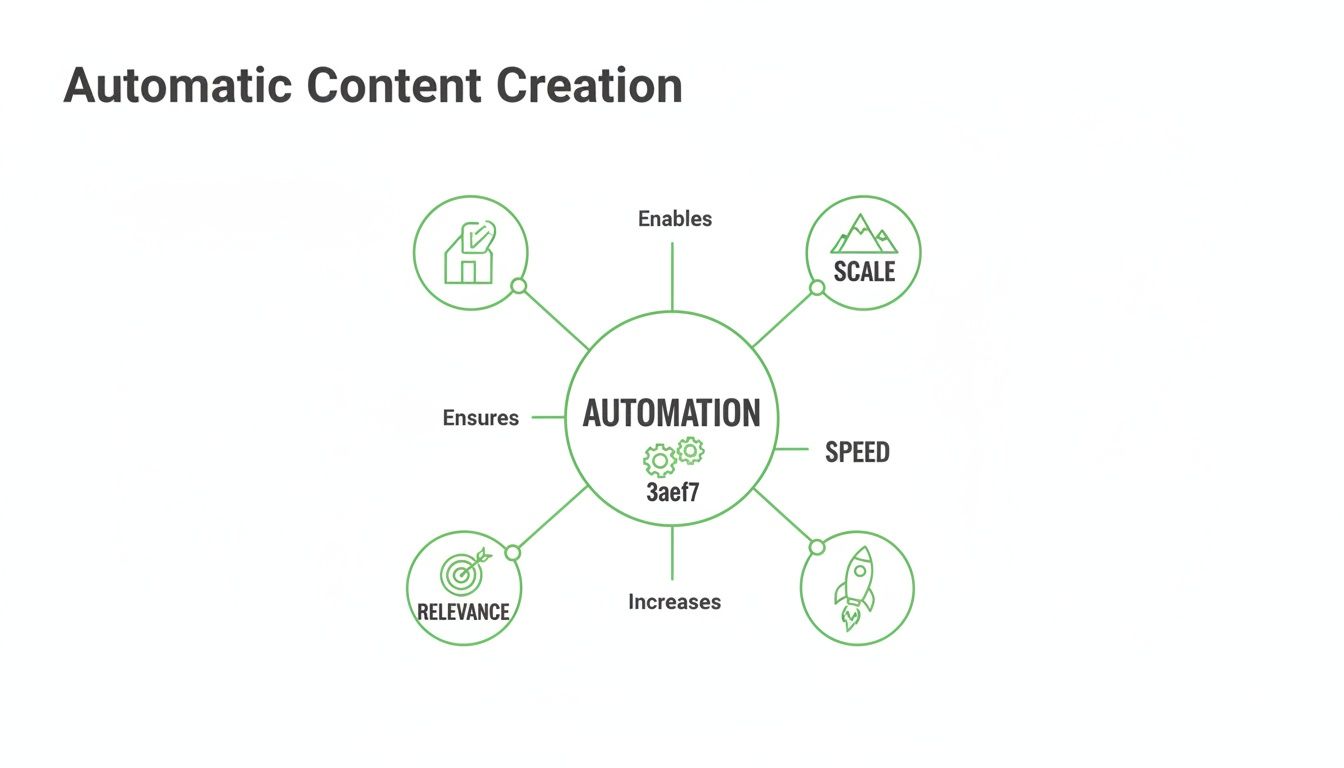
As you can see, these aren't separate goals—they’re interconnected outcomes of a single, powerful process. True automation delivers all three at the same time.
From prompts to polished copy
So what's actually happening behind the scenes? The system uses sophisticated language models, but you don't need a PhD to understand the workflow. It's actually a pretty straightforward process when you break it down.
- Data Ingestion: First, the system pulls in all your raw materials. This includes campaign goals, target keywords, product details, and—most importantly—your brand guardrails. You're basically teaching the machine the rules of the game.
- Contextual Analysis: It then analyzes the relationships between these inputs. For a keyword like 'emergency plumber in Berlin', it understands the user's urgency, their location, and the need for trust. It connects that intent to your service offerings and brand voice (e.g., 'reliable and fast').
- Content Generation: Using this context, the AI generates multiple variations of ad headlines, descriptions, and landing page copy. It doesn't just write one version; it might create dozens, each with a slightly different angle or call-to-action, all ready for testing.
- Structural Assembly: Finally, it takes the generated copy and places it into pre-designed, high-converting page layouts. The output is a fully-formed, ready-to-launch asset—not just a disconnected block of text.
This process transforms abstract inputs into tangible campaign components. The human operator’s job shifts from manual labor to strategy—defining the inputs and goals for the system.
To dig deeper into how these models work, you can learn more about what AI copywriting actually is and how it’s changing marketing workflows. It's a foundational concept for anyone serious about scaling their efforts.
So, how does this actually help my PPC and lead gen?
Alright, let's get down to brass tacks. What does all this tech actually do for your bottom line? This isn't about some cute 10% improvement; we're talking about a fundamental shift in how you run paid acquisition. It’s a complete game-changer.
When it comes to PPC, automatic content creation is all about achieving perfect message matching at an insane scale. Gone are the days of dumping traffic from dozens of different keywords onto the same generic landing page. Honestly, that approach is just lazy, and it's costing you a fortune.
Imagine being able to spin up a unique, hyper-relevant landing page and ad for every single keyword in your account. Just think about that for a second. The user journey becomes completely seamless, which creates a massive ripple effect across all your campaign metrics.
Smarter spend, better results
When a user’s search query lines up perfectly with your ad copy and your landing page headline, Google rewards you. This isn't some big secret; it's just always been brutally difficult to execute by hand.
But with automation, you can suddenly nail this alignment across thousands of keywords. The result is both predictable and powerful.
- Quality Scores Skyrocket: Better relevance leads to higher Quality Scores, which is Google’s way of saying your ads are genuinely useful. This is your primary lever for better performance.
- CPCs Drop Significantly: A higher Quality Score directly translates to lower costs-per-click. You're essentially getting a discount for providing a better user experience.
- Conversion Rates Climb: When the landing page directly speaks to the user’s specific problem, they’re far more likely to convert. You’re removing friction and building trust from the very first click.
This isn't just theory. The market's demand for tailored content is absolutely exploding. In fact, Adobe projects a fivefold surge in content demand by 2026, driven by the need to connect with audiences across more channels than ever before. If you're still doing things by hand, you're going to get left behind.
Killing junk leads once and for all
Now, let's talk lead generation, because this is where the impact gets even more interesting. We’ve all been there—a campaign generates a ton of 'leads', but the sales team complains they’re all garbage. It's that classic, incredibly wasteful disconnect between marketing and sales.
Automatic content creation helps you solve this by pre-qualifying visitors before they even see a form. By tailoring the content to the visitor's precise intent, you ensure that only the most relevant prospects are even engaging in the first place.
You stop wasting your sales team’s time with unqualified leads who were never a good fit. The system filters them out by design, because the content speaks directly to the right person and repels the wrong one.
This is a huge shift in mindset. Instead of casting a wide, generic net, you’re using precision targeting to attract high-quality leads who are already halfway to a sale. You can see this strategy in action and learn how to move from messy spreadsheets to automated PPC funnels.
The system tirelessly tests thousands of copy and layout variations—a task no human team could ever dream of managing. This continuous optimization cycle means your lead quality and conversion rates are always improving, creating a powerful engine for predictable growth. It’s not just about doing more; it’s about making every single ad dollar work harder.
Your action plan for getting started
Alright, theory is cheap. Execution is everything. So, how do you actually roll out automatic content creation without setting your brand on fire or wasting a ton of money?
The secret is to treat it like a strategic rollout, not a big bang launch.
You don't just flip a switch and pray. That’s a fast track to creating generic, soulless garbage that won’t convert anyone. Instead, you need a smart, phased approach that builds momentum and lets the machine learn as it goes. It’s about being methodical.
Let’s walk through the exact steps to get this done right. No fluff, just the action plan.
Phase 1: get your house in order
Before you let any AI touch your brand, you need to define the rules of the game with military precision. This is the single most important step, and skipping it is a classic rookie mistake.
The AI is incredibly powerful, but it’s just a tool—it needs clear, unambiguous guardrails to be effective. An AI with vague instructions is like a brilliant new hire with no job description; they’ll be busy, but they won’t be productive.
Start by defining your brand guidelines, establishing core messaging, and preparing your data sources. Clean, structured data is the fuel for any good automation engine. This initial setup isn’t the sexy part, but it's the foundation for everything that follows.
Phase 2: start small and prove it
Now it’s time to put the system to the test, but you’re not going to bet the farm on it. The goal here is to get a quick, measurable win that proves the concept and builds confidence. Don't try to automate your entire marketing department overnight.
Pick a single, high-value campaign to start with. This could be a campaign targeting a specific product line or a new market segment where you want to move quickly. The ideal pilot project has a clear goal and measurable KPIs.
Run your automated content head-to-head against your best manually-created assets. This is a direct A/B test. Let the data tell you what’s working, not your gut feeling or your ego.
This approach de-risks the entire process. If the automated campaign crushes it, you have a clear business case to scale up. If it underperforms, you’ve gathered valuable data in a controlled environment without disrupting your core business. You can learn more about how this fits into a broader strategy by checking out our guide on automated content marketing.
Phase 3: connect the data and create a feedback loop
This is where the real magic happens, and it’s what separates a 'set it and forget it' toy from a true growth engine. Your automatic content creation system cannot operate in a vacuum. It needs to be connected to your real-world performance data to get smarter over time.
This isn't a one-time setup; it’s about creating a continuous feedback loop.
Pipe your web analytics and CRM data back into the system. It needs to see which pages are getting traffic, which are generating high-quality leads, and ultimately, which are driving revenue. The ultimate measure of success is revenue. By feeding sales data back into the system, it can start optimizing for what makes you money, not just what gets the most clicks.
This feedback loop turns your system from a simple content generator into a learning machine. With every click, conversion, and sale, it gets better at creating content that delivers real business results.
That's how you build a truly scalable and intelligent marketing operation. 🚀
Common ways to screw this up and how to avoid them
With any powerful tool, there are plenty of ways to make a spectacular mess. And trust me, I’ve seen them all. The promise of automatic content creation is massive, but it’s not a magic button. It requires strategy, and most people get the strategy wrong.
Let’s talk about the dumbest mistakes I see people make and how you can sidestep them from day one. This isn't just about avoiding failure; it's about setting yourself up to actually win.
Mistake 1: Treating it like a black box
The biggest screw-up, by far, is treating this tech like a black box. You just shovel in a list of keywords, cross your fingers, and hope for the best. This is a recipe for disaster. 🙄
When you do this, you get exactly what you deserve: generic, soulless garbage that won’t convert anyone. The output is a direct reflection of the quality of your input. If you put lazy instructions in, you’ll get lazy content out.
Human strategy is still the most important input. The AI is your executor, not your strategist. You are still the one who needs to understand the customer, define the angle, and set the goals. The machine just handles the repetitive work of scaling that vision.
Mistake 2: forgetting your brand guardrails
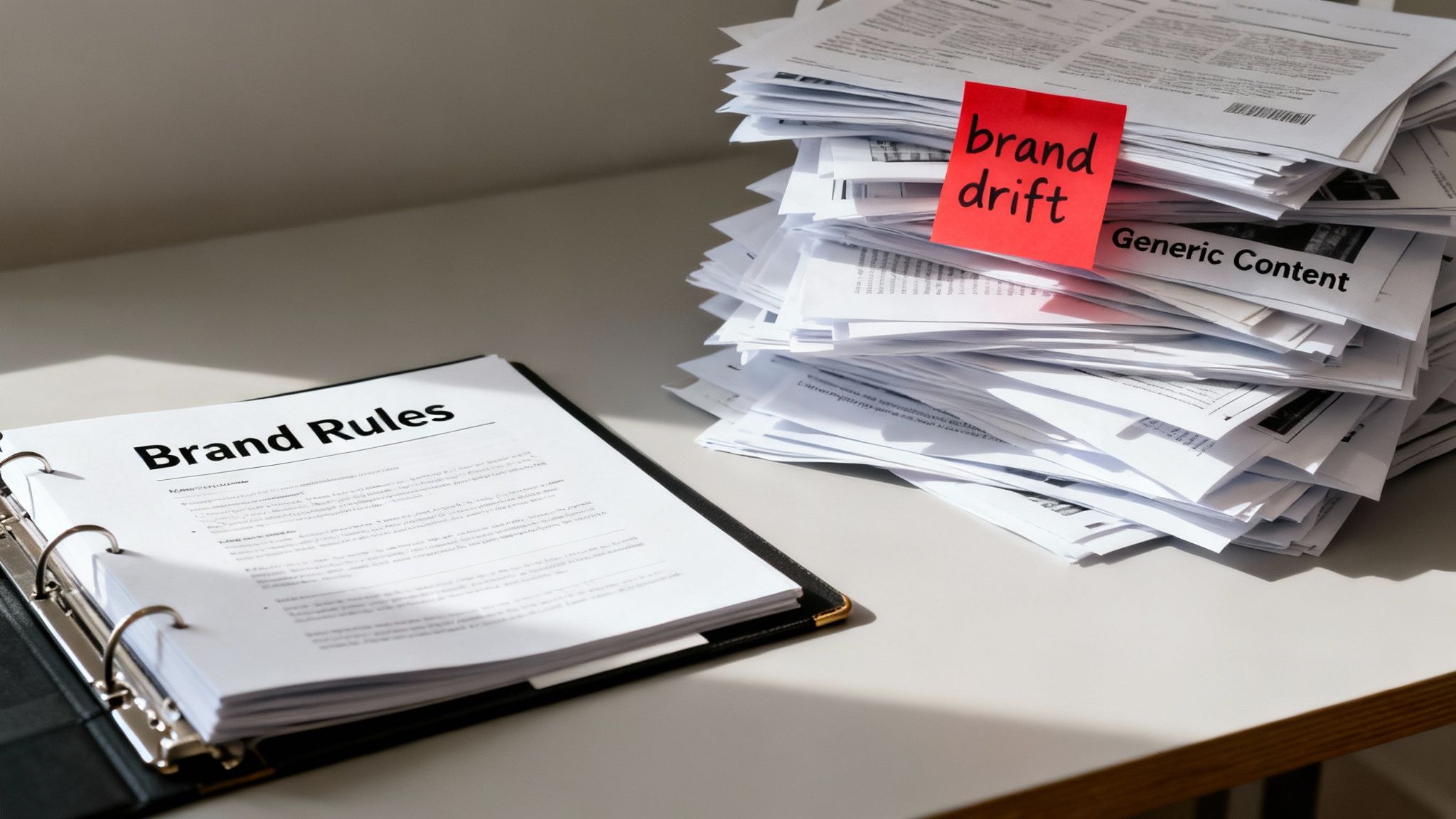
The second classic blunder is neglecting your brand guardrails. You let the AI run wild without firm rules, and what happens next is predictable: brand drift. One landing page sounds like a Silicon Valley startup, the next sounds like a corporate law firm.
This creates a chaotic and inconsistent customer experience that erodes trust. Your brand is your most valuable asset, and letting an algorithm dilute it is just bad business.
Lock it down from the start. Document your voice and messaging pillars. Create exclusion lists of topics or phrases to avoid. Without these rules, the AI will eventually go off the rails. It’s not a matter of if, but when.
Mistake 3: getting lazy with testing
Finally, people get lazy. They see the word ‘automatic’ and think their job is done. They set it up once and then forget to test. Just because the content is generated automatically doesn't mean it’s perfect on the first try. That’s a fundamentally flawed assumption.
The real power of these platforms isn’t just generation; it’s the ability to test at a scale that was previously impossible. You have to use that power.
You should be constantly running A/B tests on everything: headlines, calls-to-action, layouts, visuals—you name it. Automation gives you the engine to run thousands of experiments. Not using it for continuous optimization is like buying a race car and only driving it in school zones. Don’t be that person.
Why an automated future is a good thing for marketers
Let's be real: the demand for personalized, relevant content is absolutely exploding. Trying to keep up manually is a guaranteed path to burnout and creating mediocre work that gets ignored. It’s a dumb way to operate, and it’s not sustainable for any ambitious business.
This is why I get so excited about this tech. Automatic content creation isn't here to replace marketers; it’s here to augment us. It frees the smart, creative people on our teams from the soul-crushing, repetitive work of building a thousand campaign variations.
Instead, we can finally focus on what humans do best: strategy, creativity, and deep customer understanding. We get to be the architects, not the assembly line workers.
It's man with machine, not man versus machine
The future isn't some sci-fi battle between people and algorithms. It’s a collaboration. It's about pairing human insight with machine execution to achieve things that were impossible before. The entrepreneurs and marketing leaders who embrace this aren't just going to win; they're going to build the next generation of truly scalable, efficient, and impactful companies.
This isn't just a niche tool for tech nerds. It's a reflection of a massive economic shift.
The broader digital content market is projected to reach USD 73.49 billion by 2031, with cloud-based tools leading the charge. Companies are pouring money into their digital presence because it's the key competitive battleground. Discover more insights about the digital content market's growth.
For agencies and in-house teams, this means the ability to deliver faster, better, and more cost-effective campaigns is no longer a nice-to-have. It’s a survival mechanism.
The real opportunity for builders
For those of us building businesses, this technology is one of the most powerful levers we have. It democratizes scale, allowing a small, scrappy team to have the output of a massive department. It’s an incredible time to be a builder, and this tech is a big reason why. To fully appreciate the broad scope of benefits that automation brings to marketing, it's helpful to understand the fundamentals of what is marketing automation as a core concept.
- Focus on High-Value Work: Let machines handle repetitive tasks. Your team’s brainpower is better spent on strategy, creative direction, and analyzing results.
- Achieve Unprecedented Scale: You can finally deliver the level of personalization that customers expect, across every single touchpoint, without burning out your team.
- Build a Smarter Operation: Automation creates a system that learns and improves. Every campaign generates data that makes the next one even better, creating a powerful growth loop.
Ultimately, this is about building a more human-centric marketing function. We get to do more of the work we love and deliver better experiences for our customers. Check out our guide on how this applies directly to marketing automation for small business. It’s a future I’m incredibly optimistic about. 🚀
Frequently asked questions
Alright, let's wrap this up with some quick-fire questions I get all the time when I talk about this stuff. No fluff, just direct answers.
Is automatic content creation only for big companies?
No, and honestly, thinking that way is a huge mistake. That's a massive misconception that holds smaller teams back.
In fact, it’s a bigger advantage for startups and lean teams. It democratizes scale, letting a two-person team operate with the output of a twenty-person department. It’s the ultimate lever for efficiency.
Big companies are often slow, stuck in bureaucracy. A small, agile team can implement this kind of system and start running circles around them in a matter of weeks. It’s how you punch way above
your weight class.
Will AI-generated content get penalized by Google?
This fear comes up constantly, and it’s usually fueled by outdated SEO thinking. Let's be blunt: Google doesn't penalize AI content; it penalizes low-quality, unhelpful, spammy content. The tool used to create it is irrelevant.
If your system is producing genuinely valuable pages that match user intent and help someone solve a problem, it will perform well in search. The key is the quality of the output, not the method of creation.
Your goal is to create the best possible answer for a user’s query. As long as you’re doing that, Google will reward you. Focus on user value, and you’ll be fine.
This is a simple but critical distinction. Shoddy, auto-generated content deserves to be penalized, whether a human or a machine wrote it. High-value content that serves the user deserves to rank.
How much human oversight is actually needed?
Initially, a good amount. Don’t fool yourself into thinking you can just switch it on and walk away on day one. You’re the architect of the system, and that’s a critical role.
At the start, you define the strategy, set the brand rules, and review the first batches of content. The AI executes; you direct.
But once the system is dialed in and starts learning from real performance data, your role shifts dramatically. You move from being a content creator to a system operator and strategist.
This is a far more valuable use of your time. You’re no longer on the tools; you’re managing the machine that manages the tools. That’s how you build a truly scalable business. 🚀
Ready to stop building landing pages one by one and start creating high-performance campaigns at scale? dynares gives you the power to automate your Google Ads funnels, from ad copy to conversion-optimized landing pages. Book a demo and see it in action.


