
Let's get one thing straight. The real benefit of marketing automation isn't about fancy software or adding another tool to your stack. It's about two things: it saves you a massive amount of time, and it stops you from burning cash on repetitive, low-impact tasks.
It’s about building a smart, scalable system that works for you 24/7. This lets you step away from the spreadsheets and manual campaign tweaks to focus on actual strategy.
Let's get real about marketing automation
When most people hear marketing automation, their mind jumps to scheduling a few emails. Let's be clear: that’s like calling a rocket ship a fancy metal tube. For entrepreneurs scaling tech businesses, especially here in Europe, thinking that small is a one-way ticket to getting left behind.

This isn’t just some optional, nice-to-have software. It's a fundamental operational shift. It’s the engine room of a modern growth strategy, particularly when you're in the trenches with PPC and lead generation, where every single euro and every minute counts. The goal isn't just to be a bit more efficient; it's to build a system so robust that it becomes your biggest competitive advantage.
Building your growth engine
The core idea is painfully simple, yet most companies get it completely wrong. You build a smart system to handle the repetitive, soul-crushing tasks that drain your team’s energy and creativity. This isn't about replacing people; it's about making them better.
It's about letting machines do what they're good at—processing data, executing rules, and running tasks at scale. This frees up your team to do what they're good at: thinking, strategizing, and building real relationships.
This shift pulls you away from a reactive, chaotic approach to marketing and into something far more powerful: a predictable growth machine. You stop relying on guesswork and gut feelings and start making decisions based on real, automated feedback loops.
Why it's a competitive necessity
Let's be blunt. If you're running a European tech company and trying to scale without automation, you're fighting with one hand tied behind your back. Your competitors who are using it can test, learn, and iterate faster than your team can finish their morning coffee. They're not just working harder; they're working smarter.
This isn't just about surviving; it's about creating an unfair advantage. It’s the difference between manually tweaking bids in Google Ads like it’s 2012 and automatically deploying thousands of hyper-relevant ad-to-page experiences for every single keyword.
Think about the real benefits from this perspective. It's not just another tool; it's the foundation for sustainable scaling. It’s about building a business that doesn’t just grow but scales gracefully, powerfully, and predictably. You either build the machine, or you become a cog in someone else's. The choice is yours. 🤷♂️
Stop wasting ad spend and start scaling leads
Let's cut to the chase and talk about the most immediate, tangible benefit of marketing automation: plugging the leaks in your advertising budget. We’ve all felt that sinking feeling of watching ad spend climb while lead quality goes nowhere. It’s the silent killer of so many promising paid search campaigns.
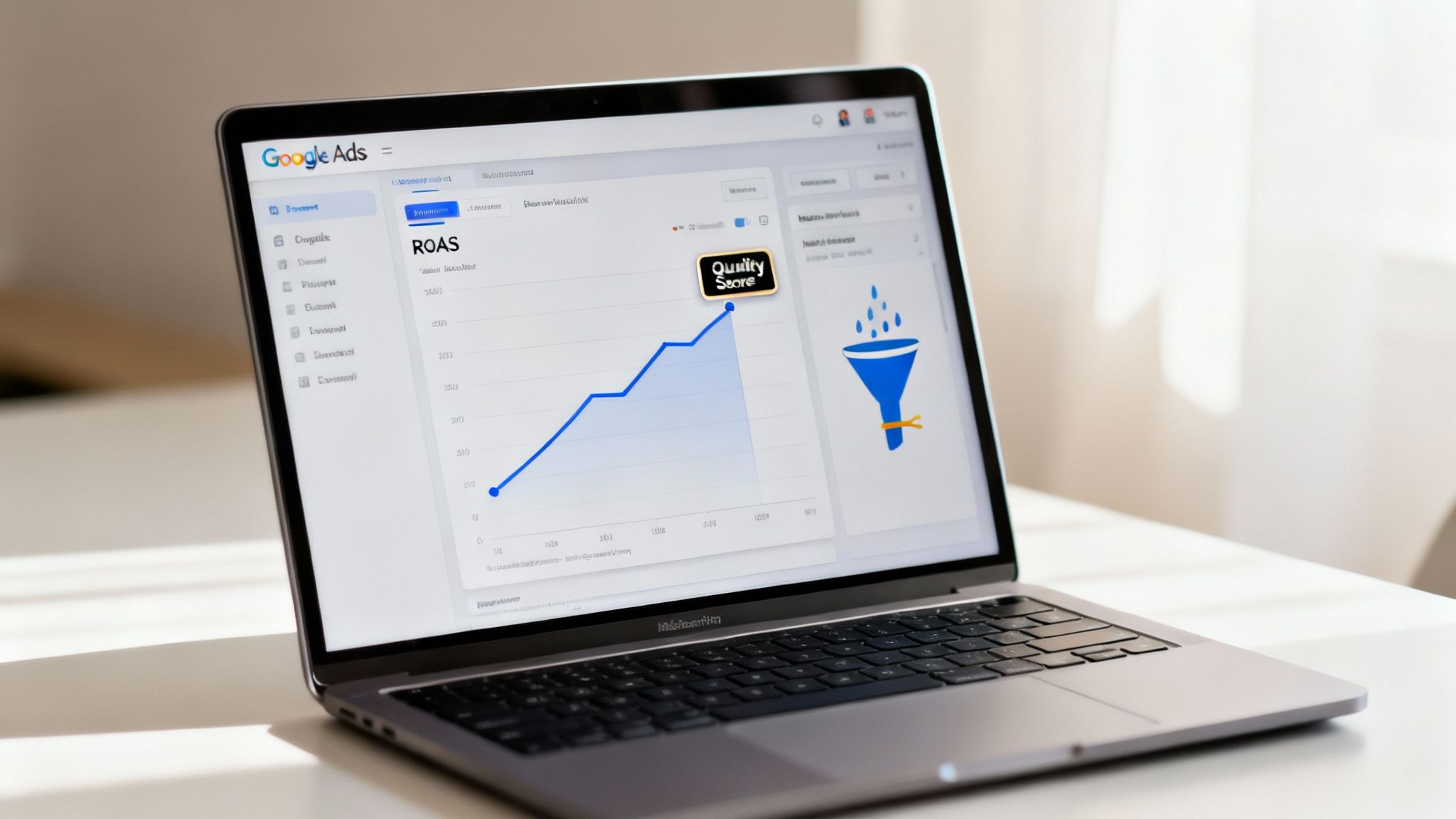
Think about the countless hours your team burns manually tweaking bids, pausing low-performing keywords, or trying to dream up unique ad variations for dozens of ad groups. It's an inefficient mess that simply doesn't scale. You're essentially paying smart people to do robotic work, and that’s a terrible way to grow a business. Automation is how you fix this—fast.
Reclaim your team's time and energy
The first thing automation does is take over the repetitive, soul-crushing tasks that drain your team's will to live. This isn't just about clawing back a few hours here and there; it's a fundamental shift in how your team operates. When your PPC managers aren't drowning in spreadsheets, they can finally focus on high-level strategy, creative testing, and figuring out what’s actually happening in the market.
Instead of your team doing the machine's work, the machine does its job, freeing your people to do theirs. This leads directly to better campaign outcomes because human creativity gets applied where it matters most, not on tasks a simple script could handle. The real win here is transforming your ad budget from a reactive cost center into a predictable revenue machine. You stop guessing and start engineering outcomes based on real-time data and automated execution.
This is where the financial upside of marketing automation becomes impossible to ignore. A more efficient team means a more efficient budget, and every dollar saved on manual grunt work is a dollar you can reinvest into scaling your winning campaigns.
From manual tweaks to hyper-relevance at scale
Now, here’s where it gets really powerful. A human team, no matter how talented, can’t possibly create a unique, perfectly aligned ad and landing page for every single keyword in a large account. It’s just not feasible. You might have thousands of keywords, and the best a manual approach can do is bucket them into broad themes.
This is exactly where you lose money. A generic landing page serving 50 different keywords will always underperform compared to a page built specifically for one of those keywords.
Automation shatters this limitation. A platform like dynares, for instance, can instantly generate thousands of hyper-relevant ad-to-page combinations, ensuring every click gets the experience it deserves.
This creates a massive ripple effect across your entire campaign performance.
- Sky-high quality scores: Google's Quality Score is all about relevance. When your ad copy, keywords, and landing page are in perfect sync, Google rewards you.
- Lower cost-per-click (CPC): A higher Quality Score directly leads to a lower CPC. You pay less for better ad positions, which means your budget stretches way further.
- Higher conversion rates: When someone searches for cloud backup for small law firms and lands on a page with that exact headline, their trust and likelihood to convert go through the roof.
This isn't just a minor tweak; it’s a complete overhaul of your campaign economics. You ensure your budget is only spent on clicks with the highest possible intent and the greatest chance to convert. The final result is a dramatic lift in your Return on Ad Spend (ROAS). That's the metric that really matters, and it’s where automation proves its worth.
How to achieve true personalization at scale
Let's talk about personalization. For years, a true 1-to-1 experience was a fantasy—something only mega-corporations with huge teams and bottomless budgets could even attempt. That's no longer true. Marketing automation is the great equalizer, making deep, meaningful personalization a reality for everyone, even for lean startups.

And I don't mean just adding a first name tag to your email subject line. That’s lazy, and everyone sees right through it. Real personalization is about tailoring the entire user journey, from the specific ad they see to the exact content on the landing page they visit. This is where automation becomes an absolute game-changer, especially in the world of PPC.
Moving beyond basic targeting
The old way of thinking was about broad audience buckets. You'd group people by vague demographics or interests and show them a generic ad. It’s a dumb, inefficient way to spend money because you’re basically shouting into a crowd and hoping the right person hears you.
True personalization respects the user’s intent. It listens to exactly what they're asking for and delivers precisely that, instantly. Think of it like a brilliant concierge versus a loud street advertiser. One provides specific, valuable help, while the other is just noise.
Automation allows even a small team to act like that hyper-attentive concierge for thousands of potential customers simultaneously. This isn't just a marketing trick; it's a fundamental shift in respecting your audience.
Matching intent from ad to landing page
Let’s get practical with a PPC example. Imagine you’re running ads for a SaaS product with multiple features. A user searches for automated report generation software. In a typical setup, they click an ad and land on your generic homepage, forcing them to hunt for the reporting feature. Most will just leave.
With a smart automation system, something different happens. The system recognizes the user’s exact search query. It then dynamically generates a landing page where the headline reads, The Best Automated Report Generation Software for Your Business.
The ad copy they clicked matches the landing page they see, creating a seamless, ultra-relevant experience. This level of relevance is what separates campaigns that limp along at a 2% conversion rate from those that consistently hit 10% or more. You're not just improving a metric; you're building trust from the very first click.
This seamless alignment between intent, ad, and page is the core of modern, high-performance marketing. It proves you understand the user's problem and have the direct solution. You can dive deeper into the nuts and bolts of how systems handle this by exploring our guide on automated content creation.
The impact of true personalization
When you nail this, the benefits cascade across your entire marketing funnel. It’s not just about one metric; it’s about upgrading the entire system.
- Drastically improved user experience: People find exactly what they’re looking for without friction. This immediate sense of understanding makes them far more likely to trust your brand and convert.
- Higher conversion rates: By removing guesswork and delivering pure relevance, you make the decision to sign up or purchase incredibly easy. You’ve answered their question before they’ve even had to ask it twice.
- Better lead quality: The leads you generate are more qualified because they’ve engaged with content that speaks directly to their specific pain point. They aren't just kicking tires; they have a clear problem you can solve.
The data backs this up decisively. Across the board, 80% of businesses using automation report an increase in leads, with 77% seeing higher conversions. It’s a direct consequence of delivering a better, more personal experience at scale.
Ultimately, automation isn't just about efficiency. It's about humanity. It allows us to treat every single prospect as an individual with a unique need—and to meet that need with precision. That’s how you build a business that people actually want to engage with. It’s powerful stuff. ✨
Building a lead nurturing engine that actually works
Getting a lead is just the first step. Honestly, it's the easy part. The real work—and where most businesses completely drop the ball—is in the follow-through.
A lead sitting in a spreadsheet is worthless. It's a conversation waiting to happen, and if you're not starting it, your competitor will be.
This is where we get practical about turning those cold leads into warm conversations. We’re talking about building a lead nurturing and scoring engine that doesn't feel robotic or annoying. The goal isn't just to send emails; it's to build relationships on autopilot.
Sorting the signal from the noise with lead scoring
Let's be blunt: not all leads are created equal. Your sales team’s time is their most valuable asset, and having them chase down every single form submission is a terrible waste of resources. This is where lead scoring comes in.
It’s a simple but powerful concept. You assign points to leads based on who they are and what they do. A CTO from a 500-person company is worth more points than an intern. Someone who visits your pricing page gets more points than someone who just reads a blog post.
The entire point of lead scoring is to create a filter. It automatically separates the tire-kickers from the genuinely interested prospects, ensuring your sales team only engages with the hottest, most qualified leads who are ready to talk.
This system is your first line of defense against wasted effort. It stops your team from burning out on dead-end conversations and frees them up to focus on closing deals.
Nurturing leads without being a robot
Okay, so you’ve scored your leads. Now what? You nurture them. But forget the generic, weekly email blasts that everyone hates and immediately deletes. That’s not nurturing; that’s spamming.
The real win with automation is creating triggered workflows that deliver the right information at the perfect time. This means your communication is based on demonstrated interest, not a rigid schedule.
For instance: a lead downloads a case study on cloud security. They're automatically dropped into a 3-part email sequence that dives deeper into security features, shares a testimonial from a similar company, and invites them to a relevant webinar. It's worth seeing how platforms like HubSpot integrate with automation systems to create these powerful workflows.
This isn’t rocket science, but it’s incredibly effective. You’re no longer shouting into the void. Instead, you're having a relevant, one-on-one conversation guided by the user's own actions.
This process dramatically shortens the sales cycle because you’re educating and building trust long before a salesperson ever gets involved. By the time they do make contact, the prospect is already informed, engaged, and genuinely interested in finding a solution.
You’re turning cold traffic into warm, qualified opportunities—all while you sleep. That’s the real power of a smart nurturing engine. 💪
Finally get clear and actionable ROI data
Let's talk about the single most important thing in business growth: knowing what works. If you can't measure your marketing, you can't improve it. It's that simple. And for too long, marketers have been flying blind, chasing vanity metrics like clicks and leads without a clear line of sight to actual revenue.
This is where marketing automation completely changes the game. It connects the dots, giving you crystal-clear visibility into your entire funnel. Every touchpoint, from the initial ad click to the final sale, gets tracked. No more guesswork. No more dumb arguments about which channel gets the credit. Just hard, actionable data.
This diagram shows a simplified flow of how automation helps process and qualify leads—the crucial first step toward tracking real results.
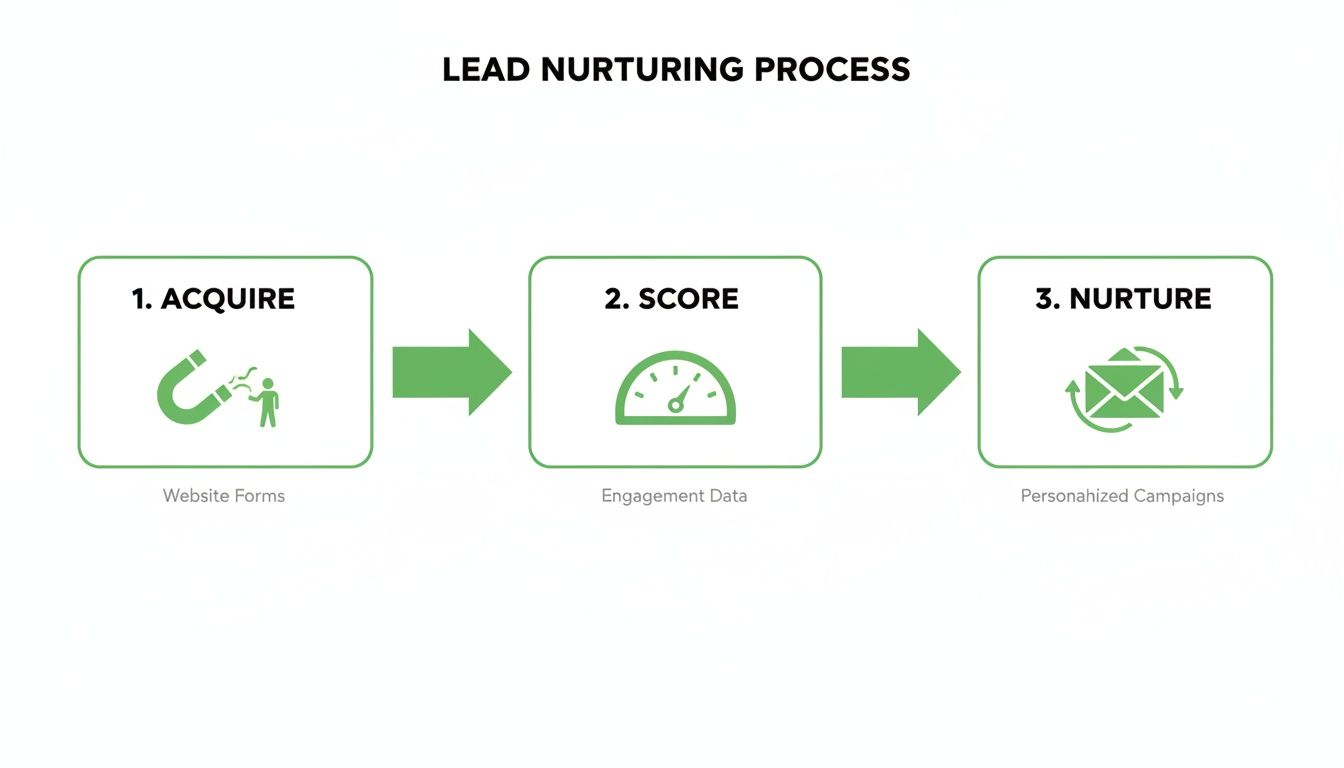
The key takeaway here is that each stage is connected and measurable. You can see exactly where prospects are in their journey and what it took to get them there.
From vague metrics to revenue optimization
The old way of running PPC campaigns was a numbers game. You'd optimize for the lowest cost-per-lead (CPL) and hope for the best. The problem? A cheap lead is often just that: cheap. It doesn't mean it’s a good lead. You could be celebrating a low CPL while your sales team is tearing their hair out dealing with unqualified prospects who never convert.
Modern automation tools fix this broken loop. They don't just track that a lead was generated; they connect to your CRM and see what that lead actually did. Did they become a paying customer? And if so, how much revenue did they generate?
This is the holy grail for performance marketers. Instead of just sending lead counts back to Google Ads, you can upload conversion data with actual revenue values attached. Suddenly, your ad platform isn't just optimizing for more leads; it's optimizing for maximum profit.
This is the difference between flying with a foggy windshield and having a crystal-clear dashboard telling you precisely where to invest your next euro for the highest return. You stop buying cheap leads and start buying profitable customers.
This level of insight is where the true ROI of marketing automation becomes undeniable. You make smarter budget decisions because every choice is tied directly to the bottom line. It’s a powerful shift in mindset and execution.
Connecting every euro spent to every euro earned
When you have a fully connected system, you can finally attribute revenue back to the specific campaign, ad group, or even the exact keyword that started the customer journey. This closed-loop reporting is one of the most powerful benefits of marketing automation.
It allows you to answer the questions that actually matter: which campaigns are generating not just leads, but our most profitable customers? What is the true lifetime value (LTV) of a customer acquired through our paid search efforts? Where should we double down on our ad spend, and which campaigns should we cut immediately?
The data here is staggering. For instance, email marketing automation stands out as a revenue juggernaut, returning an incredible $42 for every $1 spent. This stellar performance makes it a no-brainer for marketers chasing ROAS, especially when compared to paid search's average $2 return or social media's measurement struggles. Given that automation users also see 80% more leads and 77% higher conversions, the case for building an integrated system is clear. Discover more insights about these ROI statistics on firework.com.
Ultimately, this is about confidence. It’s about walking into a board meeting with a report that doesn't just show clicks and impressions but demonstrates exactly how marketing is driving revenue growth. You can learn more about which key metrics and reports are essential for proving value. No more vanity metrics—just the hard data that proves your impact. Now that's a good feeling. ✨
How to integrate automation without the headaches
Okay, the benefits are clear. The upside is huge. But let’s get to the part that makes most marketers nervous: implementation.
How do you actually plug this stuff into your business without creating a technical nightmare that eats up all your time and energy?
The fear is real. You're picturing endless integration meetings, broken workflows, and a tech stack even more complicated than the one you started with. That’s a terrible outcome, and it’s completely avoidable if you think about it the right way.
The best tools, especially in the Google Ads world, aren't built to replace your workflow. They're designed to supercharge it.
Build a connected system, not a pile of tools
The single biggest mistake I see people make is buying a bunch of siloed tools that don’t talk to each other. They’ll get a great landing page builder, a separate ad management script, and a CRM that lives on its own island.
This doesn't reduce complexity; it multiplies it.
Your goal is to build a seamless system where data flows freely from one part to the next, with each tool making the others smarter. Think of it like a relay race: your ad platform passes the baton to your automation engine, which then hands it off perfectly to your CRM.
When this works, it’s magic. When it doesn’t, you're stuck manually exporting CSVs and trying to stitch reports together. Nobody has time for that.
A simple framework for your tech stack
Don't overcomplicate things. For a lean team focused on paid search, your core stack only needs a few key players that integrate flawlessly.
Here's a no-nonsense way to think about it:
- Your ad platform (The Engine): This is Google Ads. It’s where your traffic comes from and the heart of your operation. Everything starts here.
- Your automation layer (The Brains): This is the system connecting your ads to your landing pages, like dynares. It handles the hyper-personalization, ad-to-page matching, and dynamic content at scale.
- Your CRM (The Memory): This is where your lead data lives—think HubSpot or Salesforce. It tracks the entire customer journey long after the click and tells you who actually became a customer.
That's it. When these three systems are properly connected, you create a powerful feedback loop. Google Ads sends traffic, the automation layer converts it, and the CRM reports the revenue back to Google Ads. This is how you build a scalable growth machine.
The whole point of this integration is to get to a single source of truth. You should be able to look at one dashboard and see exactly how much you spent on ads and how much revenue it generated. Anything less is just noise.
The impact here is massive. Imagine slashing your manual workload by nearly half while pumping out 35% more leads. That's the powerhouse reality of marketing automation, which cuts time spent on repetitive tasks by 49% and boosts overall marketing efficiency by 45%.
It's no wonder that in 2023, 72% of successful companies were using automation, compared to just 18% of underperformers. You can find more marketing automation stats and insights from Spiralytics.
For smaller teams, getting this right from the start is critical. Check out our guide on marketing automation for small business for a practical approach. Don't add complexity; build a simple, powerful system that scales with your ambition. 🚀
Common questions about marketing automation
Alright, let's wrap this up by tackling the questions I hear all the time. No fluff, just straight answers to help you figure out what's next.
How much does this stuff actually cost?
Look, the price can be all over the map. You could start with a basic tool for less than €100 a month or go all-in on an enterprise platform that runs into the thousands. But the price tag is the wrong question to ask—the real question is about ROI.
If a tool costs you €500 a month but saves 20 hours of manual work and lifts your lead quality by 30%, it's not a cost. It's an investment with a serious return. Stop fixating on the expense and start focusing on the value it creates.
Isn't automation just for big companies?
That’s an outdated, frankly wrong, way of thinking. A few years ago? Maybe. Today? Absolutely not. Lean startups and small teams arguably get the biggest bang for their buck from marketing automation because it lets them punch way above their weight class.
Automation is the great equalizer. It gives a two-person startup the operational power of a 20-person marketing department. It's how you compete and win without a massive budget or headcount.
Will marketing automation feel impersonal to my customers?
Only if you do it badly. Bad automation is just blasting generic, irrelevant junk at everyone. That’s just spam with extra steps.
Good automation is the complete opposite. It uses data to deliver hyper-relevant, timely messages that respect a user's intent. When someone gets an email about the exact feature they were just looking at on your site, it doesn’t feel impersonal—it feels helpful.
Ready to stop wasting ad spend and see what a truly automated, hyper-relevant PPC system can do for your business? At dynares, we built the platform to do just that. See how dynares works and connect every high-intent keyword to the experience it deserves.


