
Let's be blunt: obsessing over generic click-through rate benchmarks by industry is a complete waste of your time.
Most of these reports are just vanity numbers thrown around without any real context. Chasing some arbitrary "average" CTR is one of the fastest ways to burn through your ad budget. And for what? So you can hit a number that means nothing for your actual business?
Your success depends on your specific campaigns, your audience, and your offer—not some mushy industry average. Let's talk about what actually matters.
Why most CTR benchmarks are basically useless
Frankly, chasing a static benchmark number is just dumb. It’s like a pilot focusing only on altitude while ignoring airspeed, direction, and fuel. CTR is just one piece of the puzzle. Without the full picture, it’s a meaningless metric.
We aren't here to hit an arbitrary number. We’re here to build and scale businesses.
The problem with these benchmark reports is they rarely account for the variables that actually dictate performance. Averages just mash together the top performers with teams that are literally setting money on fire, creating a mediocre middle ground that isn't a useful target for anyone serious about winning.
The context you're almost always missing
So, what truly moves the needle? It comes down to the factors that those generic lists conveniently ignore. These are the levers you can actually pull to improve performance, instead of just staring at a spreadsheet and feeling like you're falling behind.
- Keyword intent: This is everything. Are you targeting someone ready to buy right now ("emergency plumber near me") or someone just browsing ("how does plumbing work")? High-intent, commercial keywords will naturally have much higher click-through rates. It's just common sense.
- Ad position: Being in position #1 is a completely different ballgame than being in position #4. The top spot naturally gets more clicks. Your average CTR is a blend of all your ad positions, so comparing it to an industry benchmark without knowing their position distribution is pointless.
- Device and seasonality: Mobile users behave differently than desktop users. It's a fact. Likewise, a B2B SaaS product will see completely different engagement in December than a retail brand running holiday sales. These external factors massively skew the numbers.
Recent data shows the median CTR for Google Search Ads is around 4.99%, but this varies wildly. The Dating & Personals sector hits 6.05% because it's driven by high emotional urgency, while the Technology industry sits at a measly 2.09% thanks to longer research cycles and more considered purchases.
Those gaps are huge. To truly understand performance beyond basic averages, it helps to dig into a guide on measuring digital marketing effectiveness. And if you want to see how to actually address user intent directly, check out our guide on creating compelling PPC ad examples.
A no-fluff guide to CTR benchmarks by industry
You're busy. I get it. You're here for the data, not a long-winded intro. So let's get straight to the numbers you need to see how your campaigns stack up.
Think of this as your quick reference—a cheat sheet for your next meeting or a baseline for your own strategy. This isn't the finish line; it's the starting point for figuring out where you stand.
This chart shows just how much click-through rates can vary. You’ve got the high-flyers like Dating & Personals, the overall industry average, and then more challenging sectors like Technology.
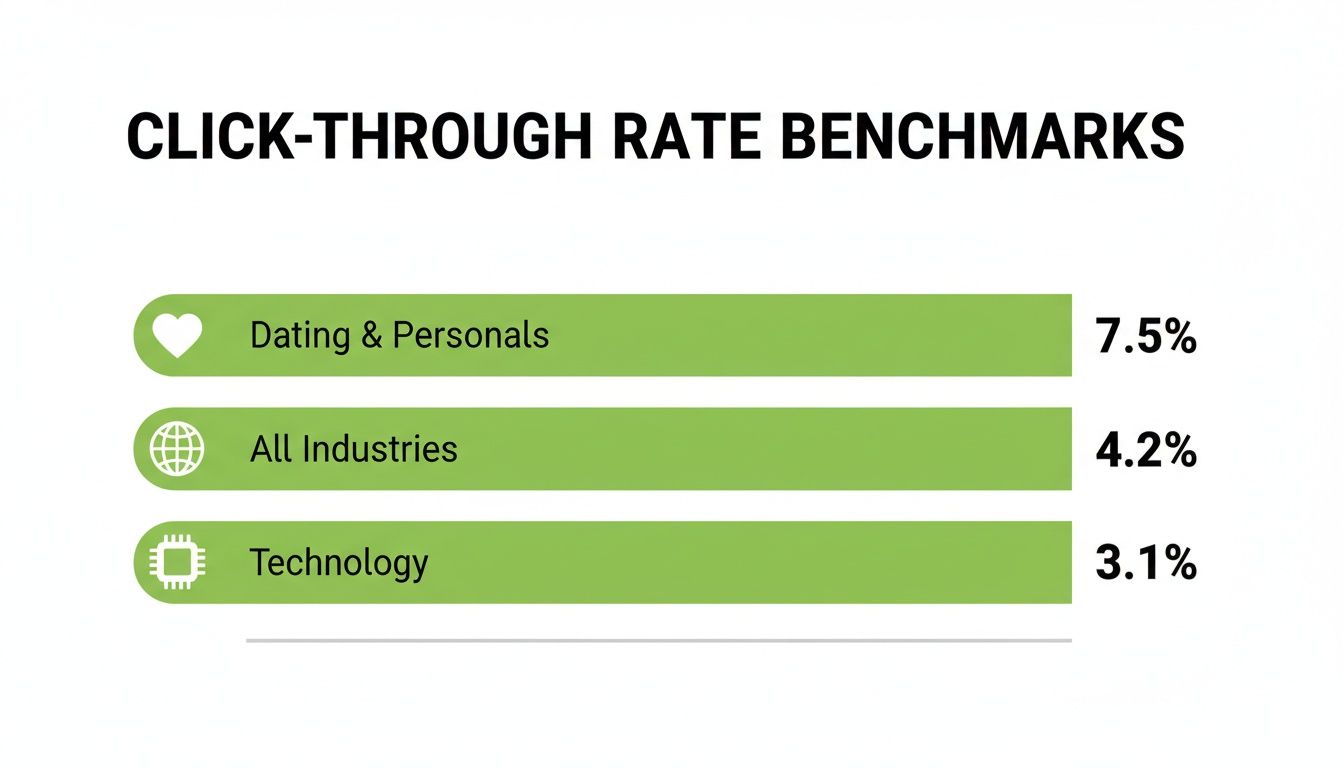
The data makes one thing crystal clear: user intent is everything. Emotionally charged, urgent searches in the dating world drive a ton of clicks, while complex B2B tech decisions naturally lead to more cautious engagement.
Key industry groupings and what they mean
Instead of just looking at a list of numbers, let's group these industries into a few buckets. I see three clear categories here: High-Urgency, Considered Purchase, and Specialized Services. Understanding where you fit is more important than fixating on a single number.
- High-urgency & emotional: Industries like Dating & Personals (6.05%) do so well because they tap into immediate, emotionally driven needs. When a user's intent is that powerful, a compelling ad is an incredibly easy click.
- Considered purchase & research-heavy: This is where you'll find Technology (2.09%) and B2B (2.41%). Here, the user is gathering information for a complex decision, not making an impulse buy. Clicks are more deliberate and have to be earned through authority and value, not just raw emotion.
- Specialized & niche services: Advocacy (4.41%) and Education (3.78%) perform well because they connect with specific, often passionate audiences. The messaging resonates with a user's core values or long-term goals, creating a strong pull that a generic ad just can't match.
The big takeaway? Don't just compare your CTR number. Compare your user's mindset. Are they desperately looking for a solution right now, or are they six months away from making a decision? That context changes the entire game.
Google Ads CTR benchmarks by industry (search network)
Now for the main event. Here’s a clean table of the median click-through rate benchmarks by industry for the Google Search Network. Find your vertical, see the number, and start thinking about the story it tells about your market.
| Industry | Median Search CTR |
|---|---|
| Advocacy | 4.41% |
| Auto | 4.00% |
| B2B | 2.41% |
| Consumer Services | 2.41% |
| Dating & Personals | 6.05% |
| E-Commerce | 2.69% |
| Education | 3.78% |
| Employment Services | 2.42% |
| Finance & Insurance | 2.91% |
| Health & Medical | 3.27% |
| Home Goods | 2.44% |
| Industrial Services | 2.61% |
| Legal | 2.93% |
| Real Estate | 3.71% |
| Technology | 2.09% |
| Travel & Hospitality | 4.68% |
| All Industries Median | 4.99% |
These benchmarks give you a vital piece of context. Are you way ahead, or is there room to grow? Either way, knowing the average is the first step toward building a strategy that beats it.
Deconstructing high-performance industries: What they do right
Some industries just crush it. Look at Dating & Personals or Real Estate—their click-through rates are consistently high, and it’s not by accident.
It's easy to dismiss their success by saying my B2B software isn't as exciting as finding a partner or a new home. That's a lazy excuse. The truth is, these high-flyers aren't just selling a product; they're solving an immediate, emotionally charged problem.
Their success offers a powerful playbook that any of us can learn from, even if we're in "boring" sectors. It’s all about reverse-engineering their psychology.
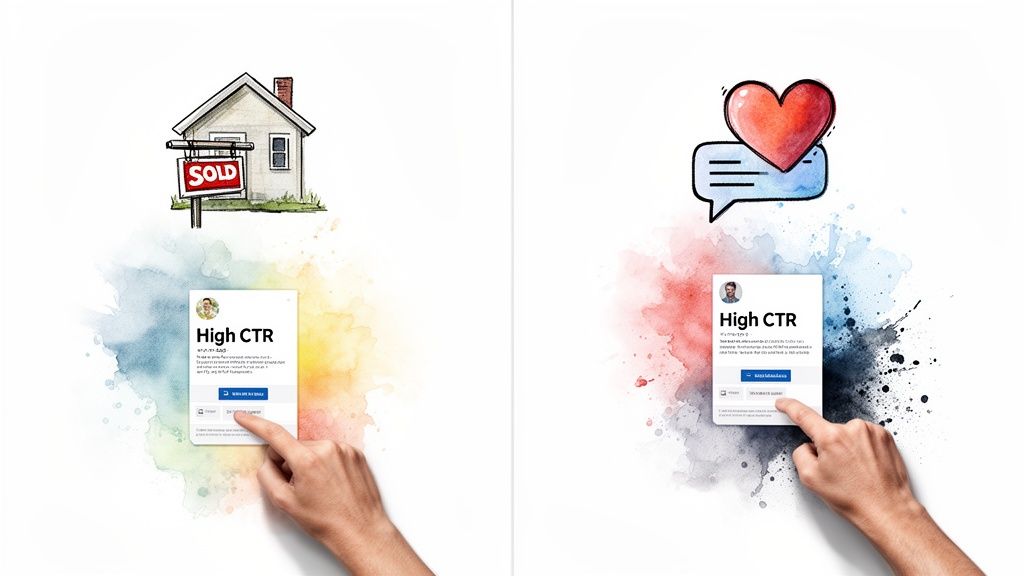
They master three core principles: tapping into high-intent emotional triggers, delivering hyper-relevant answers, and using crystal-clear calls-to-action. Let's break down exactly what they do right.
The psychology of urgency and emotion
High-performance industries connect with users on a deeply human level. When someone searches for best dating apps or homes for sale near me, their intent is sky-high and loaded with emotion. They aren’t just browsing; they’re actively seeking a life-changing solution.
These industries don't sell features; they sell outcomes. Their ad copy reflects this perfectly, using language that speaks to hope, desire, security, and belonging.
- Emotional triggers: They use words that evoke strong feelings. Instead of talking about an advanced matching algorithm, a dating app ad will say, Find your person tonight. This emotional shortcut is incredibly effective at grabbing attention and compelling a click.
- Problem-solution framing: Their ads immediately present a clear solution to a pressing problem. A real estate ad doesn't list specs; it shows you a dream home and says, Your future starts here. They sell the destination, not the journey.
- Immediacy: They create a sense of urgency. Phrases like View listings now or Start connecting today promise instant gratification, which is a powerful motivator for users with immediate needs.
This approach works because it aligns perfectly with the user's state of mind. They meet an urgent need with an equally urgent-sounding solution.
The best ads don't just answer a question; they validate an emotion. When a user feels understood, they are far more likely to click. It’s about creating an immediate connection before they even hit your landing page.
Hyper-relevance through localization and specificity
Another key to their success is radical relevance. Top-performing industries are masters of localization and specificity, making their ads feel personal and directly applicable to the searcher. A generic ad feels like spam; a specific one feels like a perfect answer.
Real estate is the ultimate example of this. An ad for "3-bedroom homes in Brooklyn" is infinitely more clickable than one for "houses for sale." This laser-focus on local intent dramatically increases the ad's relevance, which Google rewards with a higher Quality Score and, consequently, a better CTR.
Of course, once the user clicks, the journey has to be consistent. This is where many businesses fail. You can't have a great ad leading to a generic page. That's why understanding landing page design best practices is so critical; the page must fulfill the ad's promise immediately.
The lesson here is simple: go granular. Whether you're B2B or B2C, think about how you can tailor your messaging to a specific location, job title, or pain point. That's how you cut through the noise and prove you have the exact solution they’re looking for. Your click-through rate benchmarks by industry will thank you for it.
The hard truth about low-CTR industries (and how to fight back)
Let's get real for a minute. If you’re in tech, legal, or B2B, looking at the click-through rate benchmarks by industry probably feels a bit demoralizing. Seeing numbers like 2.09% for Technology or 2.41% for B2B can make you question your entire strategy.
Here's the hard truth: it’s not entirely your fault. These industries are a different beast altogether. You're not selling a pair of sneakers; you're often selling a complex, high-stakes solution that involves multiple decision-makers and a sales cycle that drags on for months.
The search intent here is fundamentally different. Your prospects aren't looking for a quick fix. They’re in deep research mode, comparing options, downloading whitepapers, and building a business case. Their journey is long and considered, which naturally suppresses immediate clicks on ads promising a simple solution. This lukewarm click intent is the core of the problem.
Why your CTR sucks (and why that's okay)
Low CTR in these sectors is a symptom of a few tough market realities. First, the keywords are often informational, not transactional. Someone searching for "cloud data warehouse architecture" is learning, not buying. Interrupting their research with a hard sales pitch is a recipe for a low click rate.
Second, the ad auctions are brutal. You're up against massive incumbents with deep pockets and established brand authority. It’s a hyper-competitive space where every click is expensive and hard-won. The combination of cautious buyers and fierce competition creates a perfect storm for low engagement metrics.
Don't mistake a low CTR for failure. In complex industries, a lower CTR can be a healthy sign that you're filtering out unqualified leads. The goal isn't to get the most clicks; it's to get the right clicks from people who are genuinely in the market for your solution.
So, instead of chasing an unrealistic CTR, the smarter move is to adapt your strategy to the reality of your market. This means shifting your focus from broad, high-volume keywords to the specific, nuanced queries your ideal customer is actually using.
The playbook for fighting back
Giving up is not in my DNA, and it shouldn't be in yours either. Just because the game is harder doesn’t mean you can’t win. Here's a practical, no-nonsense playbook for turning the tide in these tough industries.
It all comes down to precision and relevance. You need to prove to your sophisticated audience that you understand their specific problem better than anyone else in the SERP.
Here’s how you start:
- Go long-tail or go home: Forget broad keywords like "business software." Instead, target hyper-specific, long-tail phrases like "inventory management software for medical device manufacturers." The volume is lower, but the intent is pure gold. These are the queries your best customers are typing in.
- Build hyper-specific ad groups: Stop lumping dozens of keywords into one ad group. Create tightly-themed or single-keyword ad groups (SKAGs) where the ad copy perfectly mirrors the search query. If someone searches for "legal contract review AI," your ad headline should say exactly that. This alignment is what convinces a discerning user to click.
- Write ad copy that speaks to pain: Your buyers aren't moved by flashy slogans. They're moved by solutions to their expensive, time-consuming problems. Your ad copy needs to speak directly to their pain points. Use language that shows you understand their world—mention compliance, integration challenges, or ROI. Ditch the generic marketing fluff and get to the point. This is how you earn their trust and their click.
Actionable steps to systematically increase your CTR
Alright, enough theory. Let's get to work. Knowing the click-through rate benchmarks by industry is just the starting line; the real wins come from what you do next. This is your field guide for turning those numbers into better results.
Forget the generic advice. We're going to cover specific, high-impact tactics you can put into action today. This is about building a system for improvement, not just crossing your fingers for a lucky break.
Nail the fundamentals first
Before you start chasing complex strategies, you have to make sure your foundation is solid. It’s shocking how many accounts I see leaking budget because they skipped the basics. Get these right, and you're already ahead of most of the competition.
- Master your negative keywords: This is non-negotiable. Every irrelevant impression is a wasted opportunity for a relevant one. Be aggressive about adding negative keywords to stop your ads from showing up for searches that will never, ever convert. Think of it as sculpting; you’re chipping away everything that isn't your ideal customer.
- Leverage every relevant ad extension: Sitelinks, callouts, structured snippets—use them all. Ad extensions literally make your ad bigger, more informative, and more clickable. They give people more reasons to choose you over the ads next to yours. It's free real estate, so you need to claim it.
These two actions alone will have an immediate impact on your CTR by sharpening your relevance and boosting your visibility. Once that foundation is in place, you can move on to more advanced campaign structures.
The goal isn’t just to get clicks; it’s to get the right clicks. An obsession with CTR without an equal obsession with relevance is just a fast track to burning cash on unqualified traffic.
Build for hyper-relevance
This is where you truly start to dominate the SERP. The secret to a killer CTR is showing a searcher an ad that feels like it was written specifically for their query. It creates an instant connection and proves you have exactly what they're looking for.
One of the most powerful ways to do this is by building Single Keyword Ad Groups (SKAGs). The concept is simple: one keyword, one ad group, and one ad perfectly tailored to it. This structure ensures your ad copy mirrors the search query, creating an almost irresistible urge to click.
For example, if someone searches for B2B SaaS accounting software, your ad headline should be B2B SaaS Accounting Software. It’s direct, it's relevant, and it works. This level of granularity is what separates amateur campaigns from professional ones. Yes, it requires more setup, but the payoff in CTR and Quality Score is massive.
Of course, managing thousands of SKAGs by hand is a nightmare. This is where automation becomes your best friend. At dynares, our platform was built on this very principle—automatically generating hyper-relevant ads and landing pages for every single keyword. But whether you're using a tool or doing it by hand, the principle of maximum relevance always wins.
Continuously test and iterate
Your work is never really done. A systematic approach to increasing CTR means you're always testing, always learning, and always improving. You need a constant feedback loop to understand what your audience actually responds to.
Here’s a simple checklist to get you started:
- Test headlines: Pit different value propositions against each other. Does your audience care more about speed, price, or specific features? Your headline is 80% of the ad, so focus your energy here.
- Test descriptions: Experiment with different calls-to-action (CTAs). Try Get a Free Demo vs. Request a Quote vs. See Pricing. The language you use can dramatically change user behavior.
- Test landing page congruence: Make sure your landing page delivers on the ad's promise. A disconnect between your ad and your page is a surefire way to get the click but lose the conversion. If you're serious about this, our guide on setting up Google Ads conversion tracking will help you measure what actually matters.
- Analyze visuals (for display/video): If you're running campaigns on other platforms, visuals are everything. To attract more clicks with your imagery, check out these 10 YouTube thumbnail best practices for higher CTR.
By methodically testing these elements, you'll replace guesswork with hard data. That's how you systematically drive your CTR upward and leave your industry's benchmark in the dust.
The undeniable link between CTR and quality score
Here’s something that trips up a lot of marketers: a high CTR isn't just a vanity metric. It’s one of the loudest signals you can send Google that your ads are actually relevant to what people are searching for.
Think of it as a direct conversation with the algorithm. Every click is a vote of confidence, telling Google, yes, this ad is a good answer to my query. This feedback kicks off a powerful loop that can either make or break your entire paid search strategy.
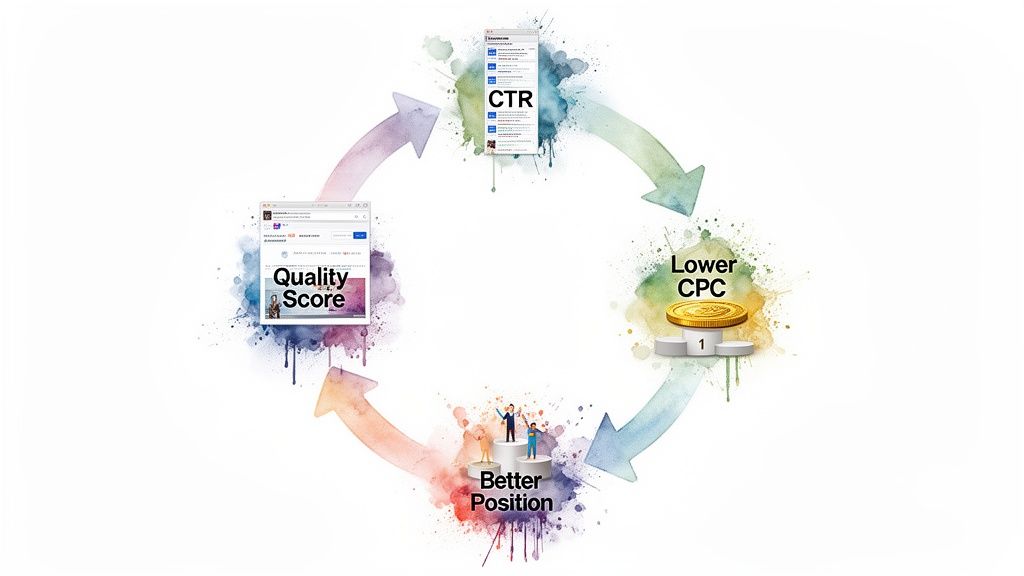
A higher CTR directly fuels a higher Quality Score. A better Quality Score, in turn, earns you lower cost-per-clicks (CPCs) and better ad positions—often for less money than your competitors are paying. This isn't a theory; it's the core mechanic of the Google Ads auction.
How the quality score components work together
Google’s Quality Score isn’t some black box you can't influence. It’s built on three pillars that are all tangled together, with CTR playing the starring role. If you want an efficient, profitable Google Ads account, you have to get this relationship right.
- Expected CTR: This is Google's prediction of how likely your ad is to get clicked for a specific keyword. Your historical CTR is a massive factor here. A track record of high CTR teaches the algorithm that your ads are winners, which directly boosts this component.
- Ad relevance: This measures how well your ad copy lines up with the search query. A high CTR is direct proof of high relevance. If people are clicking, it's because your ad feels like the perfect answer to their problem.
- Landing page experience: While this happens after the click, a relevant, high-quality landing page is the final piece of the puzzle. A good experience reinforces Google’s decision to show your ad in the first place and keeps your entire account in good health.
The whole system is designed to reward advertisers who give users what they want. When you obsess over improving your CTR, you're not just chasing clicks. You're actively improving your ad relevance and, by extension, making every dollar you spend work harder for you.
It's a simple relationship: a high CTR tells Google your ad is useful. Google then rewards that usefulness with a higher Quality Score, which saves you money and gets you more visibility. This is the most important feedback loop in all of paid search.
Beyond the usual nonsense
Too many people get lost in the weeds, but the fundamental connection between user engagement and ad costs has never changed. A higher CTR is your most direct path to a more favorable price in the auction. If you want a deeper look, our guide on what Google Quality Score really cares about in 2026 cuts through the noise.
Ultimately, your click-through rate benchmarks by industry are just a starting line. The real goal is to consistently beat your own performance. Systematically increasing your CTR is the clearest way to tell Google you deserve to win.
Your CTR questions, answered
Alright, let's cut through the noise and tackle some common questions about click-through rates. No jargon, no fluff—just straight answers to help you get a better handle on what these numbers actually mean for your business.
What is a good click-through rate?
Honestly, "good" is a dangerously relative term. While the median CTR across all industries we analyzed is around 5%, chasing that number without context is a fool's errand.
A good CTR is entirely dependent on your industry, the keywords you're bidding on, and what you're trying to achieve. For a high-urgency vertical like Dating & Personals, where the average is 6.05%, a 5% CTR might just be table stakes. But for a complex B2B service that averages 2.41%, hitting 5% would be absolutely phenomenal.
Here’s my advice: use industry benchmarks as a reality check, not a rigid target. Your real goal should be to consistently beat your own historical average. If your CTR is climbing month-over-month, you're winning. That's a "good" CTR.
How does display network CTR compare to search?
They’re two completely different beasts. Trying to compare them is like comparing apples and oranges—it just doesn’t make sense and will only lead to confusion.
Search CTRs are naturally much higher because users are actively hunting for a solution. They have intent. They typed a query into Google looking for an answer, and your ad is a potential solution.
Display ads, on the other hand, are an interruption. Your ad shows up while someone is reading an article, watching a video, or browsing a site. Because of this, Display CTRs are significantly lower, often well below 0.5%.
A 1% CTR on the Display Network could be an incredible success. That same 1% on the Search Network would be a massive red flag signaling a serious problem. Always evaluate them as separate channels with their own benchmarks and objectives.
Can I improve my CTR without increasing my budget?
Absolutely. In fact, improving your CTR is one of the most powerful, non-budget-related levers you can pull. It's about making your existing ad spend work harder, not just spending more.
The whole game here is relevance. Focus your energy on actions that directly connect your ad to the user's search query.
- Tighten your ad groups: Make them hyper-specific. The ad copy should feel like it was written only for the keywords in that group.
- Write compelling copy: Speak directly to the searcher's pain point. Offer a clear, immediate solution that makes them want to click.
- Master negative keywords: This is non-negotiable. Aggressively filter out irrelevant searches to stop wasting impressions on people who will never click, let alone convert.
When you do this, your Quality Score improves. Google rewards that relevance with lower CPCs and better ad placements—all for the same budget. That’s how you get more from what you already have.
At dynares, we built a platform to automate this entire process of achieving hyper-relevance. It generates thousands of perfectly matched ads and landing pages to systematically boost your CTR and Quality Score. See how it works at https://dynares.ai.


