
Let's be blunt: obsessing over your 1-10 quality score without understanding what it actually is is a fantastic way to waste time and money. It’s not some vanity metric; it’s Google's real-time grade on how well you're serving its users. A high score means you're creating a great experience, and Google rewards you for it with cheaper clicks.
Think of a low quality score as a relevance tax you pay on every single click. It's a penalty for not lining up your keywords, ads, and landing pages with what someone is actually searching for.
This tax means you’re stuck with higher costs, worse ad positions, and less visibility than your competitors—even if you’re bidding more. This isn't just about tweaking a campaign; it's about fundamentally understanding the game.
Google’s entire business model depends on giving people relevant results. When your ads and landing pages align perfectly with a search, you make Google look good. In return, the algorithm gives you a discount. It’s the single most powerful lever you have for making your campaigns more efficient and scalable.
For anyone doing what is paid search marketing, this isn't an optional concept. It's the core of competitive advantage. The financial impact is massive. A landmark study found that advertisers with average quality scores of 7 or above enjoyed 50% lower cost-per-click (CPC) compared to those stuck at 5 or below. For a high-volume account, that’s a seven-figure difference in savings.
Getting this right isn’t just a nice-to-have. It’s a strategic necessity for a few key reasons:
- Better ad positions: A higher score helps you outrank competitors without having to constantly up your bids.
- Lower costs: It directly reduces your CPC, stretching your budget further and boosting your return on ad spend (ROAS).
- Increased impression share: Google shows ads it deems high-quality more often, giving you more visibility in the auction.
This guide will cut through the noise and show you exactly what matters.
The three pillars that actually drive your score
Let's cut through the noise. Forget the 1-to-10 number for a second and focus on what actually moves the needle. Your quality score really boils down to three core components.
Think of them as the legs of a stool—if one is weak, the whole thing gets wobbly and unreliable.
These pillars are Google’s way of measuring the entire user journey, from the moment they type in a search to the experience they have on your website. It’s not some black-box algorithm; it's a practical framework for figuring out what’s working and what’s not.
This simple concept map tells you everything you need to know about the financial impact. A high score saves you money; a low score costs you a fortune.
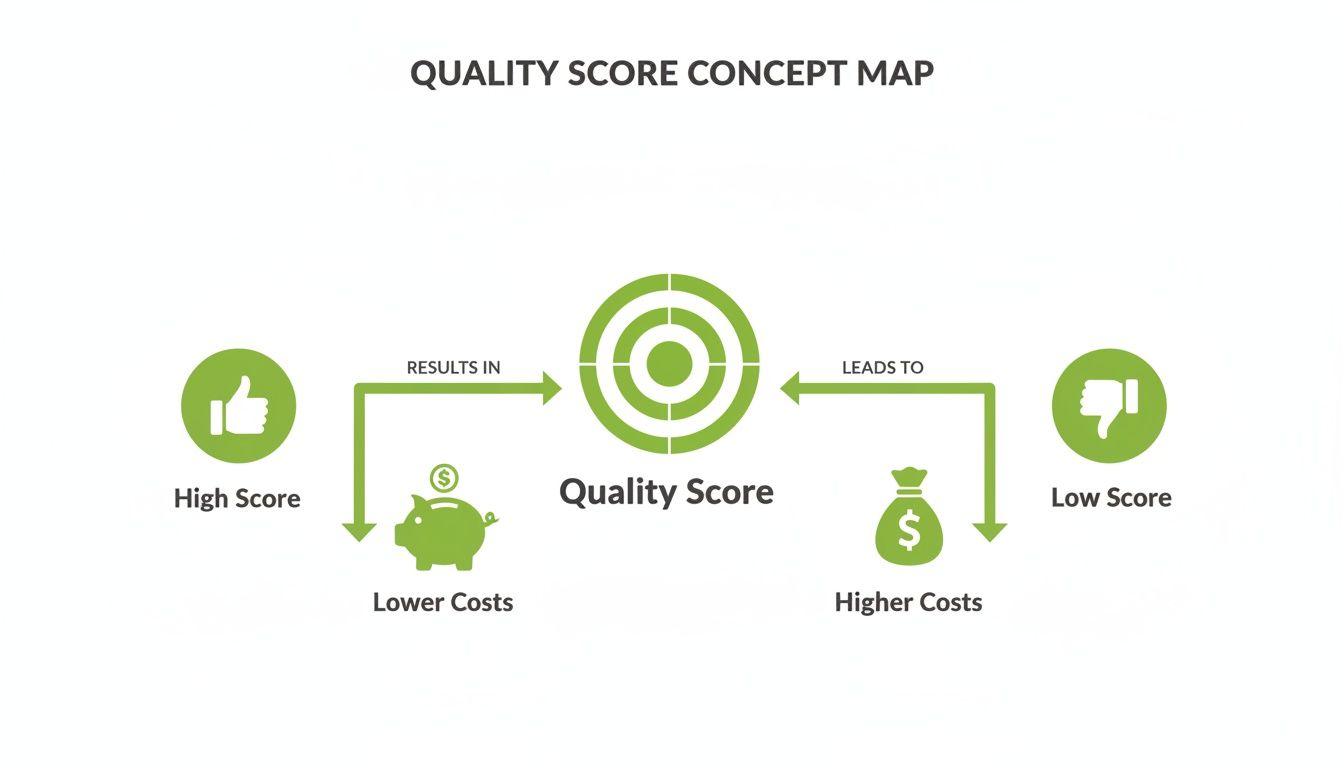
This is the core of the deal: Google gives you a direct financial incentive to create a relevant and helpful experience for its users.
The three pillars of quality score explained
So, what are these three components? In your Google Ads account, you'll see them rated as below average, average, or above average. Your mission is to push every component into that above average territory.
Each one tells a piece of the story about your ad's performance. The real answer to a low score lies in which of these three components is dragging you down.
- Expected click-through rate (CTR): This is Google's prediction. Based on your ad's historical performance (and your competitors'), how likely is a user to click it? It’s a forward-looking metric that rewards you for writing compelling, relevant ad copy that has already proven it can attract clicks. For a deeper dive, check out our guide on what is click-through rate.
- Ad relevance: This one seems straightforward, but it's where so many people go wrong. How closely does your ad's message match the intent behind the search? If someone searches for AI lead generation software, your ad better talk about exactly that—not generic marketing automation tools.
- Landing page experience: This is where most campaigns fall apart. After the click, does the landing page deliver on what the ad promised? Is it fast, easy to navigate (especially on mobile), and does it offer a clear next step? A slow, confusing, or irrelevant page is a score-killer.
The goal isn’t to trick the algorithm. It's to create a seamless and genuinely helpful experience from search to conversion. When you do that, a high quality score is the natural result, not the objective itself.
While all three pillars are important, they don't carry the same weight. Research from 2022 that analyzed 500 agency campaigns found that ad relevance was the single heaviest hitter, accounting for roughly 40% of the score's variance. This makes sense. If your ad doesn't match the search, the rest of the experience is irrelevant because the user's journey has already failed.
How quality score directly impacts your ad rank and costs
Alright, let’s get down to what really matters: your budget. A low quality score isn't just a poor grade from Google; it's a direct tax you pay for being irrelevant. Every click costs more than it should, slowly bleeding your campaigns dry.
The entire Google Ads auction runs on a surprisingly simple formula: ad rank = max CPC bid x quality score. This little equation is what decides your ad's position on the page, and it's where the magic—or the misery—happens. A high score acts as a powerful multiplier on your bid, giving you a serious edge. A low score does the exact opposite, forcing you to overpay just to keep your head above water.
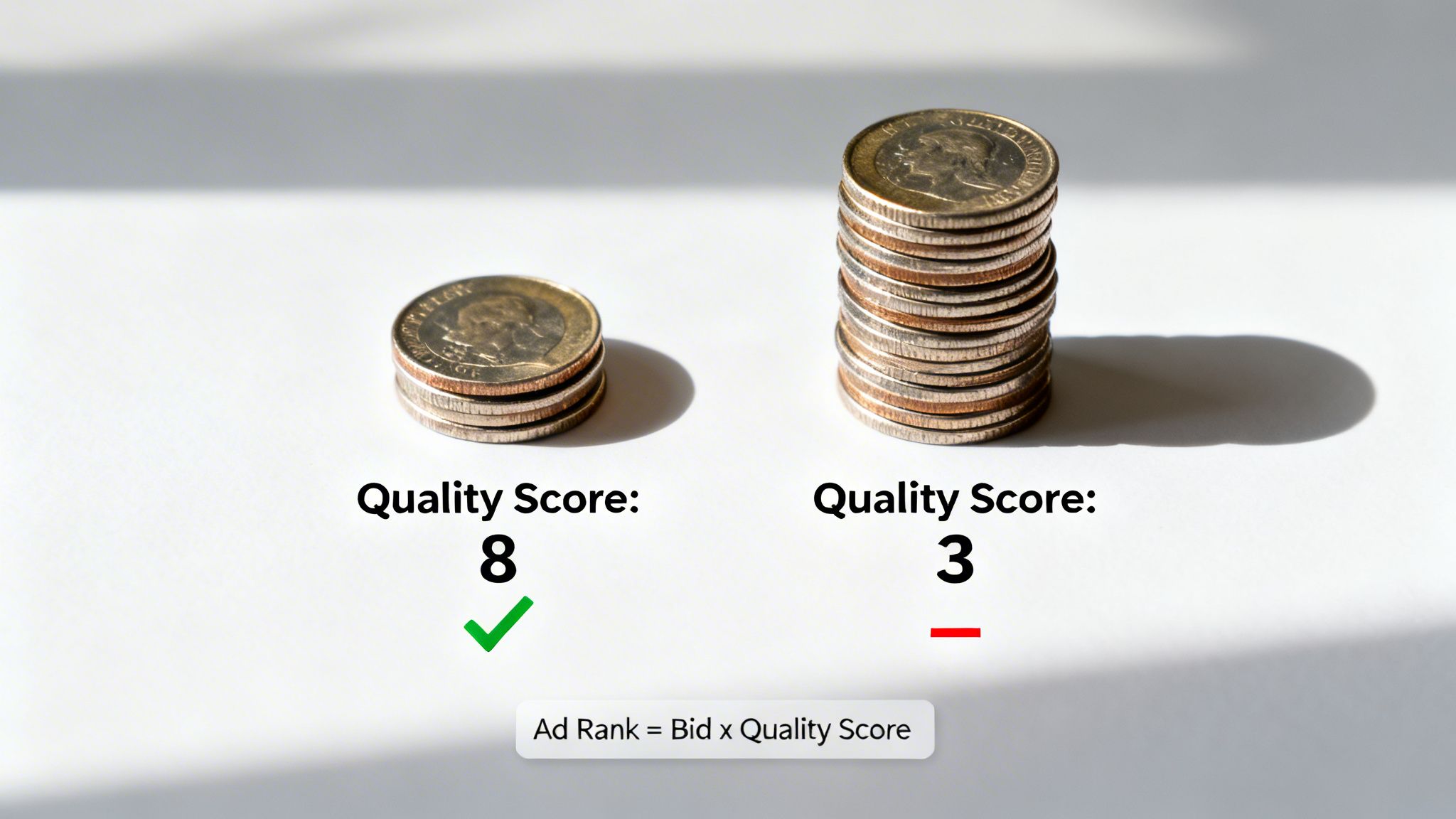
This is precisely why an advertiser with a quality score of 8 can easily outrank someone with a score of 3, even while paying less for each click. It’s Google’s way of rewarding advertisers who create a better user experience. Think of it as a relevance discount, and it's your job to go out and earn it.
The financial leverage of a high score
Let's make this real. Imagine you and a competitor are both bidding $2.00 for the exact same keyword.
- Your ad: You’ve done the work and have a solid quality score of 8. Your ad rank is 2.00 x 8 = 16.
- Competitor's ad: They've been a bit lazy and have a weak quality score of 3. Their ad rank is 2.00 x 3 = 6.
In this scenario, you don't just win; you dominate the auction. You’ll secure the better ad position, and because the gap between your ad rank and the next competitor's is so massive, you'll almost certainly pay a lower CPC. This is the leverage that lets savvy marketers scale their campaigns profitably. Getting a handle on how this works is fundamental to succeeding on the Google Ads platform.
How improvements compound over time
This isn't just theory; it's a proven financial reality. Quality score isn't a static grade. It's recalculated in real-time for every single auction, blending historical data with auction-time signals to decide your fate.
One study of 1,200 accounts found that advertisers who consistently improved their scores from 4 to 7 over 30 days slashed their CPC by a massive 41%, all while their average ad rank climbed. This isn't just about winning a single auction. It’s about building a foundation of relevance that pays dividends every single day.
In a competitive market, you can't just throw more money at the problem and hope for the best. The algorithm is literally designed to penalize that kind of lazy advertising. The most sustainable path to growth is to fix the underlying user experience. When you do that, your score improves, and you unlock cheaper, higher-quality traffic.
Common myths that are killing your performance
The PPC world is packed with myths and half-truths about quality score. Having spent years in the trenches with Google Ads, I’ve seen these misconceptions cost companies a fortune in wasted ad spend. It’s time for a reality check.
Let’s start with the most damaging one: immediately pausing any keyword with a low quality score. This is almost always a terrible, reactive decision. A low score isn't a death sentence; it's a diagnostic signal. It’s telling you there’s a mismatch somewhere between your keyword, ad, and landing page. It's an opportunity to fix the user journey, not abandon a keyword that could be valuable.
Another classic piece of bad advice is that just changing keyword match types will directly improve your score. It won’t. Switching from broad to phrase match doesn't magically signal to Google that your ad is better. What it does do is give you tighter control over the search queries your ad shows for. This, in turn, gives you a better shot at aligning your ad copy and landing page with a more specific user intent—and that is what improves the components that make up your score.
Quality score is a tool, not the target
But the biggest myth of all? That quality score is the single most important metric in your account. It's not. Your goal isn't a perfect 10/10; your goal is qualified leads, revenue, and profit. I've seen plenty of keywords with a 6/10 score that are wildly profitable and keywords with a 9/10 that don't convert at all.
Quality score is like a car's engine warning light. It doesn't tell you exactly what's wrong, but it's a critical signal that you need to look under the hood. Ignoring it is dumb, but obsessing over the light instead of fixing the engine is even dumber.
Stop chasing the score itself. Start using it as the diagnostic tool it was designed to be. Use it to find friction in your user experience and then fix those spots. For some practical ideas on where to start, our guide on ad copy best practices is a great next step. By seeing these myths for what they are, you can shift your focus from chasing a vanity metric to making smart, data-informed decisions that actually grow the business. That’s how you build something that lasts.
A practical guide to improving your quality score
Alright, enough theory. Let's get to work. Improving your quality score isn't about some secret algorithm hack; it’s about a relentless focus on creating a hyper-relevant user journey. We’re moving from diagnostics to action.
If your score is suffering, it’s because there’s a break somewhere between the search query, the ad they see, and the page they land on. Our job is to find and fix that break. This isn't just about tweaking your account—it's about building a better, more efficient system for winning customers.

Build granular ad groups
This is the foundation. Stop using broad, lazy ad groups stuffed with dozens of loosely related keywords. It’s a dumb approach that guarantees low ad relevance. Your goal should be to make your ad copy feel like a direct answer to the user’s search.
The only way to do that is with tightly themed, granular ad groups. Create a tight-knit relationship between keyword and ad, which is the first, most critical step toward a better score.
Craft dynamic and relevant ad copy
Your ad copy is the bridge between the search query and the landing page. If it’s weak, the whole journey collapses. The goal here is simple: write ads that are impossible to ignore because they speak directly to the user’s problem.
A/B testing isn't optional; it’s the price of admission. You should constantly be testing headlines, descriptions, and calls to action. Use every tool at your disposal to make your message resonate. Your ad isn't just text on a screen. It's a promise. A high-relevance ad promises a specific solution, and a great landing page delivers on it. Break that promise, and you'll pay for it with a lower score.
Lean into responsive search ads (RSAs). Pin your most critical headline to position 1 to ensure it always shows, then fill the other slots with variations. This lets Google’s AI test combinations to find the highest-performing message for you.
Achieve landing page nirvana
This is it. This is the biggest lever you can pull to influence your quality score. You can have the best ad groups and copy in the world, but if your landing page is slow, confusing, or irrelevant, you’ve already failed.
Your landing page must be a seamless continuation of the conversation started by your ad.
- Message match: The headline on your landing page has to mirror the headline in your ad. If your ad promises a free demo of AI sales software, your page better say that loud and clear, right at the top.
- Wicked-fast load speed: In 2024, there is zero excuse for a slow website. A page that takes more than 3 seconds to load is killing your conversion rates and your landing page experience score.
- Mobile-first design: The majority of searches happen on mobile. Your page must be flawless on a small screen—no pinching and zooming, just a clean, clear path to conversion.
This is the moment of truth. To really nail this, you need a page that’s not just relevant but also provides a stellar user experience. For a deeper look, check out our guide on Google Ads landing page optimization. Getting this part right changes absolutely everything.
Why scaling is impossible without mastering this metric
As someone who builds tech products for a living, I can't help but see everything through the lens of scalability. You can't scale a product with broken code, and you absolutely cannot scale a Google Ads account profitably if its foundation is cracked.
A low quality score is a broken foundation. It's as simple as that.
When your scores are low, you're not working with the algorithm; you're constantly fighting against it. Every single click costs more than it should, and your ads get shoved to the bottom of the page. It’s like trying to drive a car with the handbrake permanently on—you’ll burn a ton of fuel just to inch forward.
This is my final case for why mastering this metric isn't just another PPC tactic. It's a core business strategy. When you build systems designed to deliver highly relevant ads and landing pages, you're not just nudging a number on a dashboard. You're engineering a sustainable, ruthlessly efficient customer acquisition engine. This is a non-negotiable piece of any successful lead-gen campaigns.
The future of performance marketing
The future of advertising isn’t about endlessly tweaking manual bids. It’s about building smart, scalable systems that create a virtuous cycle. High relevance leads to a better user experience, which earns you a better quality score. That better score gives you lower costs and better ad positions, which drives a higher ROAS. It all feeds itself.
This feedback loop is how you win in the long run. It allows you to step back from the exhausting work of micromanaging bids and focus on the bigger picture—strategy, creative, and actual growth. You're no longer just buying clicks; you're building a competitive advantage that’s incredibly difficult for others to replicate.
Mastering your quality score isn't about pleasing an algorithm. It's about respecting the user's intent and building an acquisition machine that gets more efficient as it scales. That’s how you build a business that lasts. 🚀
Your questions answered
Alright, let's tackle a few of the questions that always pop up when people start digging into quality score. No fluff, just direct answers.
How often does quality score update?
Think of it in two parts. There's the real, auction-time calculation that happens instantly for every single search. That’s the real quality score that actually determines your ad rank in that moment.
But the 1-10 number you see in your Google Ads dashboard? That's more like a daily report card. It usually updates about once a day. Use that score as a general health check, but for actionable insights, pay closer attention to the component ratings (below, average, above average). That's where you'll find the clues for what to fix right now.
What is a good quality score?
Let's keep it simple. You can group scores into three buckets:
- 7/10 or higher: This is where you want to be. Getting a 7 or above generally means you're not getting penalized on your CPC. Google sees you as a high-quality, relevant advertiser.
- 4/10 to 6/10: This is the meh zone. It's average, but average is a clear sign that there’s a massive opportunity to save money. Fixing this is low-hanging fruit.
- 3/10 or below: This is a red flag. A score this low signals a serious disconnect somewhere between your keyword, your ad, and your landing page. It's actively costing you a fortune in higher CPCs and lost impressions.
Can I improve the score for a low-volume keyword?
Yes, but it's tricky. For keywords with very little search traffic, Google might not have enough data to even assign a score. If you do see a number, it's often an estimate based on the performance of other, closely related keywords in your account.
The best approach here isn't to obsess over the number itself. Instead, focus on perfecting the fundamentals. Make sure that keyword lives in a hyper-specific ad group, is paired with perfectly matched ad copy, and sends users to a landing page that flawlessly answers their intent. When search volume eventually picks up, you'll already be starting from a position of strength.
At dynares, we built a platform that automates this entire process. It creates hyper-relevant ads and landing pages for every single keyword, giving you the best possible quality score from the start. See how it works at https://dynares.ai.


