
Let’s be direct. You can build the most brilliant tech product in Europe, but if you can’t convince people to care, you’re dead in the water. Most advice on persuasion is academic nonsense written by people who have never sold anything. They talk about ethos and pathos like it’s a university lecture. It’s useless.
What actually works is seeing real examples of persuasive writing in the wild, the stuff that gets clicks, builds trust, and drives revenue. The emails that get opened. The ads that make people stop scrolling. The landing pages that convert. This isn't about flowery language; it's about clear, compelling communication that moves people to act. It's the engine of every successful business, especially in tech where you're often selling a complex vision.
I’ve spent years building and scaling products, and I've learned that everything comes down to your ability to persuade. So, I’ve pulled together 10 concrete examples of persuasive formats that we use to grow. No theory, just practical breakdowns you can steal and apply today.
This article gives you:
- Real-world examples from Google Ads to LinkedIn posts.
- Strategic analysis of why each example works and the psychology behind it.
- Actionable templates you can adapt for your own campaigns immediately.
Let's get into it.
1. Case study / success story
Let’s get straight to it: nothing persuades a skeptical buyer like seeing someone else win. That’s what a case study does. It’s not just a testimonial, it’s a detailed narrative showing a real client's journey from a specific problem to a measurable victory using your solution. It’s one of the most powerful examples of persuasive writing because it swaps abstract promises for concrete proof.
This approach is brutally effective because it follows a simple, compelling arc: challenge, solution, result. A good case study presents a relatable problem, walks through how your product or service fixed it, and then smacks the reader with hard data, like a 150% increase in ROAS or a 45% drop in cost-per-lead. It builds trust by demonstrating repeatable success, making the prospect think, if they did it for them, they can do it for me.
For PPC professionals, this is non-negotiable. Instead of just saying your agency is good, you show it with before-and-after metrics from a client's Google Ads account. For more inspiration, you can check out some real-world PPC performance case studies to see how data and storytelling combine.
To make your case studies work:
- Be specific with numbers. Don't say improved ROI. Say boosted ROI from 3.2x to 7.5x in 90 days.
- Include direct quotes. Let the client’s voice add authenticity. A direct quote is a thousand times more credible than your own marketing copy.
- Focus on the result. The process matters, but the outcome is what sells. Lead with the most impressive metric.
2. Comparison chart / feature matrix
Sometimes the most direct path to persuasion is a simple side-by-side takedown. A comparison chart or feature matrix strips away marketing fluff and forces a direct, logical evaluation. It’s a visual argument that helps buyers justify a decision by clearly laying out the options and highlighting your superior value. This is one of the most effective examples of persuasive writing for analytical audiences who want to see the facts, not just hear the promises.
This method works because it frames the conversation, putting you in control of the criteria being judged. By selecting the features and benefits to compare, you can strategically showcase your strengths against a competitor’s weaknesses or the known pains of a manual workflow. It’s an aggressive move that says, we're not afraid to be compared because we know we'll win. It builds confidence and accelerates the decision-making process by answering the prospect's internal question: is this really better than my other options?
For PPC managers evaluating new software, this is a godsend. Instead of slogging through demos, they can see in a grid why one tool's AI-powered bidding is superior. The same principle applies across many industries. For instance, when comparing different platforms for community building or course hosting, a detailed analysis like a Skool vs Circle comparison exemplifies this format.
To make your comparison charts persuasive:
- Compare against the status quo. Don't just pit yourself against direct competitors. Show how you beat manual processes or outdated methods.
- Use visual cues. Use checkmarks, colors, and bold text to draw the eye to your advantages. Make your win column impossible to miss.
- Include a value metric. Don’t just list features. Add a row for Cost Per Feature or Time Saved to translate features into tangible ROI.
3. Testimonial / quote-based social proof
If a case study is a detailed battle plan, a testimonial is the victory cry from a trusted soldier. It's a short, powerful quote from a happy customer that cuts through the noise and provides immediate validation. Using testimonials is one of the classic examples of persuasive writing because it relies on social proof, one of the most fundamental psychological triggers. When a prospect sees someone just like them succeeding, the barrier to belief instantly drops.

This tactic works because it’s authentic and direct. A customer's own words feel more genuine than slick marketing copy. Brands like Slack and Shopify built their empires on the backs of customer quotes that praised specific outcomes, transforming abstract features into real-world benefits. Seeing another founder say your tool saved them dozens of hours a week is infinitely more compelling than you making the same claim. It's the reason why testimonials are a cornerstone of high-converting pages; for more on this, check out these landing page design best practices.
To make your testimonials actually work for you:
- Ask for specifics. Instead of did you like it? ask what was the single biggest improvement you saw? This gets you metric-driven quotes like cut our reporting time by 50%.
- Add a face and title. A quote from John S., CEO of Acme Corp with his photo is ten times more credible than one from an anonymous user.
- Place them strategically. Don’t just dump them on one page. Put relevant testimonials next to your call-to-action buttons or feature descriptions.
4. Educational blog post / how-to guide
Here’s a no-nonsense approach: teach people how to solve their problems, and you earn their trust. An educational blog post or how-to guide does exactly that. It’s not about a hard sell; it’s about providing genuine value upfront. This is one of the most effective examples of persuasive writing because it shifts the dynamic from vendor-to-customer to expert-to-peer. You become the go-to resource, making your solution the obvious choice when it’s time to buy.
This strategy works because you’re meeting your audience where they are: actively searching for solutions. By creating content that answers their specific questions like how to reduce CPC, you attract qualified traffic and build authority. You're not just selling; you're educating and empowering. When you offer a clear, step-by-step framework that a PPC manager can use immediately, you’ve already proven your worth before they even see your product page. It's persuasion through competence.
For agencies and PPC professionals, this is how you build a real brand. Instead of just running ads, you create assets that bring in leads for years. For practical examples on building compelling narratives in your marketing, exploring ad copy best practices can offer deeper insights into storytelling.
To make your educational content work:
- Solve a real, specific pain point. Don't write about digital marketing. Write about How to Scale Google Ads from 50 to 500 Campaigns Without Burning Cash.
- Show, don't just tell. Use real screenshots, data, and examples to illustrate your points. If you’re talking about your tool, show it in action.
- Give away the how. Provide an actionable framework or a step-by-step guide. The goal is for the reader to walk away with something they can implement right now.
5. White paper / in-depth research report
If a case study is a scalpel, a white paper is a full-blown surgical suite. This isn't just about showing one client's success; it's about establishing your company as an undeniable authority on a critical industry topic. A well-executed white paper or research report presents original data, deep analysis, and actionable insights that your audience can't get anywhere else. This is one of the most respected examples of persuasive writing because it shifts the conversation from why should I hire you? to what do you think we should do next?
This approach persuades through intellectual generosity and sheer credibility. By conducting original research, like surveying 200 PPC managers on automation trends, you create a resource that competitors have to cite and prospects have to download. It’s not a sales pitch. It’s an educational document that builds immense trust by solving a problem before asking for a single euro. Think of HubSpot's annual State of Inbound or Gartner's Magic Quadrant reports; they don't just participate in the industry conversation, they lead it.
For digital marketers, this is a lead-generation machine. You gate the full report behind an email signup, nurture those leads with a targeted follow-up sequence, and position your sales team as expert consultants rather than cold callers. The goal is to become the go-to source for industry benchmarks and future trends.
To make your white papers deliver:
- Conduct original research. Don’t just rehash old stats. Survey your audience, analyze your own platform data, and bring something new to the table.
- Visualize the data. Use charts, graphs, and infographics to make complex findings easy to digest. People remember visuals far better than raw numbers.
- Gate it strategically. Offer a public executive summary or key findings to prove the value, then require an email for the full, in-depth report.
6. Webinar / live presentation (recording)
A webinar is basically a classroom disguised as a sales pitch, and it works. Instead of a hard sell, you offer 45 minutes of genuine value, teaching something useful. It’s a powerful form of persuasive writing because you’re not just telling people you’re an expert; you’re proving it live. This format builds a relationship, demonstrates authority, and subtly guides the audience from a learning mindset to a buying one.
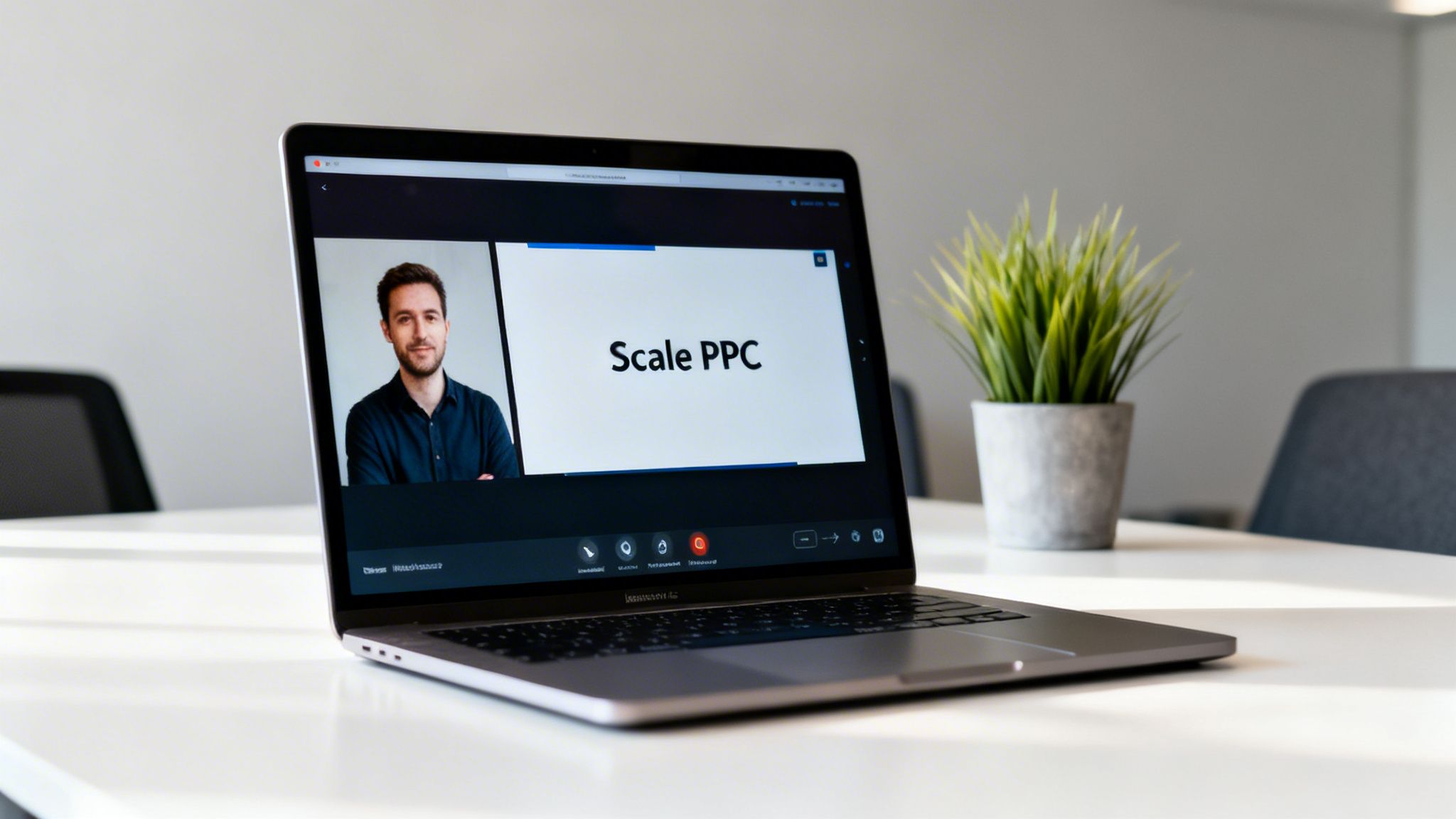
The brilliance of a webinar is that it persuades through education. You address a specific pain point, provide a framework to solve it, and then present your product as the tool to execute that framework flawlessly. By the time you get to the call-to-action, the audience is already primed. They’ve seen your expertise in action and understand the context where your solution fits. Companies like HubSpot and Shopify have built massive lead generation engines with this exact model.
For PPC agencies, this is a golden opportunity. Instead of a cold email, invite prospects to a free training on How to Cut Google Ads Waste by 30%. You deliver real value, and the pitch at the end feels natural, not forced.
To make your webinars actually convert:
- Focus on a painful, specific problem. Don’t host a webinar on Google Ads Tips. Host one on The 5-Step Framework to Scaling E-commerce Ads Past $1M/Month.
- Give away your best stuff. Don’t hold back. The more value you provide for free, the more the audience will believe your paid solution is even better.
- Include an exclusive live offer. Create urgency with a bonus, discount, or special access that’s only for attendees who act fast.
7. Video testimonial / customer success video
If a written case study is proof, a video testimonial is proof with a pulse. It takes the same core idea of showing a customer’s success but adds a layer of human connection and authenticity that text just can’t replicate. Hearing a real person describe their challenges and their results in their own voice is one of the most convincing examples of persuasive writing translated to video, and it’s incredibly effective.
This format works so well because it builds instant trust and emotional resonance. You see the person, hear their tone, and believe their story on a gut level. When a client from a specific industry looks into the camera and explains how you delivered a 40% reduction in CPC, it feels less like marketing and more like a credible recommendation. Companies like Slack and Shopify have built their brands around these stories, turning customer wins into their most powerful sales tool.
For anyone in a service-based business, especially agencies, this is a must-have. A well-produced, two-minute video can close more deals than a dozen pitch decks. It moves the conversation from what you say you can do to what you've already done for someone just like me.
To make your video testimonials hit hard:
- Recruit for results. Find customers who saw big, quantifiable wins like a 30%+ conversion lift or a major drop in acquisition costs.
- Keep it real. Ditch the script. Ask your customer to speak naturally about their problem, the solution, and the outcome. Authenticity sells.
- Focus on metrics. Ensure they mention specific numbers and timeframes, like we saw a 23% conversion rate improvement in just 8 weeks.
8. Infographic / visual data breakdown
Let’s be honest: your audience is scrolling, not reading novels. An infographic takes complex data and makes it impossible to ignore. It’s a visual sledgehammer, turning boring statistics into a compelling, shareable story. This isn't just about making things look pretty; it's about communicating a persuasive argument in seconds. These are some of the best examples of persuasive writing because they bypass the brain's analytical side and hit the visual cortex directly.
This format works because it simplifies complexity. Instead of a dense report, you present a clear, scannable narrative with a strong visual hierarchy. You can take an industry pain point, like wasted ad spend, and distill it into a single, shocking statistic that grabs attention immediately. It builds authority by showing you've done the research, positioning you as an expert without forcing prospects to wade through a white paper. For PPC managers, it’s a killer asset for LinkedIn or a blog post, proving a point before you even write a sentence.
Brands like HubSpot and SEMrush have built entire content engines around this. They turn their proprietary research into visual assets that get shared thousands of times, generating backlinks and brand awareness. The goal is to make your data so easy to understand and so impactful that people can't help but share it.
To make your infographics persuade effectively:
- Lead with a hook. Start with the most surprising or painful statistic at the top.
- Tell one story. Don't cram it with dozens of data points. Focus on a single, powerful insight.
- Brand everything. Use your colors, logo, and website URL so your brand travels with every share.
9. Sales email sequence / drip campaign
A single email is a shot in the dark; a sequence is a strategy. A sales email or drip campaign is a series of automated messages sent over weeks, designed to build a relationship and guide a prospect toward a decision. It’s not about blasting one generic offer. It’s a calculated conversation that delivers value at each step, making it one of the most effective examples of persuasive writing for nurturing leads.
This method works because it mirrors a real sales process: building trust, proving value, handling objections, and creating urgency. Instead of a single, overwhelming pitch, you break your argument into digestible pieces. One email might share a customer win (social proof), the next might tackle a common industry pain point, and a later one might present a limited-time offer. It’s persuasion over time, which feels less aggressive and more helpful. Brands like HubSpot and ConvertKit have built empires on this model.
For agencies and founders, this isn't just nice to have; it's essential for scaling without burning out your team. If you want to dive deeper into the nuts and bolts, you can find more on marketing automation for small business and see how to set up these systems.
To make your email sequences persuade, not annoy:
- Segment your audience. Don't send the same sequence to a freelancer and an enterprise CEO. Tailor the first email and subsequent pain points to their specific world.
- Each email has one job. Email 1 establishes relevance. Email 2 builds social proof. Email 4 creates urgency. Don't cram three different CTAs into one message.
- Address objections head-on. If you know prospects worry about implementation time, dedicate an email to showing how your onboarding takes less than 30 minutes. This builds massive trust.
10. LinkedIn thought leadership content (posts, articles, carousel)
Forget the corporate PR fluff. Real persuasion on LinkedIn comes from sharing your actual, hard-won expertise, not just your job title. This is where thought leadership content shines. It’s not about selling; it’s about teaching, challenging, and demonstrating your authority in a specific niche, like PPC. By consistently publishing insightful posts, detailed articles, or visual carousels, you build an audience that trusts you. This is one of the most effective examples of persuasive writing for B2B because it persuades through value, not a sales pitch.

The strategy is brutally simple: give away your best ideas for free. When you share a contrarian take on campaign bidding or a detailed breakdown of a successful client strategy, you attract the right kind of attention. PPC managers, agency owners, and founders follow you not because you’re trying to sell them something, but because you’re making them better at their jobs. For tech founders aiming to establish themselves as industry authorities, understanding how to write a thought leadership book can amplify their influence beyond traditional posts. The persuasion happens implicitly; when a follower needs an expert, you’re the first one they think of.
To make your LinkedIn content persuasive:
- Lead with a hook. Start with a bold claim, a surprising stat, or a contrarian viewpoint. Don't warm up; get straight to the point.
- Write for skim readers. Use short paragraphs, line breaks, and simple language. No one on LinkedIn wants to read a wall of text.
- End with a question. Prompting engagement signals to the algorithm that your content is valuable, expanding its reach. Ask a question that invites comments and starts a conversation.
10 persuasive writing examples compared
| Content Type | Implementation Complexity 🔄 |
Resource Requirements ⚡ |
Expected Outcomes 📊 |
Ideal Use Cases 💡 |
Key Advantages ⭐ |
|---|---|---|---|---|---|
| Case Study / Success Story | High — interviews + data collection 🔄 | Medium-High — analyst time, design, client access ⚡ | High credibility and measurable ROI (✅ attribution, strong conversion lift) 📊 | Sales enablement, landing pages, enterprise trust 💡 | Trust-building, SEO, repurposeable across channels ⭐ |
| Comparison Chart / Feature Matrix | Medium — structured data + updates 🔄 | Medium — competitor research, design, maintenance ⚡ | Fast evaluation by buyers; reduces decision friction 📊 | Evaluation stage, RFPs, competitive positioning 💡 | Scannable differentiation; shows value vs alternatives ⭐ |
| Testimonial / Quote-Based Social Proof | Low — short interviews or quotes 🔄 | Low — outreach and basic formatting ⚡ | Moderate trust boost; quick uplift on pages/ads 📊 | Landing pages, ads, email snippets, social proof 💡 | Cost-effective, easy to refresh, high deployability ⭐ |
| Educational Blog Post / How-To Guide | Medium-High — research + SEO structure 🔄 | Medium — writer, research, visuals, SEO work ⚡ | Sustained organic traffic and authority (slow burn) 📊 | Top-of-funnel education, lead nurturing, repurposing 💡 | Builds thought leadership and long-term organic growth ⭐ |
| White Paper / Research Report | High — original research + rigorous structure 🔄 | High — surveys, analysis, design, gating ⚡ | High-quality leads and strong authority; longer engagement 📊 | Enterprise demand gen, analyst pitches, gated lead capture 💡 | Benchmarking credibility and sales enablement ⭐ |
| Webinar / Live Presentation (Recording) | Medium-High — planning, slides, live ops 🔄 | Medium-High — presenter, promotion, platform, production ⚡ | High engagement; immediate lead capture and follow-up 📊 | Product demos, deep education, interactive Q&A sessions 💡 | Personal connection, multi-format repurposing, high conversion ⭐ |
| Video Testimonial / Customer Success Video | Medium — filming + edit, scheduling 🔄 | Medium — production resources, captions, talent ⚡ | Strong persuasive impact and conversion uplift (high trust) 📊 | Homepage, ads (YouTube/social), sales collateral 💡 | Emotional authenticity; higher ad performance and shareability ⭐ |
| Infographic / Visual Data Breakdown | Low-Medium — data selection + design 🔄 | Low — designer and data inputs ⚡ | High shareability and quick comprehension; awareness lift 📊 | Social, blog assets, downloadable lead magnets 💡 | Digestible visuals; strong social amplification ⭐ |
| Sales Email Sequence / Drip Campaign | Medium — copy, segmentation, testing 🔄 | Medium — CRM/email platform, copywriter, automation ⚡ | High ROI when targeted; moves prospects through funnel 📊 | Post-gated nurture, trial follow-up, retargeting flows 💡 | Scalable personalization; measurable conversions and A/B testability ⭐ |
| LinkedIn Thought Leadership (Posts/Articles/Carousel) | Medium-High — consistent content cadence 🔄 | Medium — time from founders/leaders, repurposing ⚡ | High-quality leads and brand authority over time 📊 | Founder branding, B2B lead gen, recruiting, networking 💡 | Portable credibility, organic reach, conversation-driven leads ⭐ |
Stop talking and start building
We've just walked through ten distinct formats, from punchy Google Ads to in-depth white papers. If you’ve been paying attention, you'll notice the common thread isn’t some secret formula or marketing sorcery. It's about clarity, empathy, and a relentless focus on solving a real problem for a real person. The best examples of persuasive writing aren't just clever; they're genuinely helpful. They connect a customer’s pain with a clear, credible solution.
Too many teams get stuck in a loop of admiration. They admire the problem, they admire their competitor's landing page, they admire a cool social media ad. Admiration doesn't build anything. It's time to stop observing and start doing. The examples in this article aren't here to be put in a museum. They are blueprints and starting blocks. Your job is to take them, break them apart, and build something for your own audience.
The patterns that actually matter
Forget about chasing trends for a moment. The fundamental principles of persuasion are timeless. Across all the formats we analyzed, three core ideas kept showing up:
- Specificity builds trust. Vague claims like best in class are worthless. Hard numbers, specific outcomes, and direct quotes from real customers cut through the noise because they feel real. They are real.
- Show, don’t just tell. A comparison chart showing you have more features is weak. A case study showing how a customer used a specific feature to save 10 hours a week is powerful. Let the results do the talking.
- Guide the next step. The most convincing argument in the world fails if the user doesn't know what to do next. A clear, low-friction call-to-action is not a sales tactic; it's a necessary piece of user experience.
The biggest mistake I see founders and marketers make is overcomplicating this. They aim for perfection and end up with paralysis. Your first attempt at a new ad format or landing page won’t be perfect, and that's okay. The goal is to get it live, get the data, and iterate. Stop waiting for the perfect moment or the perfect copy. Ship it. Test it. Learn. That is the only path to building something that truly connects and persuades at scale. The barrier to entry is lower than ever, so the only thing stopping you is inaction.
At dynares, we built our entire platform around this principle of action. Persuasion is great, but persuasion at scale is how you build a real business. We automate the generation of thousands of high-intent ads and landing pages, letting you test and iterate faster than you ever thought possible. If you’re tired of the manual grind and ready to see what scaled persuasion looks like, check out dynares.


