
Let's get straight to it. To figure out your Cost Per Lead (CPL), you divide your total marketing spend by the total number of new leads you got for that money. It’s the most critical number for knowing if your marketing is actually making you money or just burning through your budget.
If you're spending money on marketing—especially on platforms like Google Ads—and you don't know your CPL, you're flying blind. I’ve seen founders pour tens of thousands into campaigns without a single clue what they were actually getting in return.
Frankly, it’s a dumb way to run a business. It's a fast track to failure.
Forget the complex jargon for a second. The core idea is simple: how much does it cost you to get one potential customer interested in what you sell? This isn't just some academic exercise; it's about getting a real, hard number to base your decisions on. It’s the foundation of any serious lead generation effort.
Why CPL is your north star metric
Getting this number wrong almost sank one of my early ventures. We were celebrating a flood of cheap leads without realizing our true CPL was 5x higher once we factored in all our costs. This metric brings pure clarity, not more complexity.
Knowing your CPL helps you:
- Justify your marketing budget: Stop having vague conversations and start showing a clear return on what you spend.
- Identify your most profitable channels: Figure out if LinkedIn, Google Ads, or your blog is the real moneymaker.
- Optimize campaigns effectively: When you know the cost, you can focus on driving it down without sacrificing the quality of the leads.
This kind of clarity is non-negotiable if you want to scale.
A quick breakdown of the CPL formula
Here's a quick summary of the formula and the key inputs you'll need to calculate your cost per lead accurately.
| The Basic CPL Formula and Its Components | ||
|---|---|---|
| Component | Total Marketing Spend | Total New Leads |
| The Formula | Cost Per Lead (CPL) = Total Marketing Spend ÷ Total New Leads | |
This table gets you the baseline number, which is the essential starting point for any real analysis.
Going deeper: why context matters
So, a low CPL is always better, right? Not necessarily.
Let’s say your dynares campaigns generate 100 leads from a €5,000 Google Ads spend. Your CPL is a crisp €50. Great.
But what if you also spent €4,000 on LinkedIn to get 40 demo requests? That’s a €100 CPL. On the surface, it looks twice as expensive. But if those LinkedIn leads qualify at a much higher rate, your effective cost for a qualified lead could actually be much lower.
The goal isn't just to get a number—it's to get an honest number. Too many founders only count ad spend, which creates a vanity metric that feels good but hides the real cost of acquisition.
To truly get an accurate CPL, you have to master campaign tracking with UTM parameters. Without proper tracking, you're just assigning credit based on gut feelings, which is no way to build a company.
Accurate data is the bedrock of growth. It all starts with knowing precisely what each lead costs you. If your tracking isn't set up correctly, your CPL will be a work of fiction.
The simple math behind your cost per lead
Alright, let's get into the mechanics. The formula for Cost Per Lead is dead simple, and you don’t need a finance degree to get it right. It’s just this:
Total Campaign Cost ÷ Total New Leads = Cost Per Lead (CPL)
But here’s where a lot of founders trip up.
The calculation itself is easy. Getting the inputs right is what separates a vanity metric from a genuine growth lever. The real value—the number that actually tells you something useful—is in the details.
What actually goes into total cost?
This is the most common mistake I see: only counting ad spend. That’s a recipe for disaster because it gives you a deceptively low CPL and a false sense of security. To get an honest number, you have to be more rigorous.
Your total campaign cost is a sum of all expenses tied directly to that specific campaign.
- Direct Ad Spend: This is the obvious one—what you paid Google, LinkedIn, Meta, or any other ad platform.
- Tool & Software Costs: Think about any specific software used for the campaign, like a landing page builder, an analytics tool, or a particular design asset subscription.
- Human Capital (Salary): This is the one everyone conveniently forgets. If a team member spends a significant portion of their time managing the campaign, a fraction of their salary absolutely must be included.
Calculating CPL without including all associated costs is just lying to yourself. You can't make smart decisions with bad data, and incomplete cost calculations are the worst kind of bad data. It's a completely unforced error.
A practical SaaS campaign example
Let’s make this real. Here are the numbers from a recent Google Ads campaign we ran for one of our SaaS products, aimed at generating demo requests.
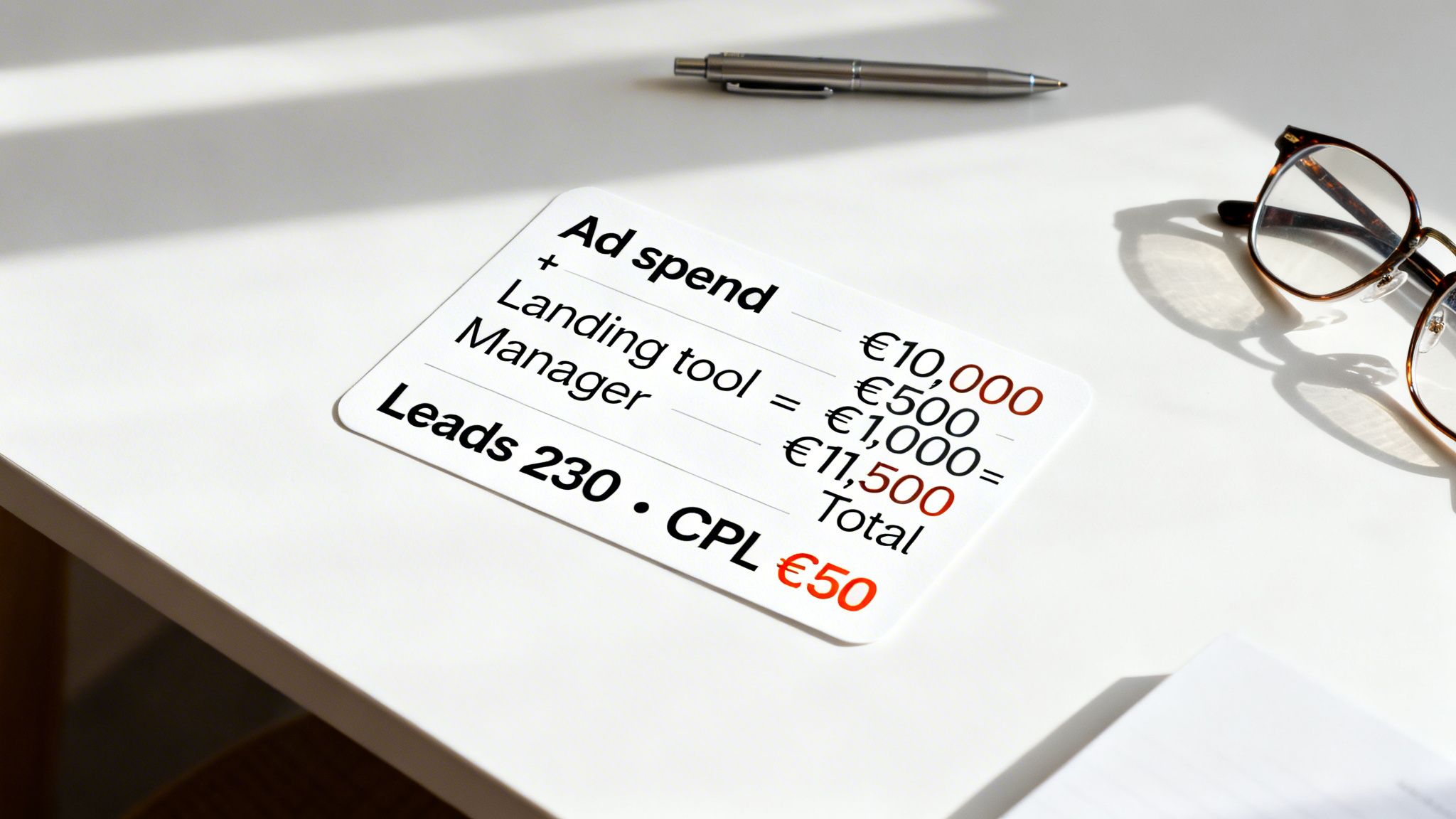
We spent €10,000 directly on Google Ads. The campaign used a dedicated landing page tool that costs €500 per month. Our PPC manager spent about 20% of her time on this campaign, which we calculated as €1,000 of her monthly salary.
So, the math is:
€10,000 (Ad Spend) + €500 (Tools) + €1,000 (Salary) = €11,500 Total Campaign Cost
This campaign generated 230 new demo requests.
€11,500 ÷ 230 leads = €50 CPL
See? Not rocket science. But by including the tool and salary costs, we have a true CPL of €50.
If we had only counted ad spend, we would have incorrectly calculated a CPL of ~€43.50, which is almost 15% off. That’s a significant difference when you start scaling your budget and making decisions based on that number.
This metric is a close cousin to another critical one; you can learn more about how to calculate ROAS the right way to get a full picture of your ad performance.
Finally, you absolutely must define what a lead is for your business and stick to it. Is it an email signup? A demo request? A contact form submission? Be consistent, or your numbers will be meaningless.
Why your CPL is probably higher than you think
This is where most marketers trip up.
They glance at their ad spend, do some quick math, look at the CPL staring back at them from their Google Ads dashboard, and think, hey, not bad.
That number is a vanity metric. It's dangerously incomplete, and if you're making budget decisions based on it, you're flying with a massive blind spot.
Your true CPL is almost certainly higher. To get a real, strategic handle on what it costs to acquire a lead, you have to look past the obvious ad spend and dig into the hidden costs, channel nuances, and the messy reality of attribution.
The attribution headache no one wants to talk about
Here’s a story you’ve probably lived. A potential customer sees your post on LinkedIn and clicks through to your blog. A week later, a retargeting ad catches their eye on Facebook. Finally, they Google your company's name, click your ad, and book a demo.
So, who gets the credit?
Google Ads will happily raise its hand and claim 100% of the win. This is called last-click attribution. It’s the default setting for most platforms because, well, it makes them look fantastic. It's also incredibly misleading.
Don't let your ad platforms grade their own homework. Last-click attribution ignores the entire customer journey and overvalues bottom-funnel channels, leading you to misallocate your budget and kill the marketing efforts that actually build demand.
You don’t need a data science degree to fix this. A simple model that works well for most businesses is a linear or position-based attribution model. These models spread credit across multiple touchpoints. It’s not perfect, but it’s a hell of a lot more honest than giving all the glory to the final click.
Comparing apples and very expensive oranges
Different channels produce wildly different kinds of leads, and their CPLs will reflect that. A classic mistake is looking at CPL in a vacuum without considering the quality and conversion potential of the lead.
Think about these two scenarios:
- Google Ads Lead: You spend €50 to get a demo request from someone who is well-informed and ready to buy.
- Trade Show Lead: You spend €5,000 on a booth and come away with 10 qualified leads. Your CPL here is €500.
On paper, the trade show looks absurdly expensive. But what if that €500 lead converts to a paying customer at 5x the rate of the €50 Google Ads lead? Suddenly, the expensive lead is actually the cheaper one when you connect it to what matters: revenue.
This is exactly why you must tie your CPL to Customer Lifetime Value (LTV). A high CPL for a high-LTV customer is a brilliant investment. A low CPL for a lead that never converts is just money down the drain.
Your goal isn’t the lowest possible CPL; it’s the most profitable CPL.
What a good CPL actually looks like by industry
So, you’ve done the math and landed on a Cost Per Lead number. Now what? Is it good? Bad? Horrifically expensive?
The only honest answer is: it depends.
A good CPL is completely relative to your industry, your business model, and most importantly, your profit margins. Context is everything here. Don't get hung up on a number without understanding the landscape you're playing in.
A €650 CPL might be a fantastic bargain for a law firm that’s about to close a €50,000 case. In that context, the acquisition cost is a tiny fraction of the potential return. But that same €650 CPL would be a total disaster for an e-commerce store selling €20 t-shirts.
It’s just unit economics.
Benchmarks give you context, not a target
To give you a real-world perspective, let's look at some industry benchmarks. These numbers can swing wildly, and understanding why is far more important than memorizing the numbers themselves.
Industry benchmarks from First Page Sage research show some stark CPL variations. For example, B2B SaaS has a blended average CPL of $237, while more specialized fields like cybersecurity can hit $406 and IT services reach $503.
Legal services get even steeper, averaging between $649 and $784 for paid leads. In stark contrast, e-commerce sits around $91, and higher education can be a shocking $982.
These differences usually come down to a few key factors:
- Average Deal Size: Higher-priced products or services can justify a much higher CPL. Simple.
- Sales Cycle Length: Industries with long, complex sales cycles (think enterprise software) require more marketing touchpoints, driving up costs.
- Competition: A crowded market means more companies are bidding on the same keywords and fighting for the same eyeballs, which naturally inflates CPL.
Knowing these benchmarks helps you set realistic goals and explain your performance to stakeholders without them thinking you're just lighting money on fire.
This side-by-side comparison shows just how drastically different channels can impact your cost per lead.
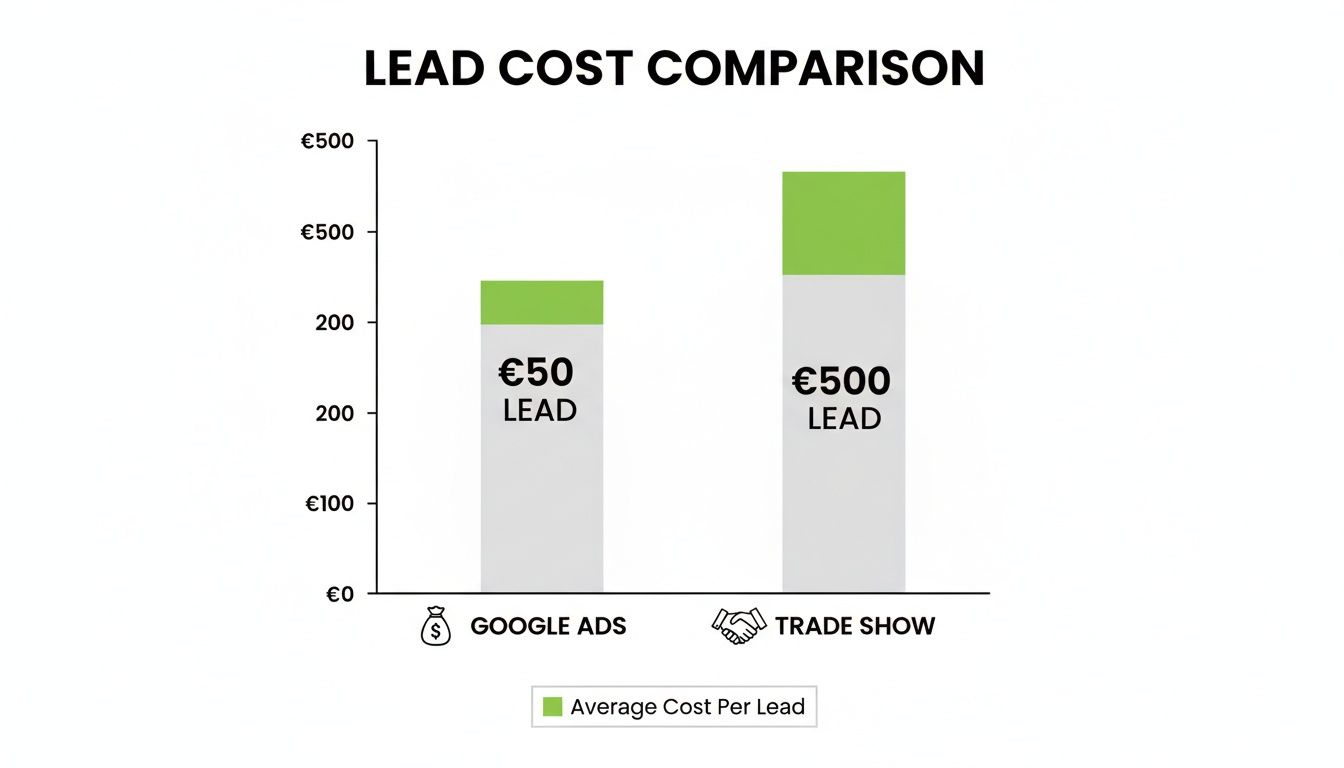
The key insight here isn't just that a trade show lead costs 10x more. It's that its value must be at least 10x greater to be worth it.
Your goal isn't to hit the average CPL for your industry. The goal is to know where you stand so you can intelligently plan how to beat it. The average is just a starting line.
Ultimately, CPL is deeply connected to another crucial metric. If you want the full picture of your marketing health, you need to understand how these two numbers work together. Learn more about what is a good conversion rate in our article.
Actionable ways to lower your cost per lead
Knowing your CPL is the starting point. Actually lowering it is where the real money is made.
Forget the hunt for some secret hack. This is about systematic, relentless optimization. It's about building a more efficient marketing machine, not just throwing more budget at a leaky funnel. This isn't glamorous work, but it’s what separates the companies that scale from those that stagnate.
Here are my go-to tactics you can put into play this week.
Nail your ad relevance
The biggest lever you have, especially in paid search, is relevance. It's a straight line: higher relevance leads to a better Quality Score, which directly lowers your cost-per-click (CPC) and absolutely slashes your CPL.
Google wants to show users the most relevant results possible. If you help them do that, they reward you with cheaper traffic. It’s a simple, beautiful transaction.
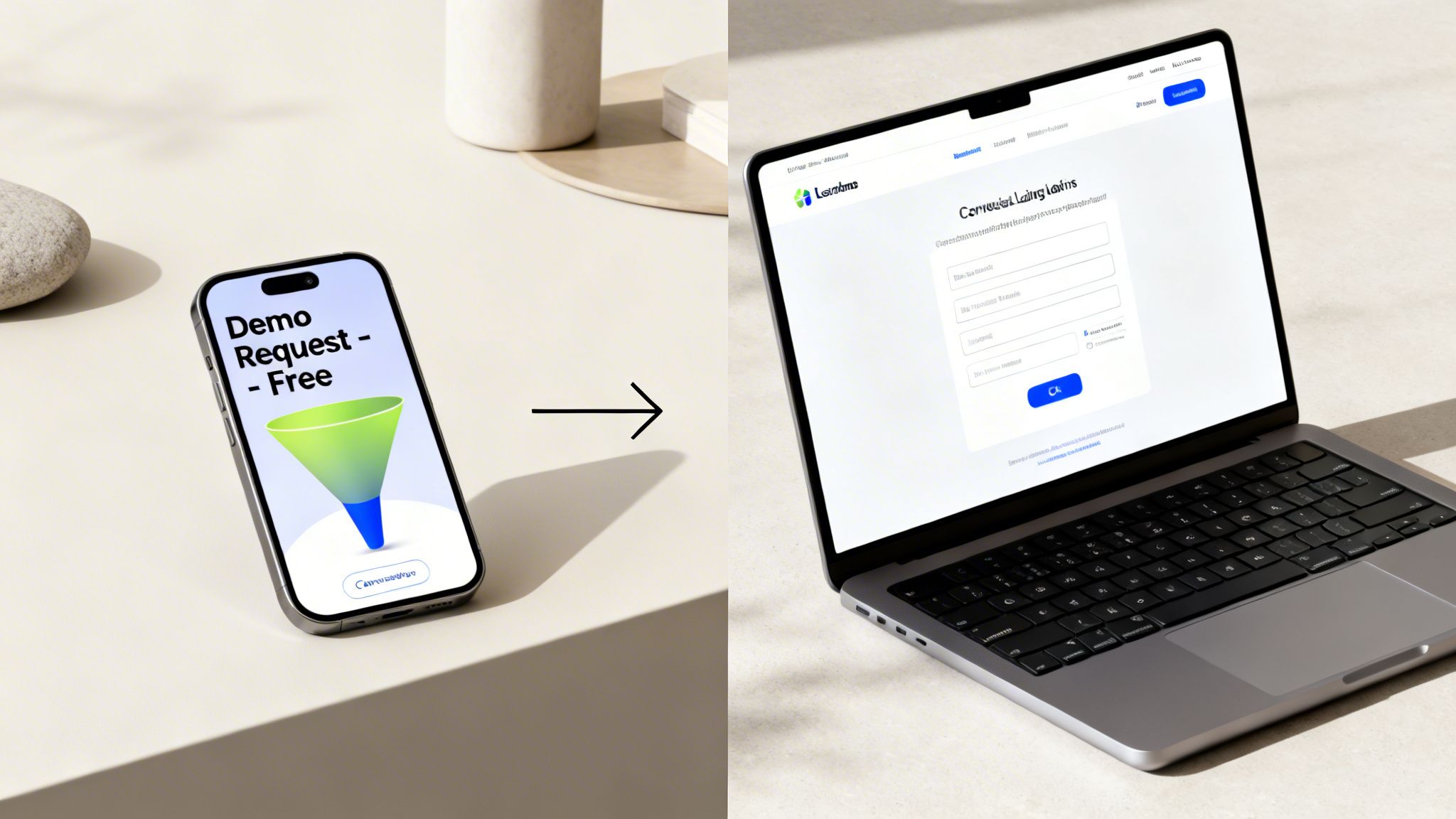
Stop running generic ads that point to your homepage. Instead, get obsessed with creating hyper-specific ads and landing pages for every single keyword group.
If someone searches for B2B SaaS accounting software for startups, your ad and landing page should scream that exact phrase right back at them. This isn't just a best practice; it's the core of the game.
Stop marketing to everyone
I can almost guarantee your audience targeting is too broad. It's a classic mistake, usually driven by a fear of missing out, but it's costing you a fortune. You need to be ruthless about who you spend your money on.
- Refine Your Demographics: Go way beyond just age and location. Dig into the specifics—job titles, company sizes, and industries that perfectly match your ideal customer profile (ICP).
- Use Exclusion Lists: Actively build lists of negative keywords and audiences. Stop showing your ads to students, competitors, or anyone who will never, ever buy from you. This is free money waiting for you to claim it.
- Leverage Retargeting: Put a portion of your budget toward people who have already shown interest. They've visited your site or engaged with your content. These are warm leads, and your CPL for this group will almost always be lower.
Optimize your landing page experience
You can have the best ad in the world, but if your landing page is slow, confusing, or untrustworthy, you’re just setting cash on fire. Your conversion rate is the final multiplier on your CPL, and even a small lift here can have a massive downstream impact.
Your only goal should be to make it incredibly easy for a lead to convert. Streamline everything. We cover this in detail in our guide on creating an effective lead capture form. A frictionless experience is non-negotiable.
A low CPL is useless if the leads are junk. The goal is the lowest possible CPL for a quality lead. A €100 CPL for a lead that converts is infinitely better than ten €5 leads that waste your sales team's time.
The connection between your CPL, conversion rates, and lifetime value (LTV) is everything. If your LTV is €3,000 and 10% of leads convert, you can comfortably afford a CPL of up to €100. Prioritizing quality over cheap volume is the only sustainable path to growth.
Got CPL questions? I've got answers
I talk about CPL a lot. On the surface, it seems like a simple metric, but there's a ton of nuance that trips people up. Here are some of the most common questions that land in my inbox, with straight, no-fluff answers from years in the trenches.
CPL vs CPA: what's the real difference?
People mix these up constantly, and it’s a critical distinction. Getting this wrong can completely derail your marketing strategy.
- CPL (Cost Per Lead): This is what you pay to get a potential customer’s contact info. Think email sign-ups, demo requests, or a phone number. It’s a top-of-funnel metric that signals interest.
- CPA (Cost Per Acquisition): This measures what it costs to land an actual paying customer. It’s a bottom-of-funnel metric tied directly to revenue.
Here’s the simplest way to think about it: CPL tells you how good your marketing is at starting conversations. CPA tells you how good your entire business is at turning those conversations into money.
You might be celebrating a fantastic CPL of €20, but if it takes 50 of those leads to land one customer, your CPA is actually a painful €1,000. Both metrics are vital, but they tell completely different stories.
How often should I actually calculate my CPL?
This really depends on your campaign volume and how long your sales cycle is. There’s no magic number, but I can tell you the wrong answer: checking it daily. You’ll drive yourself crazy reacting to normal, everyday blips instead of focusing on real trends.
For high-volume, fast-moving channels like Google Ads, I review our CPL on a weekly basis. This gives us enough data to spot meaningful patterns and make quick adjustments before we burn too much budget.
For longer-term plays like content marketing or SEO where leads trickle in, a monthly check-in is usually fine. The key is consistency. Pick a cadence that makes sense for the channel—weekly or monthly—and stick to it. That’s how you separate the signal from the noise.
A super-low CPL is one of the most common traps founders fall into. It feels like a win, but it's often a sign that you're just generating a high volume of low-quality leads that will never convert and will only waste your sales team's time and morale.
Is a low CPL always a good thing?
Absolutely not. And this is probably the biggest rookie mistake I see.
Chasing the lowest possible CPL is a race to the bottom that can quietly kill your business. Why? Because a rock-bottom CPL is often a direct indicator of low-quality leads. I would much rather pay €200 for a lead that has a 25% chance of becoming a high-value customer than €10 for a lead that goes nowhere.
The goal isn't the cheapest CPL; it's the most profitable CPL.
Always look at CPL in context with lead quality, conversion rates, and the actual revenue each lead generates. A slightly higher CPL that delivers customers who stick around for years is infinitely more valuable than a cheap lead that just wastes everyone's time.
Stop flying blind with your Google Ads campaigns. At dynares, we automate the creation of thousands of high-intent, keyword-specific landing pages and ads, so you can slash your CPL and focus on leads that actually convert to revenue. See how it works at https://dynares.ai.


