
Let's get real about what makes a "good" conversion rate. It's the question every founder asks, and the honest answer is always, it depends.
A 2% conversion rate might be phenomenal for a high-ticket B2B SaaS product, but an absolute disaster for a simple email signup. Forget the generic industry benchmarks for a minute; they’re mostly noise.
Stop chasing a mythical number
Every founder I talk to is obsessed with finding that one magic number, that single "good" conversion rate they should be hitting. Let's be blunt: that’s a rookie mistake. Chasing a universal average is a waste of time and money because it completely ignores the most critical factor—context.
Your conversion rate isn't just a vanity metric to compare with competitors on a spreadsheet. It’s a direct signal of how well you understand your customer. It’s a health check for your entire funnel, from the ad they clicked to the final thank-you page.
A low rate isn't just a "bad number"; it's a symptom of a deeper problem. Maybe your ad promises one thing and your landing page delivers another. Maybe your value prop is fuzzy, or your form is asking for too much, too soon.
When you improve your conversion rate, you're not just improving a metric—you're building a better, more customer-centric business. It's the truest feedback you'll ever get.
What your conversion rate is actually telling you
Instead of asking, "What is a good conversion rate?" the better question is, "What is my conversion rate telling me about my business?" It’s a diagnostic tool, not a final grade. Viewing it this way forces you to look at the whole system, not just one isolated number.
Think of it like this: if you’re selling a €50,000 enterprise software package, a 0.5% conversion rate from demo requests might be phenomenal. You’d be celebrating. 🎉
But if you’re trying to get people to sign up for a free newsletter and you’re only converting at 0.5%, something is seriously broken. The product, the channel, the offer, and the audience all define what "good" looks like.
So, let's reframe the conversation. We aren't here to find a single number to make you feel good or bad. We're here to understand the levers that influence that number. The goal isn't to hit an arbitrary industry benchmark found in some report. The real goal is to build a system for continuous improvement—to consistently beat your own baseline, month after month. That’s how you build a resilient, scalable business.
Finding your true conversion rate benchmark
Alright, let's get one thing straight: chasing a single, mythical "good" conversion rate is a great way to waste your time. Context is everything. But you still need a starting line—a benchmark to know if you're even in the right ballpark.
Think of a benchmark as the "you are here" pin on the map. It’s not your final destination. It’s the reference point you need to start navigating. The goal here is to find a realistic target for your business, not to blindly copy-paste some number from a report and feel bad when you don't hit it.
The reality is, a high-intent industry like legal services will almost always have a higher conversion rate than a browse-heavy sector like home goods. Intent is the driving force. Someone searching for "emergency plumber near me" is ready to act now. Someone looking at "modern sofa ideas" is just window shopping.
Why industry and channel matter so much
Your industry sets the stage for user intent, but your channel dictates the quality of that intent. This is where so many marketers and founders get tripped up. They look at their blended, site-wide conversion rate and either panic or celebrate without understanding the story behind the number.
Not all traffic is created equal. A conversion from a highly-targeted Google Search ad is a completely different animal than one from a broad Facebook ad. Here’s a simple way to think about it:
- Search Ads: This is like a customer walking into your store and asking for a specific product by name. Intent is sky-high. You just need to convince them you're the right choice.
- Social Ads: This is more like setting up a kiosk in a busy town square. People aren't actively looking for you, but a compelling offer might catch their eye. The intent is much lower, and so are the conversion rates.
- Display Ads: This is the digital version of a billboard on the highway. You’re aiming for brand awareness, hoping your message sticks. Expecting high direct conversions here is just setting yourself up for disappointment.
When you lump all these channels together, you get a meaningless average. You have to break it down.
This chart shows a simple but powerful example. The expected conversion rate for a complex B2B SaaS purchase is naturally going to be miles away from a simple email signup.
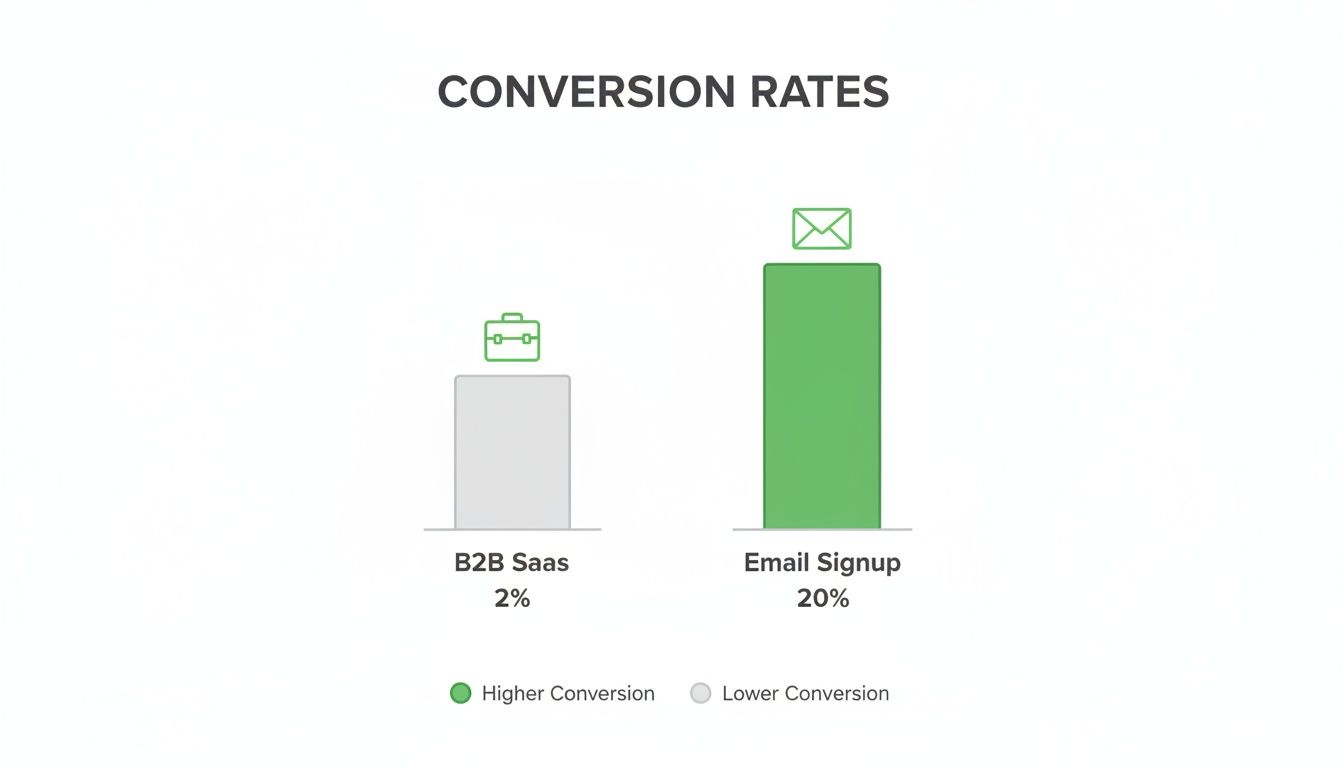
The takeaway? The complexity and commitment of the conversion action drastically change what a "good" rate even means.
Realistic Google Ads benchmarks
Since Google Ads is a primary channel for so many businesses, let's get into some real numbers. But again, you have to look past the top-level averages.
The average search campaign conversion rate is reportedly around 3.75%, but even that is deceptive. E-commerce often sees a benchmark around 2.81%, while a high-stakes field like legal services can hit 7% or more. On the other end of the spectrum, real estate often struggles to get past 2-3%.
To see just how much this varies, check out the data.
Google Ads average conversion rate by industry
This table is a quick reference for realistic Google Ads search conversion rate benchmarks. Use this to find your industry's baseline, not as an absolute target.
| Industry | Average Search Conversion Rate (%) |
|---|---|
| Vehicles | 7.98% |
| Arts & Entertainment | 7.91% |
| Dentists & Dental Services | 7.71% |
| Legal | 7.45% |
| Dining & Nightlife | 6.55% |
| Home Services | 6.37% |
| Finance | 5.10% |
| Education & Instruction | 4.31% |
| Real Estate | 3.51% |
| E-Commerce | 2.81% |
| Apparel / Fashion & Jewelry | 2.77% |
Data sourced from Wordstream's 2023 Google Ads Benchmarks.
These numbers give you a rough starting point. They show what's possible, but your mileage will absolutely vary based on your offer, creative, and landing page experience.
Of course, none of this matters if your data is a mess. Accurate tracking is non-negotiable. If you haven't already, make sure you have a rock-solid process for setting up your Google Ads conversion tracking.
So, what's the bottom line? Use these numbers as a guide, not a gospel. Find your industry, see the average, and then immediately start thinking about all the reasons you can do better. This data is just the starting pistol for a race against yourself.
The hidden factors killing your conversions
If your conversion rate is weak, it’s almost never one single thing. It’s usually a death-by-a-thousand-cuts situation—a combination of hidden friction points you're not seeing that are silently killing your growth. Let’s pull back the curtain on these silent killers.
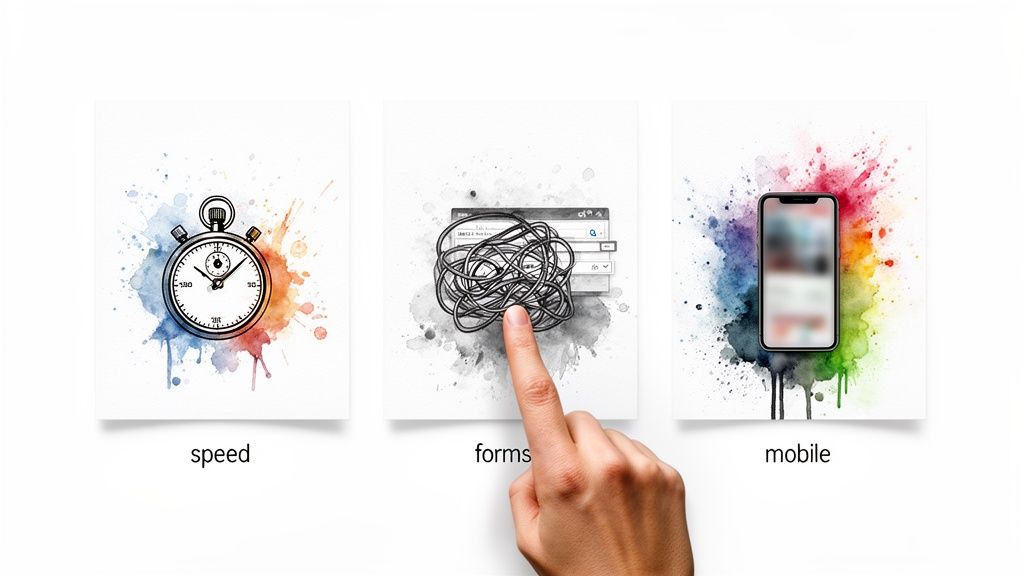
Sure, we can talk about the obvious culprits all day. Everyone knows a slow-loading website is a conversion killer. If your page takes more than a couple of seconds to load, you're hemorrhaging potential customers before they even see your offer. It's 2024, people. Speed isn't a feature; it's the price of entry.
And please, don't get me started on the mobile experience. If your site looks like a jumbled mess on a phone, you've already lost. More than half of all web traffic is mobile, and that number is only going up. A clunky, non-responsive design isn't just annoying; it's a sign that you don't respect your user's time.
Beyond the basics of friction
But those are the low-hanging fruit. The real damage often comes from more subtle issues, the kind of things you get blind to when you look at your own site every day. The biggest one I see is a fundamental misalignment between the ad and the landing page. It’s a classic bait-and-switch, even if it’s unintentional.
Your ad makes a specific promise, the user clicks, and the landing page talks about something completely different. It's like ordering a pizza and getting a salad. The user feels confused, maybe even tricked, and they bounce. Message matching isn’t just a nice-to-have; it's the core of a high-converting funnel.
Another silent killer? A greedy form. You’re excited to get a new lead, so you ask for their name, email, phone number, company name, job title, and their dog's name. 🐶 Stop it. Every additional field you add to a form creates friction and tanks your conversion rate. Ask only for what you absolutely need to take the next step. You can always gather more information later. Your first job is to get your foot in the door, not to conduct a full background check.
Device-specific conversion killers
What works beautifully on a desktop can be a total nightmare on mobile, and the data backs this up. The user's mindset, context, and patience level are completely different depending on the device they're using. Ignoring this is just lazy marketing.
For example, a multi-step form with complex dropdowns might be fine on a desktop with a big screen and a keyboard. But on a mobile device, trying to navigate that with your thumb is a recipe for frustration. You need to simplify, streamline, and design for the thumb.
Device type has a massive impact on Google Ads performance. Research shows mobile devices can generate a median conversion rate of 6.2%. Desktops are slightly lower at a 5.7% median rate, but tablets fall behind at just 4.9%. This isn't random; it's a direct reflection of user behavior and intent across different platforms. To dive deeper, you can discover more insights about these device-specific trends at Focus Digital.
Here’s a quick-hit list of the most common offenders I see in the wild:
- Slow Page Speed: If your site doesn't load in under three seconds, you’re already losing. Users today have zero patience for lag.
- Terrible Mobile Experience: A desktop site shrunk down to a mobile screen is not a mobile experience. It needs to be designed for touch, with large buttons and simple navigation.
- Unclear Value Proposition: If a visitor can't understand what you do and why it matters within five seconds, they're gone. Your headline and sub-headline have to do the heavy lifting.
- Complicated Forms: Are you asking for too much information? Every field you add is another reason for someone to abandon the process. Keep it lean.
- Message Mismatch: The promise in your ad must match the message on your landing page. Any disconnect creates confusion and destroys trust. For more on this, check out our guide on the best practices for landing page optimization.
I've seen seemingly tiny tweaks lead to massive uplifts. We once changed a button color from a muted grey to a vibrant green and saw a 21% lift in conversions. Another time, rewriting a headline to be more direct and benefit-driven doubled the conversion rate overnight. These aren't just vanity changes; they are about removing friction and clarifying value. Your job is to find and eliminate every single one of these hidden obstacles.
How we build high-converting funnels at scale
Alright, enough theory. Let's get into the nuts and bolts of how you actually build something that converts at scale.
This isn’t about some magic button color or a secret copywriting hack. It's about building a system. And the one core principle that drives everything we do is dead simple: perfect message matching.
The journey from the keyword someone types into Google, to the ad they click, to the landing page they visit, and finally to the thank-you page has to feel like a single, seamless conversation. Any break in that chain creates confusion. Confusion creates friction. And friction absolutely murders conversion rates.
It’s the most common and, frankly, the dumbest mistake I see. A company runs an ad promising AI-powered accounting software for freelancers, but the landing page is a generic, one-size-fits-all page about their enterprise accounting platform.
It's a total disconnect. The user instantly feels like they're in the wrong place and bounces. You just paid for a click that had zero chance of ever converting.
The end of the "one-size-fits-all" landing page
This is where we had to get radical. The traditional approach of having a handful of landing pages for dozens or even hundreds of ad groups is fundamentally broken. You can't possibly maintain message match that way. It’s an outdated model from a bygone era of PPC.
Our solution was to use AI to atomize the entire funnel. We don't just swap out a keyword on a page. We generate thousands of hyper-specific landing page variants where the whole story—from headline and sub-headline to body copy, social proof, and the final CTA—is tailored to the user's exact search intent.
Someone searching for a CRM for small real estate teams sees a page that speaks their language. It talks about managing property listings, client follow-ups, and commission tracking.
Someone else searching for a SaaS sales CRM sees a completely different page focused on pipeline management and MRR forecasting.
Same product, but a completely different conversation. That's the power of true message matching. The game is no longer about having the best landing page. It’s about having the best landing page for every single keyword. The only way to do that without an army of marketers is through automation.
Why automation and modularity are your only hope
Trying to do this by hand is a fool's errand. You'll get buried in spreadsheets and busy work, and by the time you launch, your market will have already moved on. You can get a glimpse into how this works from our story about moving from spreadsheet hell to automated PPC funnels.
This isn't about small, incremental improvements. This is a fundamental shift in how you approach paid acquisition. Competing in today's PPC landscape requires speed, precision, and the ability to operate at a scale that manual processes simply can't handle.
You either embrace automation or you get left behind. It's that simple.
Alright, theory is great, but let's get our hands dirty. This is where we stop analyzing and start doing. I'm going to give you a practical, no-fluff playbook to start nudging your conversion rate in the right direction today.
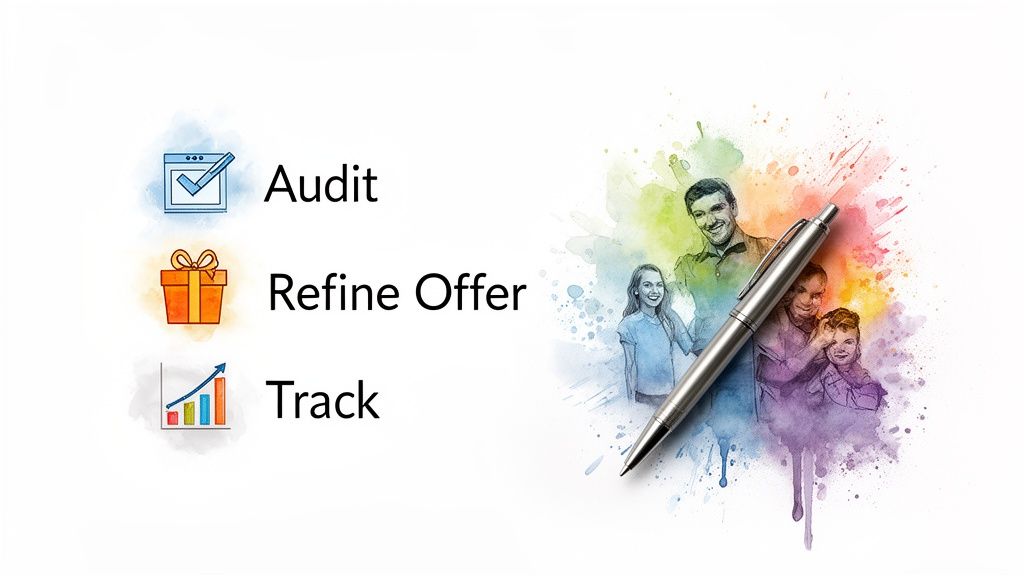
Forget the endless list of growth hacks and tiny tweaks. They're mostly a distraction. Real, lasting improvement comes from mastering the fundamentals. We'll focus on three core pillars: auditing your landing page, refining your offer, and nailing your tracking.
Nail your landing page first
Your landing page is where the magic happens—or doesn't. If it's weak, nothing else matters. Not your clever ad copy, not your massive budget. Before you touch anything else, you need to conduct a ruthless audit of that page.
Be brutally honest. Open your landing page and ask these three simple questions:
- Clarity: Can a first-time visitor understand what you offer and why it matters within five seconds? If your headline is vague or your value prop is buried, you’ve already lost.
- Relevance: Does the page directly deliver on the promise made in the ad that brought them here? A message mismatch is the fastest way to kill trust and send your bounce rate through the roof.
- Trust: Does the page feel credible? Are you using social proof like testimonials, case studies, or logos of well-known customers? People are skeptical online; you have to give them a reason to believe you.
This isn't just about aesthetics. It's about psychology. Every single element on that page should guide the user toward the one action you want them to take. Anything that doesn't is just noise—get rid of it.
Make your offer a no-brainer
Once your page is clean and clear, it’s time to look at the offer itself. A good conversion rate is often just the direct result of an irresistible offer. Your call-to-action (CTA) shouldn't feel like a chore; it should feel like the most obvious, logical next step for your visitor.
Making an offer compelling isn't about deep discounts or gimmicks. It’s about communicating value so effectively that saying "no" feels like a missed opportunity. The best offers aren’t about what you’re selling; they’re about the problem you’re solving. Frame your CTA around the user’s desired outcome, not your product’s features.
You’ll need to test what works for your specific audience. For a more structured approach to experimentation, our guide on multivariate testing mvs A/B testing can help you set things up properly.
If you can't measure it you can't improve it
This last pillar is completely non-negotiable. I talk to so many founders who are flying blind, making huge decisions based on gut feelings because their tracking is a complete mess. Don't do this. If you aren't measuring conversions accurately, you can't possibly improve them.
Setting up basic conversion tracking in Google Ads is table stakes. But the real game-changer is sending conversion values back to Google. This is what separates optimizing for leads from optimizing for revenue.
Here’s why it matters: not all leads are created equal. A lead from a small business might be worth €1,000, while an enterprise client could be worth €50,000. If you treat them all the same, Google’s algorithm will just get you more of the cheap, easy-to-win leads, not the ones that actually grow your business.
By sending back revenue data, you’re literally teaching the algorithm what a good customer looks like. This lets you use smart bidding strategies that optimize for ROAS (Return On Ad Spend), not just a meaningless CPL (Cost Per Lead). This is how you scale intelligently. For some different perspectives on this, you can explore more actionable advice on their blog.
It's time to stop guessing and start winning
If there’s only one thing you take away from this entire guide, let it be this: chasing some arbitrary “good” conversion rate you saw in a report is the wrong game. It’s a distraction. It keeps you focused on vanity metrics instead of what actually drives growth—building a system for continuous improvement.
The real goal isn’t to hit a static number you read in a blog post. It's to consistently beat your own baseline, week after week. This isn’t a small tweak; it’s a fundamental mindset shift away from manual guesswork and spreadsheets and toward data-driven, automated optimization.
The new playbook for growth
The future of performance marketing is already here, and it's not about who has the biggest budget. Lean, ambitious teams are now getting results that used to be possible only for massive corporations. How? They’re using technology to out-think and out-iterate the competition, not just out-spend them.
This is where AI platforms come into the picture, letting smaller teams punch way above their weight. They can now execute at scale, test relentlessly, and optimize intelligently using real performance data to continuously refine every single part of the funnel.
This isn't some far-off vision; it’s happening right now. The barrier to entry for world-class marketing is collapsing, and the advantage is shifting to teams that are fast, agile, and smart. Your conversion rate is the ultimate measure of how well you understand your customer. Improve that, and you're not just improving a metric—you're building a better, more resilient business.
So, stop guessing. Stop chasing irrelevant benchmarks.
Start building a system that learns, adapts, and wins. The tools are here. The opportunity is massive. The only question is whether you're ready to seize it.
Go build something great. 🚀
A few lingering questions
Still wrestling with the idea of a "good" conversion rate? I get it. Here are the most common questions I hear from founders and marketers trying to make sense of their numbers.
"How long do I need to wait before I know my conversion rate?"
This is a big one. It's so tempting to check your stats after a day, see a 1% conversion rate, and panic. Don't. You're just guessing at that point.
You need enough data for the numbers to mean something—what statisticians call statistically significant data. In the real world, that means running a campaign long enough to smooth out the random bumps and dips. A good rule of thumb is to wait until you have at least 200 clicks on an ad or landing page and 5–10 conversions before you start drawing firm conclusions. If your traffic is low, you'll need to run your test for longer, maybe 1-2 weeks, to hit those numbers.
Making huge decisions based on 1 conversion from 100 clicks is a classic way to over-optimize and chase ghosts. Give it time to breathe.
"My click-through rate is low. Is that why my conversion rate sucks?"
Not always, but they're often symptoms of the same problem: a disconnect in your messaging. Think of it as a broken conversation.
If your ad promises one thing but your landing page talks about something else, people get confused. The wrong audience clicks through, finds a page that doesn't solve their problem, and bounces. This kills both your click-through rate (CTR) and your conversion rate. When your ad copy, your visuals, and your landing page headline all tell the same story, the right people click, and they're far more likely to convert when they arrive. If both metrics are low, your core message is probably off.
"Can I get a 100% conversion rate?"
In a perfect world, sure. In reality? It's a fantasy.
Even with the most perfectly targeted campaign imaginable, you'll always have people who click by accident, are just browsing, or get distracted. A 100% conversion rate is a unicorn.
The real goal isn't perfection; it's progress. Doubling your conversion rate from 2% to 4% is a massive win—that’s a 100% increase in your leads or sales. That's the kind of gain that changes a business.
So instead of chasing an impossible number, focus on a repeatable process for improvement. Audit your clarity, refine your offer, optimize your tracking, test your messaging, and review your channels. Then you do it all over again. Stay curious. Keep testing. The wins will compound.
Ready to turn that data into real growth? dynares can automate the message matching and A/B testing that drives these improvements, so you can stop guessing and start seeing real, measurable lifts in your conversion rate.


