
Let's be blunt: most guides on how to perform keyword research are packed with theoretical fluff. It's a waste of time for entrepreneurs and builders who need revenue, not just a bump in traffic. This guide is different. It’s a direct, practical workflow for finding Google Ads keywords that actually make you money.
Stop chasing vanity metrics and start driving revenue

I’m sharing the exact, battle-tested process I use to find keywords that convert and grow my own businesses. No sugarcoating, just a direct playbook for founders who need to move fast and make every euro count. We’re going to skip the obvious stuff and get straight to what matters.
First, let's get real about what success looks like. Spoiler: it’s not clicks or impressions. Those are vanity metrics that look great on a chart but don’t pay the bills. Real success is measured in revenue, customer acquisition cost (CAC), and return on ad spend (ROAS).
The goal isn't just to find keywords; it's to understand market intent and build a strategy that becomes the foundation for profitable, scalable ad campaigns. This is about building a machine that generates revenue, not just reports.
To do that, you have to think beyond traffic and focus on the money. Your entire keyword process should be laser-focused on finding people who are ready to pull out their wallets. It all starts with defining your goals and knowing what a valuable lead or sale—a conversion—truly is for your business. You can learn more about what is a conversion in marketing in our detailed article.
This means digging into the data to understand what your customers are really looking for, not what you assume they are. We’re going to focus on three critical pillars:
- Defining clear goals: Moving beyond 'more traffic' to specific outcomes like demo requests, qualified leads, or actual sales.
- Mastering user intent: Spotting the difference between someone just browsing and someone ready to buy your product now.
- Building a scalable structure: Creating campaigns that are easy to manage, optimize, and grow without burning through your budget.
This isn’t about finding a magic list of keywords. It’s about building a system that consistently uncovers opportunities, attracts the right customers, and directly grows your bottom line. Let’s get to work. 🚀
Set clear goals and master user intent
Before you touch a keyword tool, let's get one thing straight. If your goal is 'more traffic', you've already lost. That's a classic vanity metric—it looks nice in a report but doesn't pay the bills. As operators, we don't have time for fluff. We need revenue.

The very first step in any keyword research that's worth doing is to define a real business objective. Be painfully specific. 'High-quality leads for our sales team' is getting warmer. 'Demo requests from companies with over 50 employees'—now we're talking. This clarity will drive your entire strategy, from the keywords you chase to the ad copy you write.
The blunt truth is that without a specific, measurable goal, your keyword research is just an academic exercise. Tie every keyword back to a tangible business outcome, or don't bother.
This focus forces you to think like an investor, not just a marketer. Every keyword is a small investment. Your job is to find the ones with the highest potential return on ad spend (ROAS).
Decoding user intent
Once your goal is locked in, the next battle is understanding user intent. This is where most people stumble. They spot a high search volume and get excited, completely ignoring what the user actually wants. You have to get inside their head and figure out the 'why' behind the search.
For a tech business focused on lead gen, intent is everything. It's the difference between a click that costs you money and a click that makes you money. To bring this to life, here’s a quick breakdown of how user intent aligns with actual business goals.
| User Intent | Example Keyword | Primary Business Goal | Likely Campaign Type |
|---|---|---|---|
| Informational | 'what is CRM software' | Brand Awareness, Top of Funnel | Content Promotion, Display |
| Commercial | 'best CRM for small business' | Lead Generation, Mid-Funnel | Search, Performance Max |
| Transactional | 'hubspot pricing' | High-Quality Leads, Sales | Search (High-Intent), Brand |
| Navigational | 'hubspot login' | Customer Support, Retention | Brand (Exclusion/Low Bid) |
As you can see, not all keywords are created equal. Focusing on the right intent is fundamental to building a campaign that doesn't just generate clicks, but actually drives pipeline.
From intent to keywords
For high-value leads, you need to live in the commercial and transactional spaces. These are the people whose problems you can solve right now.
- Commercial Intent: These users are in research mode. They're comparing solutions and figuring out their options. Think ‘best CRM for small business’ or ‘dynares vs competitor’. They have a problem and are actively looking for a fix.
- Transactional Intent: This is the gold. These users are ready to act. Searches like ‘dynares pricing’ or ‘AI ad generator demo’ show they are at the bottom of the funnel, practically wallet-in-hand.
Mapping these intents to your customer's journey is the real work. Think about the path someone takes from realizing they have a problem to signing up for your product. What questions do they ask? What solutions do they compare? For a deeper dive on this, check out our guide on what is search intent in SEO and how to apply it to PPC.
Your job is to find the exact phrases that signal they're ready for a conversation. This goes beyond simple keyword matching. Truly elite PPC requires a deeper grasp of how concepts relate, a field often covered in guides to Mastering Natural Language Processing for Search.
This approach helps you connect with users on a level that basic keyword stuffing can't touch. It’s about understanding the context, not just the words. This shift in thinking is fundamental to building campaigns that drive revenue, not just traffic. It’s what we’ll focus on next.
Alright, let's get our hands dirty with the data. This is where we move from high-level strategy to building the actual keyword lists that will fuel your campaigns.
Forget juggling a dozen different tools and getting lost in spreadsheets. As founders and builders, our time is our most valuable asset. You only need one or two solid platforms to get this right.
The industry standards are Semrush and Ahrefs for a reason—they have massive keyword databases and the features to make sense of them. I lean towards Semrush myself, but both are excellent. The key is to learn one of them deeply and use it to find actionable intelligence, not just spit out endless, useless keyword lists.
Go beyond vanity metrics
The first mistake I see people make is obsessing over search volume. A keyword with 10,000 monthly searches looks great on paper, but it's often a vanity metric.
High volume usually means broad intent. That attracts tire-kickers, not buyers.
Instead, you need to look at a combination of signals to find the real opportunities. These are the metrics that tell you whether a keyword is actually worth your time and money.
Here's what I actually pay attention to:
- Cost-Per-Click (CPC): This shows how much advertisers are willing to pay for a click. A high CPC is often a massive buy signal—it tells you other businesses are successfully making money from that keyword. Don’t be scared of a €15 CPC; embrace it as a sign of high commercial intent.
- Keyword Difficulty (KD): This score estimates how hard it is to rank organically for a keyword. For PPC, it’s a useful proxy for competition. Lower KD scores can reveal gaps in the market where you can win clicks more cheaply.
- SERP Features: I can’t stress this enough: look at the search engine results page. Are the top results ads? Are there featured snippets? Is it all informational blog posts? The SERP tells you exactly what Google thinks users want, which is far more valuable than any single metric.
This combination of metrics gives you a much richer picture. It helps you find that sweet spot: keywords with clear commercial intent, manageable competition, and a direct path to the customers you actually want. This is a core part of building a solid foundation, and we cover it more in our guide on selecting the right keywords for PPC.
Find the gold in the long-tail
The real money in Google Ads isn’t in the big, obvious head terms. It’s in the long-tail keywords—those longer, more specific phrases that signal a user is deep in the buying cycle. This is where you find the gold.
Your process should start with broad 'seed' keywords related to your product. For a product like dynares, a seed keyword might be 'Google Ads automation'. On its own, that's too broad. The magic happens when you add modifiers that signal specific intent.
Think about combining your seed keywords with different types of modifiers:
- Transactional Modifiers: These are words like 'pricing', 'demo', 'trial', 'buy', or 'quote'. Someone searching 'AI ad copy generator pricing' is not just browsing; they are getting ready to make a decision.
- Commercial Modifiers: These include 'best', 'top', 'alternative', 'review', or 'comparison'. A search for 'HubSpot alternative for startups' is from someone actively evaluating solutions and looking for a better fit.
- Audience Modifiers: Terms like 'for small business', 'for agencies', or 'for SaaS' help you target your exact ideal customer profile. These are incredibly powerful for filtering out irrelevant traffic.
The goal is to build a master list that combines these elements. A keyword like 'automated ad creation tool for small business' is a hundred times more valuable than just 'ad tool'. It's specific, shows clear intent, and targets the right audience.
As you build out your keyword arsenal, it's important to understand keyword management. This includes knowing the risks of having too many keywords in your PPC campaign and how to structure them effectively. An oversized, disorganized keyword list is a recipe for burning cash.
By the way, the sheer scale of these tools is a critical factor, especially if you have global ambitions. For instance, SEMrush's Keyword Magic Tool gives you access to over 25 billion keywords across 142 geographic databases. That’s crucial when you consider Google holds over 90% of the global search market share, giving you incredible reach for international campaigns.
By focusing on these metrics and strategic keyword combinations, you move from guessing to making data-driven decisions. You stop chasing traffic and start building a predictable engine for acquiring high-value customers. It's a more disciplined approach, but it's the only one that reliably drives revenue. 📈
Structure your campaigns for precision and scale
A giant list of keywords is useless without structure. This is where most campaigns fail and burn cash. It’s like having a warehouse full of great inventory but no shelves or aisles—just a chaotic pile on the floor. You'll never find what you need, and your customers will leave frustrated.
We're going to use a strategy called semantic grouping, or topic clustering. Let's be direct: throwing 50 random keywords into one ad group is a lazy approach that guarantees you’ll overpay for clicks and get terrible results. Instead, you're going to create tightly-themed ad groups where every single keyword is closely related.
For example, all of these keywords should live together in a single, focused ad group: 'AI ad copy generator', 'automated ad creation tool', 'PPC ad writer AI', and 'generative AI for Google Ads'.
This diagram breaks down the hierarchy of metrics you should be considering, moving from broad indicators like volume to the most critical factor: user intent.
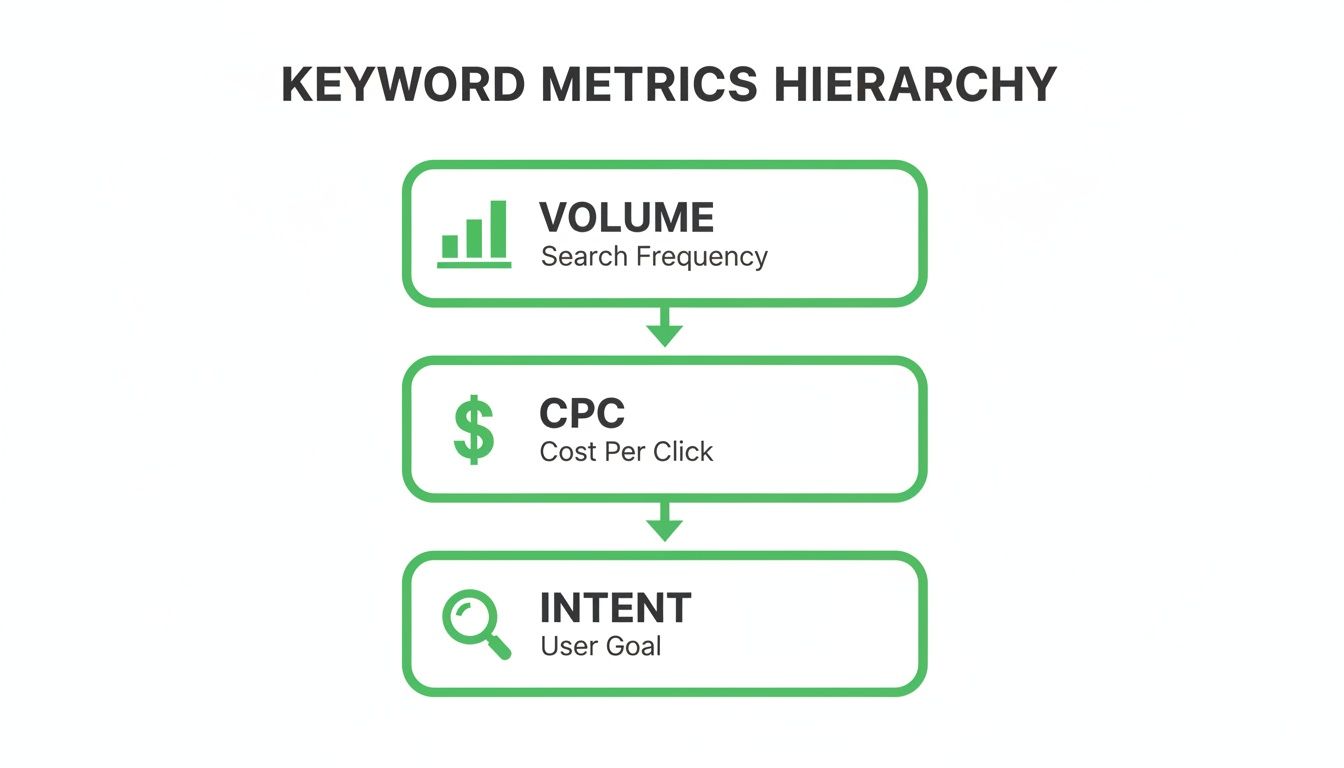
While volume and CPC give you context, intent is what ties your keywords directly to revenue.
Why this obsessive grouping matters
So why does this obsessive organization matter? Because it lets you write hyper-relevant ad copy that speaks directly to the search query. When someone searches for an 'AI ad copy generator', they see an ad that says 'Tired of Writing Ad Copy? Use Our AI Generator'. The message match is perfect.
This approach dramatically improves your Quality Score, which is Google's rating of your keyword, ad, and landing page relevance. A high Quality Score is your secret weapon. It directly lowers your cost-per-click (CPC) and boosts your ad position. You pay less to get more prominent placements. It’s one of the few real 'hacks' in Google Ads.
Think of it this way: a high Quality Score is Google rewarding you for creating a good user experience. You’re not just trying to sell something; you’re precisely answering a user's question. That’s the entire business model of search, and when you align with it, you win.
This tight structure also makes your campaigns infinitely easier to manage. You can quickly see which themes are performing and double down, and which ones are duds you can cut without a second thought.
A smart match type strategy
Alongside semantic grouping, you need a disciplined approach to keyword match types. Each match type has a specific job. Using them incorrectly is like trying to drive a screw with a hammer—messy, ineffective, and frankly, a bit amateur.
Here’s a practical, no-nonsense breakdown for a lead-gen campaign:
- Exact Match
[keyword]: This is your primary workhorse. You use it for your highest-intent, most specific keywords where you know exactly what the user is after. Think[ai ad copy generator pricing]or[dynares demo]. This match type offers the most control and usually delivers the highest conversion rates. Start here. - Phrase Match
"keyword": This is for capturing slight variations of your core terms. If your keyword is"AI ad creator", your ad could show for 'best AI ad creator for startups' or 'how to use an AI ad creator'. It balances reach with relevance and is fantastic for the mid-funnel. It’s your second most important tool. - Broad Match
keyword: Use this with extreme caution. ⚠️ I’m serious. Broad match can be a powerful discovery tool, but without a massive negative keyword list and smart bidding, it will burn your budget faster than you can say 'ROAS'. I only ever use it in carefully controlled, low-budget campaigns specifically for research, never in my core conversion campaigns.
Getting this structure right from the start is the difference between a chaotic, money-burning account and a streamlined, profitable machine. This isn't just a 'best practice'; it's the only way to build a Google Ads engine that can actually grow a business. Take the time to build this framework now. Your future self will thank you.
Automate the execution and win on speed
You’ve done the hard work. You have your keyword clusters, you know the intent, and you see the opportunity. Now comes the part that kills most great PPC strategies: the execution.
Manually building unique ads and landing pages for every single keyword group is a soul-crushing bottleneck. It’s slow, it’s expensive, and it’s a terrible use of your team’s brainpower. You should be focused on strategy, not copy-pasting your way through a spreadsheet.
This is exactly why we built dynares. It came from the sheer frustration of seeing great strategies die in a dev queue. We saw that the most brutal part of the job—creating hyper-relevant ads and pages at scale—was a perfect fit for automation. It’s about working smarter, not just harder.
From manual bottleneck to automated funnel
Tools like ours are completely changing how fast you can move. You feed the system your carefully organized keyword lists, and it programmatically builds out the corresponding ads and landing pages by the thousands. This isn't just about going faster; it’s about achieving a level of precision that's impossible to do by hand.
And this isn’t just slapping a new H1 on a generic template. The system can pull in public data to get the customer's voice right, inject the right keywords in the right places, and guarantee a perfect message match from the ad to the page. That tight alignment is what Google rewards with a better Quality Score, which directly feeds into a healthier ROAS.
Imagine launching a campaign with 50 unique, tightly-themed ad groups—each with its own tailored landing page—in the time it used to take you to build one. That’s not a sales pitch. That's how you dominate a market: by being faster and more relevant than everyone else.
This kind of automation frees your team up to do what they’re actually good at: high-level strategy, creative thinking, and digging into performance data. You can explore our guide on other Google Ads automation tools to see how this fits into a bigger efficiency-first tech stack.
Responding to the market in hours, not weeks
Being able to move fast isn’t just a nice-to-have. It’s a massive competitive advantage, especially when the market decides to change overnight. You need the infrastructure to pivot instantly. Automation is what gives you that power.
Think about how quickly things can change. In early 2020, the keyword 'COVID 19' saw a mind-boggling 3,650% month-on-month growth in March. This shows just how fast huge, timely opportunities can surface from keyword trends. For a team using a platform like dynares, that’s not a crisis—it’s an opportunity to spin up new campaigns overnight, capturing fresh intent while your competitors are still stuck in planning meetings. You can read more about these kinds of trends in this detailed statistical analysis.
This agility lets you capitalize on:
- Sudden trends: Quickly launch campaigns around a new feature, a news event, or a cultural moment that’s relevant to your audience.
- Competitor moves: Instantly react to a competitor’s new product or price drop with targeted counter-messaging.
- Market opportunities: Scale up campaigns to capture a surge in demand without getting stuck behind a manual production bottleneck.
At the end of the day, doing killer keyword research is only half the battle. The other half is having the operational horsepower to actually act on what you find. When you automate the repetitive, high-volume work of creating ads and landing pages, you build a marketing engine that isn't just efficient—it's fast, responsive, and built to scale. That's how you win. 🚀
Master the feedback loop of tracking and iteration
Let's be real: launching a campaign isn't the finish line. It’s the starting gun. All the research you’ve done up to this point is just a well-educated guess. Now it's time to see how that hypothesis holds up against reality.
The most valuable data you'll ever find isn't in a third-party tool—it's waiting for you inside your own Google Ads account.
Your search term report is pure gold. This isn't what you think people are searching for; it's what they are actually typing to trigger your ads. It's the most honest feedback you'll ever get from the market, and ignoring it is just lighting money on fire.
This is what separates the pros from the amateurs who 'set and forget' their campaigns.
Mine for gold and get rid of the junk
Think of your search term report as a treasure map that's also littered with budget-draining junk. You need a simple, repeatable process to mine it every single week. This isn't a task to delegate; it's one of the highest-leverage activities you can do to improve ROAS.
You’re really looking for two things:
- New Keyword Opportunities: You'll uncover surprising long-tail keywords with high commercial intent that you never would have found in a tool. These are gems. Add them as exact match keywords to a relevant ad group and bid on them directly.
- Budget-Burning Negatives: You will see all sorts of irrelevant garbage. For a SaaS product, this could be terms like ‘jobs’, ‘free’, ‘reviews’, ‘tutorial’, or ‘salary’. These clicks are worthless and absolutely destroy your profitability.
The discipline of weekly search term review is non-negotiable. Building a robust negative keyword list is the single fastest way to cut waste and immediately improve campaign performance. It's not glamorous, but it’s incredibly effective.
Turn reaction into a proactive strategy
Most people treat negative keywords as a reactive chore they get to when the budget is already wasted. That’s a mistake.
A much smarter way is to build proactive, shared negative keyword lists that you can apply across multiple campaigns. This creates a protective shield for your entire account before you ever spend a dime on a bad click.
Think systematically about the types of searches you never want to appear for:
- Job Seekers: Add terms like
jobs,hiring,careers,salary,internship. - Information Hoarders: Exclude
template,free guide,pdf,statistics,what is. - Bargain Hunters: Unless you offer it, block
free,cheap,discount,coupon.
This isn't a one-and-done task. It's a continuous feedback loop.
You test your keywords, analyze the real-world search data, refine your keyword lists (both positive and negative), and then test again. This disciplined process of tracking and iteration is how you build a resilient, profitable advertising machine. 📈
A few questions I hear all the time
I get it. When you're digging into keyword research, a lot of questions come up. Here are some of the most common ones I hear from other founders and marketers, with the straight-up answers you actually need.
How long should I spend on keyword research before I launch?
Don't get stuck in analysis paralysis. Seriously.
For a new campaign, a solid 1-2 days of focused work on intent, grouping, and building an initial negative keyword list is plenty. The most valuable data—the stuff that actually makes you money—will come after you launch and see what real people are searching for.
Your initial research is just a starting point, not a final masterpiece. Perfectionism is the enemy of progress here. Launch, learn, and iterate.
The real game begins when you have actual search term data from users interacting with your ads.
Should I actually bid on competitor brand keywords?
Yes, but you have to be smart about it. It’s an aggressive tactic, but bidding on competitor names is a fantastic way to get in front of high-intent users who are literally in the middle of comparison shopping.
Just be prepared for a lower Quality Score and higher CPCs, since you aren't the brand they searched for.
The key is to send this traffic to a dedicated comparison page that hammers home your advantages. Don't just dump them on your homepage; that's lazy and it doesn't work. Show them exactly why you’re the better choice.
What’s a 'good' search volume to target?
There’s no magic number. A B2B SaaS keyword with 50 searches a month could be worth a fortune, while a B2C keyword with 50,000 searches might be nothing but worthless junk traffic.
- Focus on the intent and relevance, not the raw volume.
- A small group of highly specific, long-tail keywords with transactional intent will almost always beat a single high-volume, generic term.
- Ask yourself: would I rather have 100 demo requests or 10,000 blog readers from my ad spend? Your answer tells you which keywords to target.
Ready to stop guessing and start building campaigns that actually drive revenue? With dynares, you can automate the creation of thousands of high-intent ads and landing pages, turning your keyword strategy into a scalable growth engine. See how it works at dynares.ai.


