
Let’s cut through the jargon. A conversion isn't some abstract marketing term; it's the moment a person browsing your site actually does the thing you want them to do.
It’s the click that matters. The form submission that turns a stranger into a lead. The purchase that makes your entire funnel worthwhile. A conversion is the digital handshake between your marketing spend and a real business result. Everything else is just noise.
What is a marketing conversion, really?
Honestly, most marketing metrics are for vanity. Clicks, impressions, even traffic—they don't pay the bills. A conversion is the only thing that moves the needle from interest to action.
It’s the specific outcome you’re aiming for with any campaign, whether that’s getting someone to download an ebook or buy your flagship product.
This whole idea is the bedrock of performance marketing. If you don't have a crystal-clear definition of what you want users to do, you’re just throwing money at the wall hoping something sticks. That's not a strategy; it's a gamble. And as founders, we don't get the luxury of gambling.
The only two types of conversions that matter
To keep things practical, I only think about conversions in two buckets: macro and micro. Anything else is just overcomplicating it.
Obsessing only over the big wins is a huge mistake. Why? Because almost nobody buys on their first visit. Micro conversions are the breadcrumbs that show you you’re on the right path. They signal intent and help you build a relationship before you ask for the sale. Tracking both gives you the full story of your funnel's health.
Here’s a quick breakdown of the big goals versus the small steps.
| Conversion Type | What It Is | Examples | Why It Matters for Founders |
|---|---|---|---|
| Macro | The main event. The primary action that directly drives revenue or qualified leads. | • Making a purchase • Requesting a demo • Starting a free trial |
These are your bottom-line results. They directly measure the financial success of your campaigns and validate your entire marketing effort. |
| Micro | The small steps. Actions that signal interest and move a user closer to a macro conversion. | • Signing up for a newsletter • Downloading a PDF guide • Watching a product video |
These are early indicators of engagement. They show you which channels are bringing in interested prospects and help you nurture them toward the big goal. |
Ultimately, a healthy funnel has a steady stream of both. Micro conversions fill the top of your funnel with engaged prospects, while macro conversions turn that engagement into revenue.
Why this isn't just semantics
Defining these actions properly is fundamental to scaling your business. It’s how you measure the real effectiveness of your ads, landing pages, and messaging. A low conversion rate is a blaring alarm that something is broken—your targeting is off, your offer is weak, or your user experience has too much friction.
Getting this right also fuels your entire marketing machine. For instance, a form submission isn't just a row in a spreadsheet; it's the very first step in a successful lead generation marketing strategy. Each conversion, big or small, provides the feedback you need to make your campaigns smarter and more profitable over time.
Recent data shows just how critical this focus is. A striking report from WordStream revealed that the average Google Ads conversion rate now stands at 7.04%, a concerning 10% drop from the previous year. This tells me two things: competition is heating up, and users are getting more selective. Every single conversion you earn is now more valuable than ever. It’s a tough environment out there, but it's where the best operators always find a way to thrive.
The simple math that drives your business growth
Let's get practical. Forget impressions, clicks, and all the other vanity metrics that make you feel busy but don't actually move the needle. The single most important health metric for your marketing is your conversion rate.
It’s the number that tells you, in brutally honest terms, how good you are at convincing people to actually do something. It's the ultimate truth serum for your funnel.
The formula is dead simple: (Number of Conversions / Total Visitors or Clicks) x 100. But the real insight isn't in that top-line number; it's buried in the details. The magic happens when you start slicing up the data to see what’s really going on under the hood.
Digging deeper than the basic formula
A blended, account-wide conversion rate is almost useless. It hides the winners and the losers in your strategy. To find anything you can actually act on, you have to segment your data. It’s the difference between flying blind and having a clear dashboard telling you exactly which levers to pull.
Here are a few ways I always segment conversion data to get a real picture of performance:
- By device: How does your conversion rate look on mobile versus desktop? If your mobile rate is garbage, your site probably isn’t optimized, and you’re just burning cash on that traffic.
- By traffic source: Are visitors from Google Ads converting better than those from LinkedIn? This tells you exactly where to double down on your budget and effort.
- By visitor type: How do new visitors convert compared to returning ones? A huge gap might mean your initial offer is compelling, but your product or follow-up is weak.
This is where you find the insights that lead to real growth. It stops you from making broad, dumb assumptions and forces you to address specific weaknesses in your funnel.
Introducing conversion value: The metric that matters most
Okay, tracking your conversion rate is essential. But here’s a pro tip that changes the game entirely: stop treating all conversions as equal. A newsletter signup is not the same as a demo request from a qualified enterprise lead. This is where Conversion Value comes in.
Conversion Value is just about assigning a real monetary value to each action. A demo request isn't just one lead; it might be worth €500 in potential revenue based on your historical close rates.
By tracking value, you start teaching your ad platforms—especially Google—what kind of customer is actually valuable to your business. The algorithm then starts optimizing for high-value leads, not just any lead. This is how you shift your focus from Cost Per Lead (CPL) to Return On Ad Spend (ROAS), which is the only metric the C-suite really cares about.
Putting it all together for a clearer picture
So, what is conversion in marketing? It boils down to measuring the actions that fuel your revenue. For a lot of small businesses and agencies, that might be as simple as tracking a lead form submission from a Google Ad.
The data here is incredibly telling. For instance, industry stats show the average landing page conversion rate sits around 10.76%, while a good email opt-in form typically converts between 5-15%. But so often, design gets in the way; 29.5% of pages are overloaded with text, which drags those rates down. If you want to dive deeper into these benchmarks, you can explore the full digital marketing statistics from Landingi.
This isn't just about hitting a number. It’s about understanding the entire path from click to cash. By combining a segmented conversion rate with a clear conversion value, you finally get a true, unfiltered view of your marketing performance. It's the simple, powerful math that separates the founders who guess from the ones who build scalable growth machines.
How to actually track conversions without losing your mind
If you don't track it, it didn't happen.
That’s the brutal reality of performance marketing. Getting your tracking setup right is completely non-negotiable, but it’s the exact spot where most founders and marketers trip up, get frustrated, and start making bad decisions based on bad data.
Let’s clear this up in plain English. This isn't about becoming a developer overnight. It's about understanding the core concepts so you can have an intelligent conversation with your team or agency. Mess this up, and everything else you do is basically guesswork.
Client-side vs. server-side tracking
Most people start with client-side tracking. This is the classic setup: you grab a snippet of code, like the Google Ads tag, and slap it onto your website. When a user lands on your thank-you page after filling out a form, their browser (the client) fires that tag, and a conversion is recorded.
It’s simple, quick, and the standard way to get started. The problem? It’s also fragile.
Ad blockers, browser privacy updates like iOS 14, and other restrictions can easily block these tags from firing. That means you’re missing conversions, your data is incomplete, and your ad platform’s algorithm is getting dumber by the day because it's not seeing the full picture.
This is where server-side tracking comes in. Instead of relying on the user’s browser, the conversion event is sent from your website’s server directly to the ad platform’s server. It’s more robust, more accurate, and largely bypasses the issues with ad blockers and browser restrictions. It's a bit more work to set up, but it’s the professional-grade solution for anyone serious about accurate measurement.
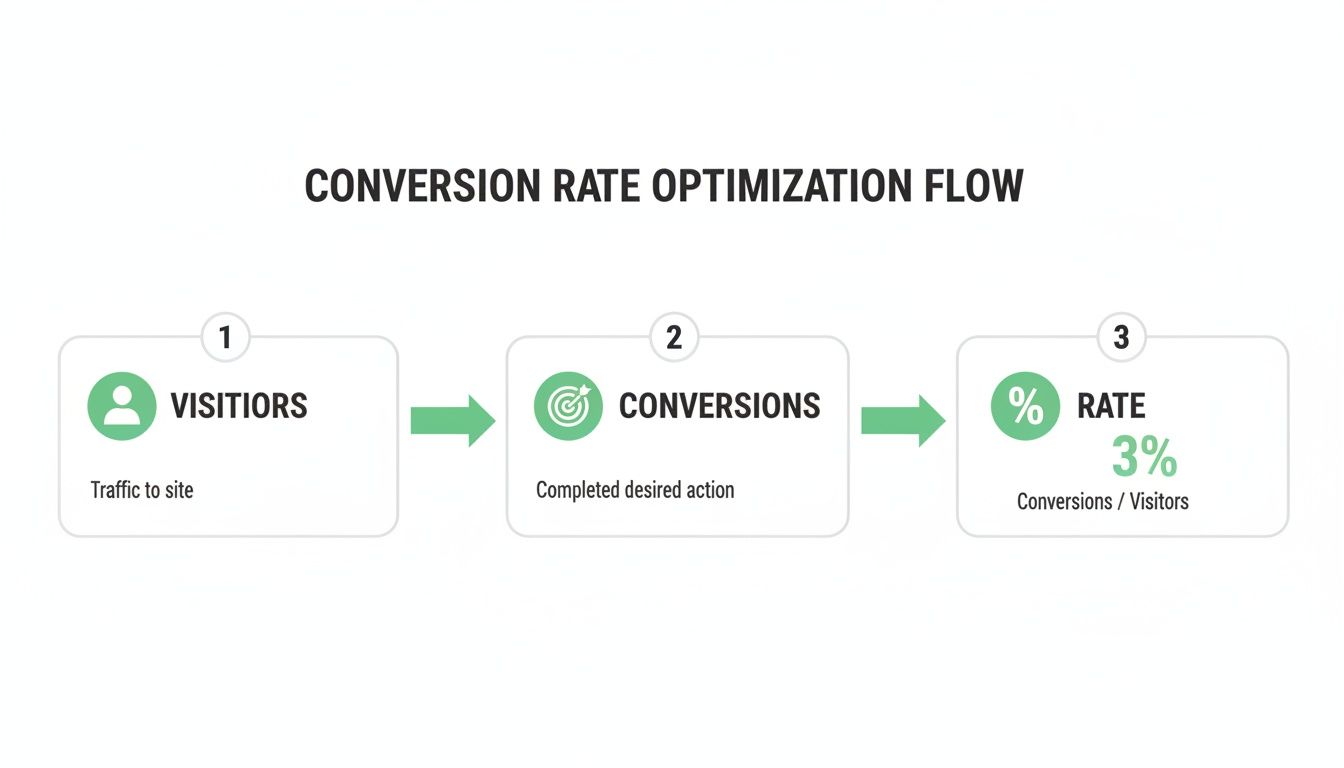
The ideal flow is simple: visitors become conversions at a measurable rate. Your tracking setup is what makes this visible and allows you to improve it.
Why last-click attribution is killing your growth
Now, let's talk about attribution models. This is just a fancy way of saying, 'Who gets the credit for the conversion?' The default model in most ad platforms is last-click attribution, and frankly, it’s dumb. It gives 100% of the credit to the very last touchpoint a user had before converting.
Think about it. A customer might see your ad on LinkedIn, read a blog post a week later from an organic search, and finally, click a branded search ad and convert. With last-click, that branded search ad gets all the glory. The LinkedIn ad and the blog post that did the heavy lifting get nothing. You look at your data, conclude that LinkedIn and SEO are useless, and cut their budgets. Big mistake.
Models like data-driven attribution (DDA) are the solution. DDA uses machine learning to analyze the entire customer journey and assign partial credit to each touchpoint along the way. It gives you a much more accurate picture of what’s actually working, so you can invest your budget intelligently across the whole funnel. To ensure you’re accurately attributing and optimizing your marketing spend, it's also crucial to understand effective affiliate conversion tracking techniques, since they often involve multiple touchpoints.
Don't forget your offline conversions
Here’s what separates the amateurs from the pros. What happens when a lead comes from a Google Ad, but closes a week later on a phone call with your sales team? If you don't tell Google about that, the algorithm never learns.
Importing offline conversions is the process of feeding that sales data back into your ad platforms. You connect your CRM to Google Ads and say, 'Hey, that click from last week? It just turned into a €10,000 deal.'
This is mission-critical. It teaches the algorithm to find more people like your best customers, not just people who fill out forms. For a detailed walkthrough, check out our guide on the Google Ads conversion tracking setup. This single step can dramatically improve the quality of your leads and your overall return on investment.
Practical CRO tactics that actually move the needle

Conversion rate optimization (CRO) is an industry drowning in fluff. You’ll find endless debates about changing button colors from red to green. Let’s be real—most of that is a distraction.
We’re going to talk about the tactics that actually work. These are the levers that, when pulled correctly, can fundamentally change the economics of your paid campaigns. This isn’t about guessing; it’s about a systematic, hypothesis-driven approach to getting better results.
Nail the message:Match or burn your money
This is the number one lever, and it's not even close. Message Match is the dead-simple idea that your landing page must deliver on the promise your ad just made. If your ad screams 50% Off High-Speed Web Hosting, your landing page headline had better say something almost identical.
When there’s a disconnect, people get confused, lose trust, and hit the back button. It’s a jarring experience that tells them they’re in the wrong place. If your message match is broken, you are literally lighting your ad budget on fire.
A marketing conversion always starts with a promise. Fulfilling it instantly is the first and most critical step. You can dig into some great examples in our guide on landing page optimization best practices.
Simplify everything for a single goal
Your landing page should have one job. That’s it. It’s not a brochure for your whole company; it's a focused tool designed to get one specific action.
Cut everything that doesn't contribute to that goal. That means ditching the site navigation, having one primary Call to Action (CTA), and killing the clutter. Don't ask them to Request a Demo and Download Our Ebook. Pick one. The goal is to reduce cognitive load and make the action you want the most obvious next step. A confused mind never buys.
Reduce friction in your forms and CTAs
Every field you add to a form is another reason for someone to give up. Be ruthless here. Do you really need their fax number in 2024? Probably not. Start with the absolute minimum you need to qualify a lead—usually just a name and an email. You can always gather more data later in the sales process. The first conversion is just about getting your foot in the door.
Your Call to Action (CTA) copy also matters more than you think. 'Submit' is lazy and uninspiring. Your CTA should reinforce the value the user is about to get. Instead of 'Submit', try 'Get Your Free Quote' or 'Start My Free Trial'. The button copy should complete the sentence, 'I want to...' This small shift in framing can have a massive impact on your conversion rate. The same psychological principles of clarity and benefit that create high-converting email subject lines apply directly to your CTAs.
Stop arguing and start A/B testing
This is how you end those conference room debates about what works. A/B testing is the scientific way to let data—not the highest-paid person's opinion—make the decisions.
The process is simple: you create two versions of a page (A and B) with one key difference. Maybe you test a new headline, a different offer, or a shorter form. Then you split your traffic evenly between them and see which one converts better.
A few ground rules for testing that actually works:
- Test one thing at a time: If you change the headline, CTA, and images all at once, you'll have no idea what actually caused the change in performance.
- Have a clear hypothesis: Start with an educated guess. For example, 'I believe changing the headline to focus on cost savings will increase conversions because our audience is price-sensitive.'
- Wait for statistical significance: Don't call a winner after 50 visitors. You need enough data to be confident the result isn't just random chance.
This systematic approach creates a powerful feedback loop. You test, you learn, you implement the winner, and you test again. Small, incremental wins from A/B testing compound over time into massive lifts in your overall conversion rates.
Using automation to scale your growth
Alright, let's be real for a second. Doing all this conversion optimization by hand is a complete nightmare, especially when you're trying to scale.
Imagine trying to create a unique, perfectly message-matched landing page for every single keyword in your Google Ads account. For 10 keywords, it’s tedious. For 10,000, it’s flat-out impossible.
This is the exact point where technology becomes a founder's best friend. If you’re not using automation to handle the repetitive, high-volume work, you’re not just wasting time—you’re actively capping your own growth. You can't hire enough people to keep up with the level of detail needed to win at scale.
The manual grind is a dead end
The old way of doing things—one ad, one landing page, one form—just doesn't work when you have thousands of keywords, each with its own unique user intent. The sheer volume creates a bottleneck that no amount of coffee can fix.
Your team gets bogged down in mind-numbing tasks instead of focusing on what matters: high-level strategy. This is the 'spreadsheet hell' so many of us have lived in. It's not a scalable system.
As a tech founder myself, I live and breathe this stuff. It's why I started building my company, dynares. We exist to solve this exact problem. The future of performance marketing isn't about working harder; it's about building smarter systems that operate with a precision humans alone can't achieve.
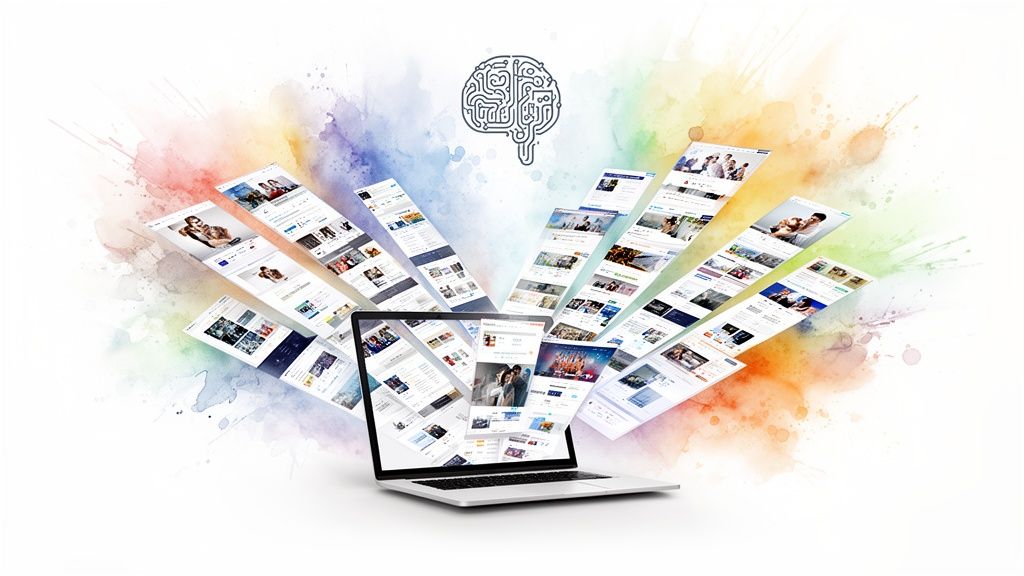
The key insight here is moving from a one-to-one manual workflow to a one-to-many automated system. It's the only way to achieve true message match when you're managing thousands of keywords.
Giving your team superpowers
This isn't about replacing talented marketers. It's about giving them superpowers.
It’s about automating the grunt work so they can focus on what they do best: strategy, creative thinking, and understanding the customer. A machine can A/B test a thousand headlines, but it can't come up with the core value proposition that actually connects with your audience.
In practice, this means AI can automatically generate thousands of high-intent landing pages and ads from a single set of brand guidelines, ensuring perfect message match. The system can then test variants and learn what works, pushing winning combinations live without you having to touch a thing. This shrinks the optimization cycle from weeks down to hours. The best systems even upload conversion values back into your ad platforms, teaching the algorithms to optimize for Return On Ad Spend (ROAS), not just cheap clicks or leads.
This creates a powerful, self-improving system. The more data it gets, the smarter it becomes, creating a flywheel effect that drives down costs while pushing revenue up. It’s about building a machine that operates with a speed and precision that was previously unimaginable.
We've written extensively about making this shift happen, and you can explore our full breakdown of moving from spreadsheet hell to automated PPC funnels with AI.
The goal is to let your team operate at a strategic level, using technology to execute flawlessly at a massive scale. That’s how you build a real, sustainable competitive advantage.
Stop guessing and start converting
Alright, let’s bring this all home. Understanding conversions isn’t some abstract concept you read about and forget; it’s the absolute bedrock of a predictable, scalable business.
You have to shift your entire mindset. Stop thinking about ‘getting traffic’ and start focusing on ‘generating outcomes’. It’s a subtle change in perspective, but it makes all the difference.
When you clearly define what a conversion means, track it accurately, and then systematically optimize for it, your marketing transforms. It stops being a line-item expense and becomes a powerful investment with a measurable return. You're no longer just spending money; you're buying data that makes your entire system smarter.
This process builds a critical feedback loop. Every euro you spend teaches your campaigns how to be more efficient and better at finding your ideal customer. It’s a self-improving engine for growth.
Build a machine, not just a campaign
Your goal isn't just to run ads. That’s a small, tactical piece of a much bigger puzzle. Your real objective is to build a well-oiled machine that turns ad spend into paying customers with ruthless efficiency.
It's about creating a system where the inputs (your budget) reliably produce the outputs (your revenue). This is how you move from a constant state of hoping and guessing to a place of confident execution. You start to see patterns, understand your unit economics, and make strategic bets backed by real numbers.
Start small and build momentum
Don't try to boil the ocean. You don't need a perfect, 20-step funnel on day one. Just start with one campaign, one offer, and one crystal-clear conversion goal. Focus on getting the tracking absolutely perfect for it, test a single meaningful variable, learn from the result, implement the winner, and move on to the next test.
The momentum you gain from these small, consistent wins is how great companies are built. It’s not about one massive breakthrough; it's about the relentless pursuit of incremental improvement.
Stop guessing. Define your goal. And start converting.
Your common conversion questions answered
Alright, we’ve covered a lot of ground. I know from talking to other founders that this is usually where a few key questions pop up.
Let's tackle the most common ones head-on. No fluff, just the straight-up answers I'd give you if we were grabbing coffee.
What is a good conversion rate?
This is the million-euro question, and the only honest answer is: it depends.
A 'good' conversion rate is completely relative. Think about it: a 1% conversion rate on a €10,000 enterprise software sale is incredible. But a 10% rate on a free ebook download? That might just be okay.
Stop obsessing over universal benchmarks. The only number that truly matters is your own. Is your conversion rate better this month than it was last month? That’s the real win. Your most important competitor should always be your past self.
With that said, having some context is useful. Just don't treat these numbers as gospel—they're a sanity check, not a report card.
Conversion rate benchmarks by industry
I'm including this table because everyone asks for it, but I'm begging you: don't get hung up on these numbers. They're blended averages that hide a million different variables. Your offer, your traffic quality, and your brand reputation will have a far bigger impact than whatever industry label you fall under.
Use these to get a rough feel for the landscape, then get back to work on your own funnel.
| Industry | Average PPC Conversion Rate |
|---|---|
| E-commerce | 2-4% |
| B2B / Tech | 2-10% |
| Finance & Insurance | 5-12% |
| Legal Services | 3-7% |
Again, these are just ballpark figures. They're a starting point for a conversation, not the final word.
How long does it take to improve conversion rates?
Improving your conversion rate is not an overnight fix. It’s a game of continuous, incremental improvements.
Sometimes you get lucky. A single A/B test on a headline can give you a quick 20% lift in a week. Other times, you'll need to run a test for a full month just to get a statistically significant result.
The speed of your progress really comes down to your traffic volume. If you're working with 100,000 visitors a month, you can get reliable test results incredibly fast. If you only have 1,000 visitors, you'll need to be more patient or focus on testing bigger, more dramatic changes to see a clear winner emerge.
The key is to build a system for testing and learning. Don’t think of conversion optimization as a one-time project. It’s a core business function, just like sales or product development. Once you start, the momentum builds on itself. 🚀
Building that system is exactly what we’re obsessed with at dynares. We automate the creation of thousands of message-matched landing pages, run the A/B tests for you, and feed value-based conversion data back to Google Ads to drive real ROAS. It’s the engine we built to stop guessing and start scaling. Check it out at dynares.ai.