
Let's be blunt for a second. The success of a marketing campaign isn't about looking busy or generating feel-good reports full of vanity metrics. Real success is about moving the needle on what actually pays the bills: revenue, qualified leads, and brand authority that feeds your sales pipeline.
Defining real campaign success beyond vanity metrics
I’ve seen too many marketers—even seasoned ones—get hung up on metrics that don't matter. Likes, impressions, and follower counts feel good, but they don't keep the lights on. If you’re serious about using marketing to build a business, your campaigns have to contribute directly to growth.
Otherwise, you're just burning cash. It’s that simple.
True campaign success boils down to a few core pillars. These aren't theoretical concepts; they're the direct link between your marketing efforts and the health of the business.
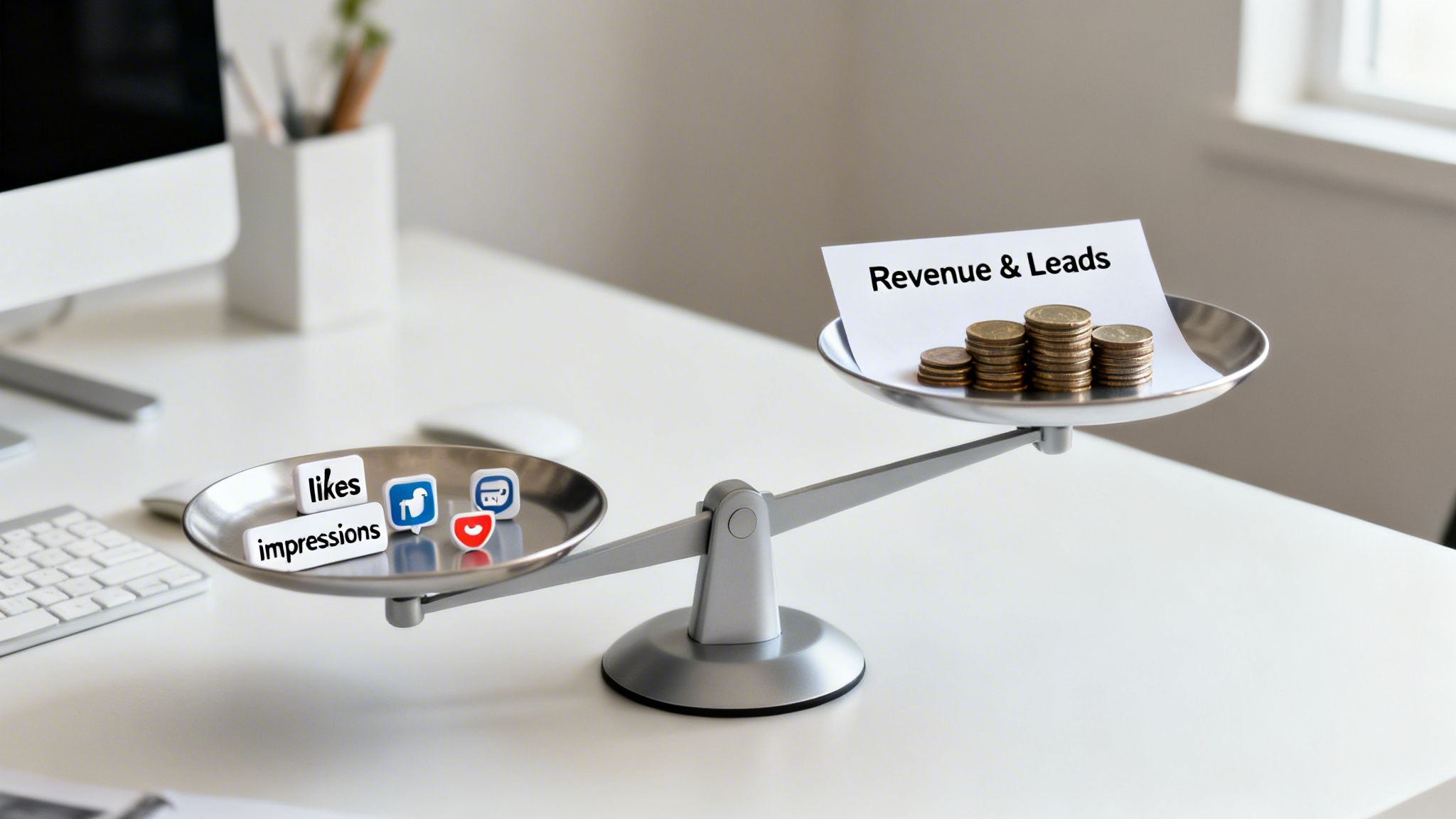
The three pillars of meaningful success
Let's cut through the noise. Every marketing campaign you run should be designed to impact one of these three areas. If it doesn't, you need to ask why you're doing it.
- Awareness that builds a pipeline: This isn't just about getting your name out there. It’s about becoming known by the right people for the right reasons. Success here means your sales team starts hearing, "Oh yeah, I've heard of you guys" from ideal prospects.
- Lead generation your sales team actually values: A lead isn't a lead just because someone downloaded a PDF. A successful lead gen engine produces contacts that your sales team is genuinely excited to call because they have a high probability of closing. It’s about quality, not just quantity.
- Revenue attribution that proves your worth: This is the ultimate goal. You have to be able to draw a clear line from your marketing spend to the revenue it generates. This is how you justify your budget, earn trust, and make smart decisions about where to invest next.
Shifting your focus this way takes discipline. It means having uncomfortable conversations about what’s working and what isn’t. But it’s the only way to build a marketing machine that truly scales.
You have to be ruthless about what you measure, because what you measure is what you’ll inevitably optimize for. The objective of your campaign should dictate every single metric you track. If you want a clear picture of what this looks like, you might be interested in a deep dive into what is a conversion in marketing. It helps connect these high-level goals to specific, trackable actions.
To make it crystal clear, let's map these goals directly to the key performance indicators (KPIs) you should be tracking. Anything outside of this is likely a distraction.
Matching campaign goals to actionable KPIs
This table shows how your high-level objectives should connect directly to specific, actionable metrics.
| Campaign Objective | Primary KPI | Secondary Metrics |
|---|---|---|
| Awareness | Share of Voice (SOV) & Branded Search Volume | Direct Traffic, Social Mentions, Backlinks |
| Lead Generation | Marketing Qualified Leads (MQLs) & Cost per Lead (CPL) | Conversion Rate, Form Submissions, Demo Requests |
| Revenue | Return on Ad Spend (ROAS) & Customer Acquisition Cost (CAC) | Lead-to-Customer Rate, Sales Cycle Length, Lifetime Value (LTV) |
By aligning your campaigns with these concrete KPIs, you move away from ambiguous brand building and start creating a system that produces measurable, predictable business results.
The metrics that matter and the ones that don't
Alright, let's talk about the numbers you should actually be watching to see if a marketing campaign is working. Too many marketers drown in data, celebrating stats that have zero connection to the bottom line. It’s a waste of time and, frankly, a bit of a rookie move.
If a metric doesn't lead back to cash in the bank or a real business goal, you shouldn't be high-fiving your team over it. You're just making noise and distracting everyone from what actually drives growth.
Your true north stars
For any serious marketer focused on paid search and lead gen, there are only a handful of KPIs that are non-negotiable. These are your true north stars—the metrics that tell you if your business has momentum. Get these right, and you're on the right path.
- Conversion Rate: The most basic, fundamental number. What percentage of people who click your ad actually do the thing you want, like filling out a form or requesting a demo? A low conversion rate is a blaring siren that something is broken between your ad and your landing page.
- Cost Per Acquisition (CPA): This is what you pay for each new customer or qualified lead. If your CPA is higher than a customer's value, your business model is broken. Period. You have to know this number and be obsessed with lowering it.
- Return on Ad Spend (ROAS): The king of all metrics. For every dollar you put into ads, how many do you get back? A ROAS of 3:1 means you’re making €3 for every €1 you spend. If you don't know your ROAS, you're flying completely blind.
- Lead-to-Customer Rate: This one exposes the quality of your leads. It measures the percentage of leads that actually turn into paying customers. A ton of leads with a lousy lead-to-customer rate just means your sales team is burning time on junk. Your targeting is off.
Leading indicators vs. lagging outcomes
So, what about all the other numbers, like Click-Through Rate (CTR) and Quality Score? They're important, but you have to see them for what they are: leading indicators, not the final score. Think of them as diagnostic tools, not trophies.
Celebrating a high CTR with no conversions is like celebrating a packed restaurant lobby where no one is ordering food. It's a sign of interest, but it's not a business result. Paid media campaigns are great at getting visitors—the hard part is turning them into revenue. Check out our breakdown of essential marketing KPI examples to see how all these pieces fit together.
Your leading indicators help you figure out why your core metrics are off. Low CTR? Your ad copy or creative probably isn't hitting the mark. Time to test new messaging. Low Quality Score? Google is telling you there’s a gap between your keyword, ad, and landing page. Fix it, and your costs will drop.
Paid media campaigns, especially PPC, consistently drive more traffic than organic efforts. For performance marketers obsessed with ROAS, this just reinforces the need for smart automation. Tracking revenue, not just lead counts, is the only way to get a true picture of profitability. Industry data shows 82% of marketers use engagement metrics like CTR as leading indicators, but conversion rate is still the ultimate validator. You can read more on these marketing statistics and benchmarks to see how you measure up.
Ultimately, you use these leading indicators to fix your campaigns and improve the numbers that actually matter: CPA and ROAS. That’s the game. Stop reporting on vanity metrics and start focusing on what drives scalable growth.
How to properly measure and attribute success
So you’ve got campaigns running on Google, LinkedIn, maybe some niche display networks. Now for the hard part—the part where most marketers, frankly, drop the ball.
How do you actually know what’s working? This is where marketing attribution comes in, and for most companies, it’s a complete mess.
Let's cut through the noise. It’s tempting to use simple attribution models because they're, well, simple. But relying on them is like trying to understand a football match by only watching the person who scored the final goal. You miss the entire game that led up to it.
Single-touch attribution: the easy—and wrong—answer
Single-touch models are the most common and, honestly, the most misleading way to measure your marketing. They give 100% of the credit for a conversion to a single click. It’s lazy, but a shocking number of teams still do it. Both main flavors are deeply flawed: first-touch and last-touch.
First-touch gives all credit to the first interaction, which is useful for knowing what brought someone to your door, but it ignores everything after. It over-values top-of-funnel channels. Last-touch is the default for platforms like Google Ads and gives all credit to the final click. This model makes your bottom-of-funnel channels look like rockstars while devaluing all the hard work that built awareness and consideration in the first place.
Relying on these isn’t just a reporting error; it's a strategic mistake. You’ll end up over-investing in last-click channels and gutting the budget for the very activities that tee up those final conversions. It’s a fast track to shrinking your own pipeline.
Why multi-touch is the only real answer
In 2026, if you aren't using a multi-touch attribution model, you're flying blind. It's that simple. Multi-touch attribution spreads credit across multiple touchpoints in the customer journey, finally acknowledging that different interactions play different roles.
This is all about connecting your spend to real results, which boils down to a few core metrics: Conversion Rate, Cost Per Acquisition (CPA), and Return on Ad Spend (ROAS).
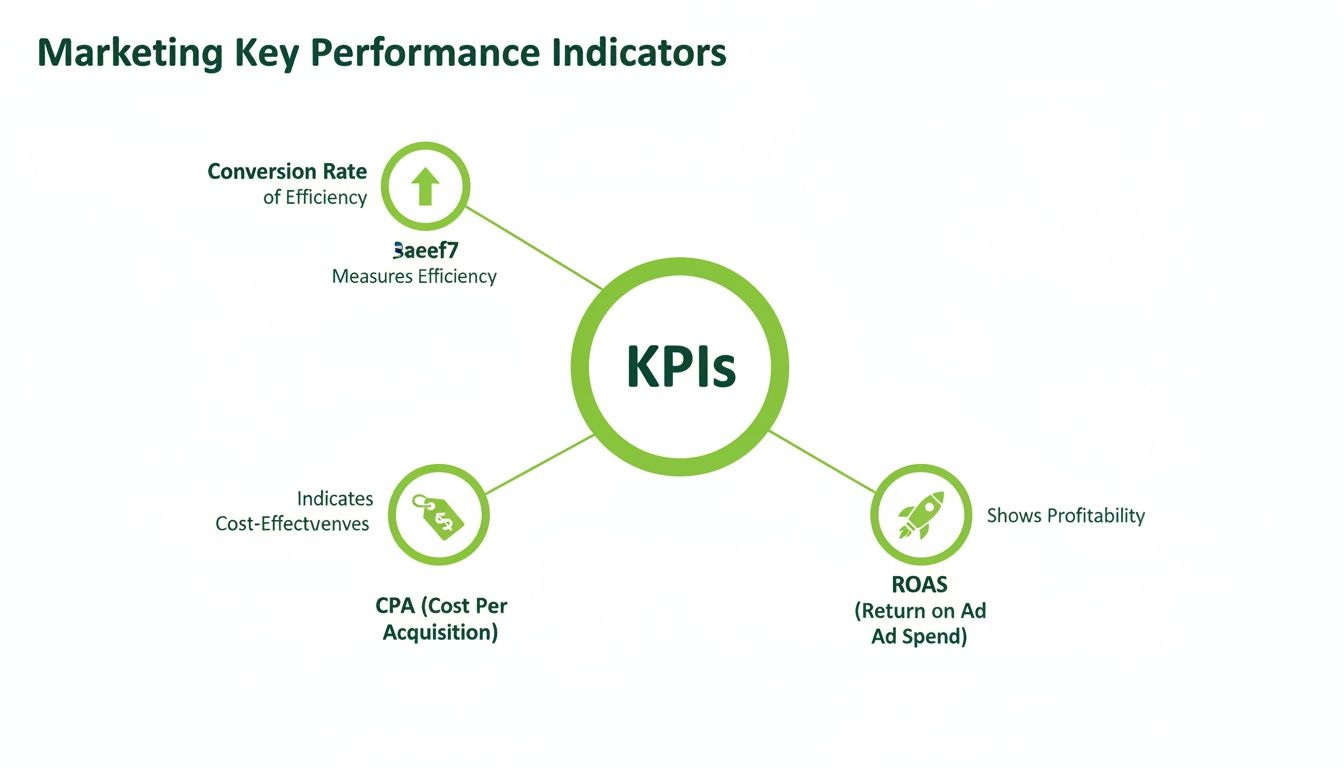
These KPIs are all interconnected parts of the same puzzle. For a deeper analysis of this relationship, you might want to check out our guide on how to measure marketing ROI.
This shift from vanity metrics to a holistic revenue view is becoming the standard. Recent data on content marketing campaigns shows that over 41% of marketers now measure success primarily by direct sales impact. Even better, more than a third named conversion rates as their top KPI for 2025 planning. You can discover more insights about these marketing statistics on HubSpot.
Common multi-touch models include Linear, Time-Decay, and U-Shaped. At dynares, we use a data-driven model. It uses machine learning to analyze all converting and non-converting paths, assigning credit based on what actually drives results. It's more complex, but it gives you the clearest picture of what's really going on.
Adopting this mindset empowers you to have much smarter conversations about budget and prove the value of every single dollar you spend.
An optimization playbook for improving campaign success
So you’ve got your data. Your attribution models are looking sharp. Now what?
Let’s be very clear: data without action is a vanity project. It’s a nice-looking dashboard for analysts, not a growth engine for the business. This section is a hands-on playbook for turning those insights into better performance and, ultimately, more profitable marketing campaigns.

This isn’t about randomly tweaking button colors or playing with headlines and hoping for the best. That’s guessing, not optimizing. What you need is a systematic process—a machine for continuous improvement.
Real growth comes from a disciplined, repeatable loop, not from occasional flashes of creative genius.
The measure, analyze, hypothesize, test loop
The core of this playbook is a simple but powerful cycle: Measure, Analyze, Hypothesize, and Test. This is the engine that drives all meaningful optimization. Let's break down each step so you can start using it immediately.
It all begins by looking at the right data and asking the right questions. You've set up your metrics and attribution; now it’s time to use them to spot weaknesses and opportunities.
- Measure: This is your starting point. You're tracking your core KPIs—CPA, ROAS, Conversion Rate—and you have a baseline. The goal here is just to have clean, reliable data coming in.
- Analyze: This is where you put on your detective hat. Where are the drop-offs in your funnel? Which audience segment is underperforming? Is a specific ad creative showing a high CTR but a terrible conversion rate? You’re looking for clues.
- Hypothesize: Based on your analysis, you form an educated guess. A strong hypothesis is a clear, testable statement: "If we change the landing page headline to match the ad's primary claim, then the bounce rate will decrease by 20% and the conversion rate will increase." It's specific and measurable.
- Test: You run a clean A/B test to validate or invalidate your hypothesis. You only change one variable at a time so you know exactly what caused the change in performance. This is science, not art.
This cycle never ends. Winners get implemented, losers provide valuable lessons, and every test feeds into the next hypothesis. This is how you build a culture of experimentation instead of a culture of opinions.
Where to look for optimization wins
You don't need to reinvent the wheel. Most campaign failures happen in a few common areas. Start your analysis by looking at these two critical components first—they almost always have room for improvement.
First, landing page refinement is probably the lowest-hanging fruit for improving campaign success. Your ad makes a promise, and your landing page needs to deliver on it, instantly. Your landing page isn't a brochure; it's the final closing argument. If there's any friction or confusion—any disconnect from the ad that brought the user there—you've lost them. Message match is non-negotiable.
Secondly, look at your audience segmentation. Are you sending the same generic message to everyone? In an era of personalization, that's just lazy and expensive. Dig into your data and find your high-value segments. Build dedicated campaigns and creatives that speak directly to their pain points.
A slightly more targeted message to the right group can often outperform a broad campaign, even with a smaller budget. If you're running ads on Google, for example, your entire strategy should revolve around this. If you want to dive deeper, we've got a detailed guide to Google Ads campaign optimization you should check out.
Ultimately, this playbook is about making small, iterative improvements that compound into massive gains over time. One successful test might only lift conversions by 5%, but running this cycle relentlessly, week after week, is how you double your ROAS in a year.
Stop guessing and start testing.
Look, the optimization playbook we've covered works. But doing it all by hand is a fast track to burnout. It's slow, expensive, and frankly, it just doesn't scale.
This is where you stop being a manual operator and start building a system. Technology, especially AI, becomes the lever that lets a small team outperform a massive one. Forget spending your days in spreadsheets; that's the old way, and it’s a recipe for getting left behind.
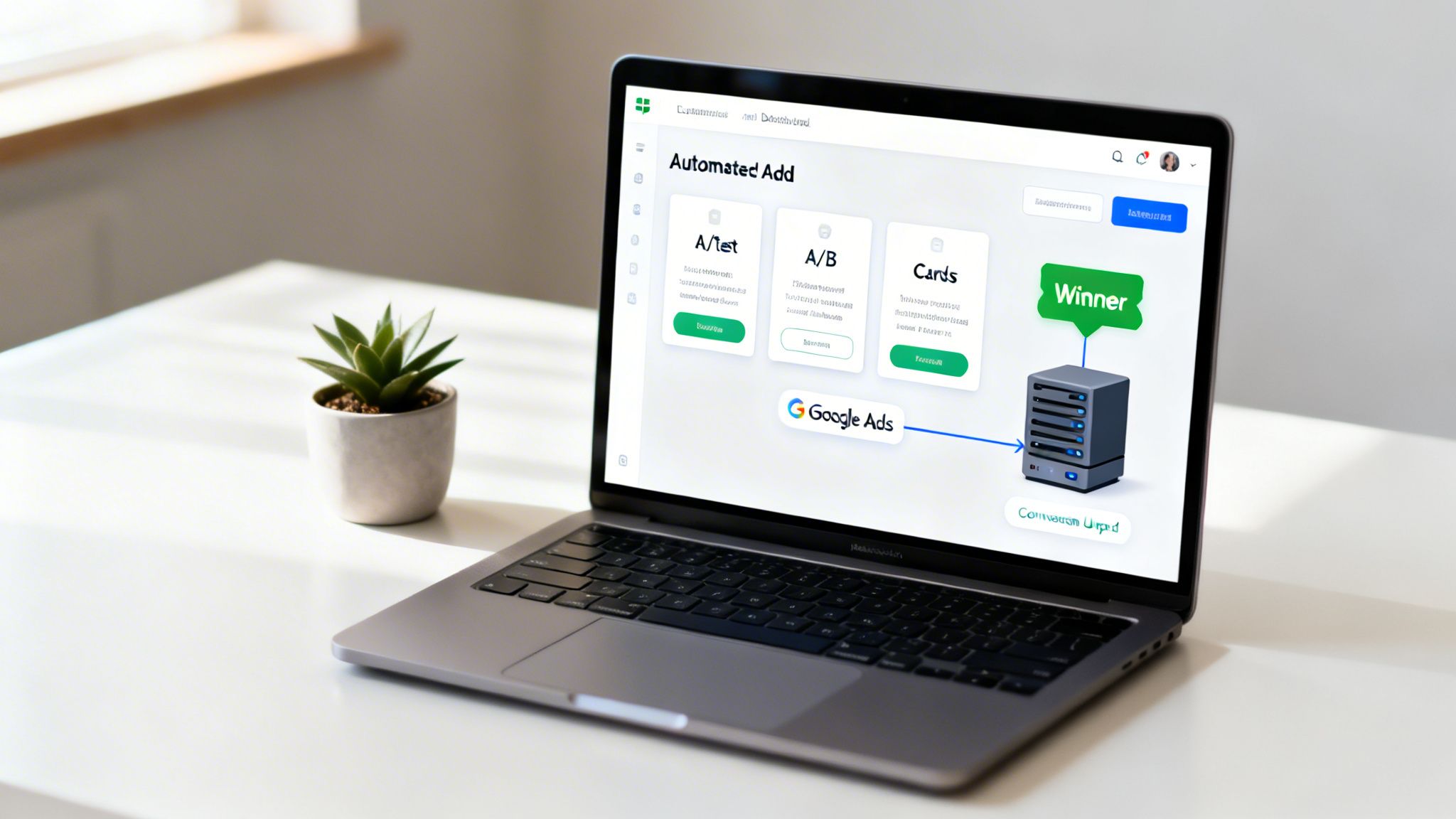
Building your automated growth engine
Imagine a system that generates a hyper-relevant ad and a matching landing page for every single keyword you target. That’s not science fiction anymore. It’s what platforms like dynares.ai are designed to do.
Instead of one generic landing page for an entire ad group, every ad links to a page that feels custom-built for that user's specific search. This creates an insane level of message match, which is a huge factor in driving up your Quality Score and pushing down your costs.
The system then runs A/B tests 24/7, automatically promoting the winners and killing the losers in real time. This isn't just about making your life easier; it's about achieving a level of optimization that no human team could ever manage. It frees you up to think about strategy, not the soul-crushing work of campaign maintenance.
The power of aligning your message with deep audience insights is huge. Look at the Tobacco Free Florida initiative. They cut youth smoking from 8.3% to 4.3% in four years by using data to hit the right audience with the right emotional message. It’s a powerful lesson in how data-driven targeting works at scale. You can read more about data-driven campaigns on Leadpages.
From leads to revenue: the final piece of the puzzle
This is where it gets really good. Most marketers get stuck optimizing for leads because tracking actual revenue has always been a pain. This is a massive, costly mistake. A lead is just a proxy for value; revenue is the real thing.
Smart automation is what finally closes this loop. The game-changer is the ability to automatically upload conversion values—not just lead counts—back into ad platforms like Google Ads. This is absolutely critical. You're no longer telling Google to "get me more leads." You're telling it to "get me more profitable customers." The algorithm then optimizes for actual revenue, not just the volume of form fills.
This changes the entire game. Your ad spend automatically flows toward the keywords and audiences that generate the highest-value customers. You’re building a truly intelligent, self-optimizing marketing machine.
- You stop wasting money: Spend is no longer wasted on keywords that only generate low-quality leads that never buy anything.
- You scale predictably: Your marketing becomes a true growth lever, directly tied to revenue and profit, not just top-of-funnel noise.
- You gain a real edge: While your competitors are busy celebrating their lead counts, you’re optimizing for what the CEO actually cares about—the bottom line.
This level of automation isn't some far-off future concept; it's happening right now. For any business that's serious about scaling, using AI-driven optimization isn't just an option. It’s how you survive and win.
Your FAQs, answered
Let's wrap this up by hitting a few of the most common questions I get from PPC managers in the trenches. No fluff, just straight answers to help you get this right.
What is a good conversion rate for a PPC campaign?
Honestly? Anyone who gives you a single number is selling something. “Good” depends entirely on your industry, your offer, and the quality of your traffic.
An e-commerce store might celebrate a 2-3% conversion rate. A high-ticket B2B service could be thrilled with 10%. They're both right.
Stop chasing some universal benchmark you read in a report. Focus on your own baseline. If your conversion rate is 2% today, then a “good” rate is 2.5% next month. The only goal that matters is continuous improvement.
How long should I run a campaign before deciding if it’s successful?
Patience is a virtue in PPC, but waiting too long is just burning cash. You should see leading indicators within a few days—are you getting clicks? Is your CTR completely in the gutter? Those are your early warning signs.
But to judge real success based on conversions and ROAS, you need enough data to mean something. Don't be the person who panics and kills a campaign after one bad 48-hour stretch.
A solid rule of thumb is to wait for at least 100 conversions or to let the campaign run for two full sales cycles. If your sales cycle is 30 days, you need to wait longer than a week to see the real impact.
My campaign has high traffic but low conversions. what should I fix first?
Classic problem. This almost always points to a massive disconnect between your ad and your landing page. Your ad wrote a check that your landing page couldn't cash. That friction is what’s killing your results.
Here's a quick diagnostic to run:
- Message Match: Does the headline of your landing page directly reflect the ad headline? If not, you’re creating a jarring experience that sends people straight to the back button.
- Audience-Offer Fit: Are you sending the right people to the right offer? You might have amazing traffic, but if they aren't the people who actually need your product, they will never convert.
- Landing Page Experience: Is your page slow? Is the call-to-action (CTA) unclear or buried below the fold? Make it painfully obvious what you want the user to do next. Don't make them think.
If you're tired of manually patching these disconnects and want to build a truly scalable, self-optimizing machine for your Google Ads, check out dynares. It’s the platform we built to automate this entire process, ensuring every ad perfectly matches its landing page to drive real results.
See how it works at https://dynares.ai.


