
Sales funnel content isn’t just a random collection of blog posts and case studies. Think of it as a series of specific conversations you design to guide someone from who are you? all the way to take my money.
It’s all about delivering the right message at the right time. You need to match what a person is thinking and feeling at each step of their journey, instead of shouting the same thing at everyone.
Why your sales funnel is leaking money
Let's be direct. Your Google Ads campaigns are probably burning cash. You're getting clicks, sure, but not enough actual leads or sales to justify the spend. The reason is almost always the same: you're sending high-intent traffic to generic, one-size-fits-all content.
It’s like inviting a Michelin-star chef to a party and only serving stale crackers. It's a dumb, expensive mistake that far too many businesses make every single day.
This isn't just a hunch; the data is brutal. The gap between an average funnel and a high-performing one comes down to how well you align content to your audience's intent.
The brutal reality of sales funnel performance
Here's a quick look at average vs. top-tier B2B SaaS conversion rates. This shows why optimizing your funnel content is not optional.
| Funnel Metric | Average Performer | Top 10% Performer |
|---|---|---|
| Visitor-to-Lead Rate | 1.5% - 2.5% | 8% - 15% |
| Lead-to-MQL Rate | ~25% | ~50% |
| MQL-to-SQL Rate | ~30% | ~60% |
The numbers don't lie. For every 100 visitors, most teams get one or two lukewarm leads. Elite teams get eight or more qualified ones. This is the clear difference between struggling to stay afloat and scaling predictably.
A one-size-fits-all landing page is the fastest way to absolutely kill your return on ad spend (ROAS). The problem is simple, and you're probably living it:
- Problem-aware traffic (searching why is my team so unproductive) gets dumped on a book a demo page. They aren't ready for a sales pitch. They need to understand their problem first.
- Solution-aware traffic (searching best project management software) lands on a generic about us page. They need comparisons and proof, not your company's origin story.
- Product-aware traffic (searching dynares pricing) is forced through a confusing maze of features instead of seeing a clear, simple path to buying.
I’ve seen this firsthand while building and scaling tech products. Obsessing over your sales funnel content isn't just a good idea—it's the only way to build a scalable, profitable machine for lead generation. This is about building a system, not just running another campaign.
If you suspect your funnel is underperforming, the first step is to diagnose the leaks. Check out our guide on how to perform a conversion rate optimisation audit to get started.
It all boils down to creating a smooth, logical journey for your potential customer. When the message matches their mindset, friction disappears, and conversions just happen. Without this alignment, you’re just pouring money into a leaky bucket and wondering why it’s always empty. 🤷♂️
Mapping content to your customer's mindset
Most sales funnel models you see online are academic and, frankly, useless.
They get obsessed with acronyms—TOFU, MOFU, BOFU—as if they're some secret marketing code. Let’s get real. A sales funnel isn't a complex diagram; it's a map of your customer's mindset.
Thinking about it this way simplifies everything. Instead of jargon, you get a clear, human journey you can build for. Your job is to meet people where they are, not shove them into a rigid framework that makes zero sense to them. Fail at this, and your funnel springs leaks. Big ones.
This is what it looks like when money drains from your funnel because you're serving generic content or targeting the wrong mindset.
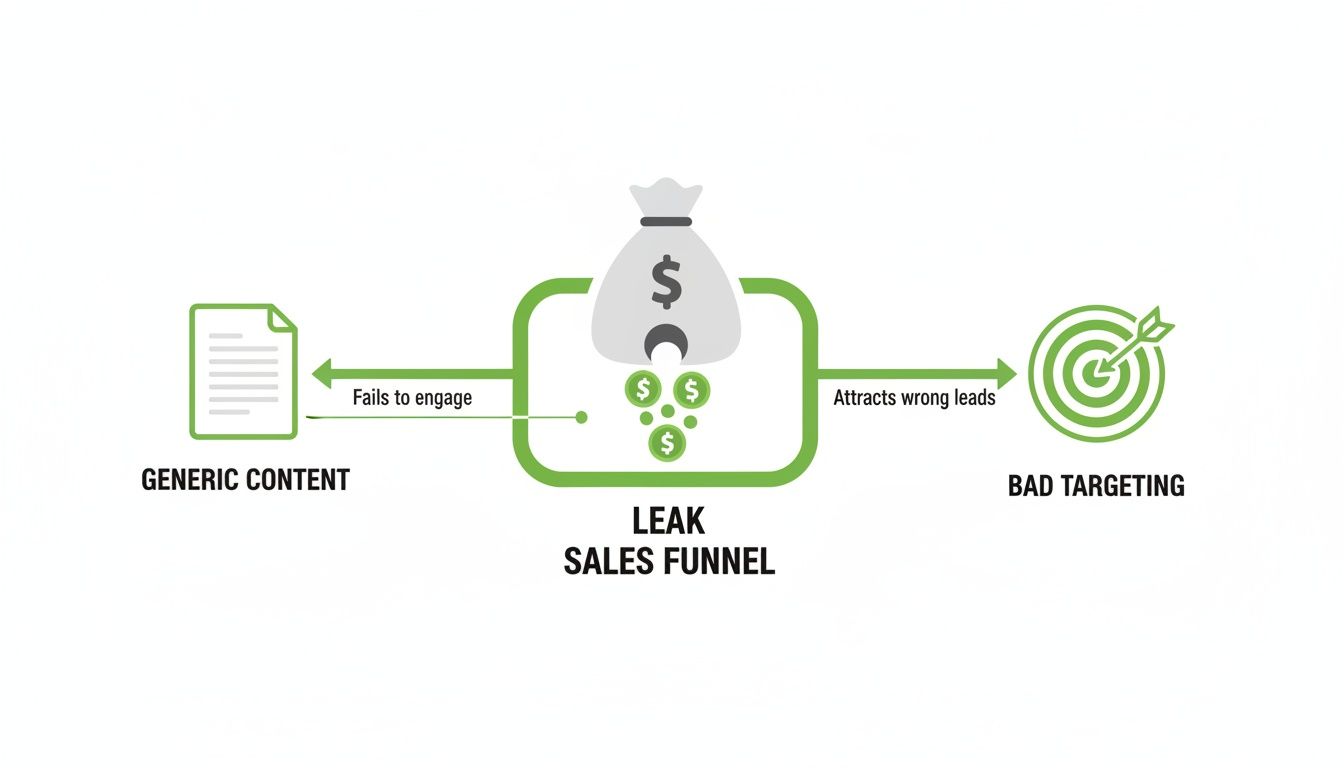
It’s a simple picture of a costly problem. When your content doesn't match what your audience is thinking, you’re just lighting ad spend on fire and losing customers you should have won.
The four stages of mindset
To build a practical content arsenal, let’s break the journey down into four actionable stages. No acronyms, just a clear path from stranger to happy customer. This is how you stop guessing and start building a real system for growth.
- Awareness: They have a problem but might not have a name for it yet. They definitely don’t know you or your solution. They're looking for information, not a sales pitch.
- Consideration: They get the problem now and are actively hunting for solutions. They know you exist and are sizing you up against other options. They want proof and details.
- Decision: They're ready to buy. They have a short list—and you’re on it. They just need a final, compelling nudge and a frictionless way to pull the trigger.
- Retention: They’ve bought from you. The journey isn't over. Now your job is to make sure they succeed and turn them into advocates for your brand.
The core mistake I see founders make is pushing for a Decision-stage action (like book a demo) with Awareness-stage content. It’s like asking for marriage on the first date. It’s desperate, ineffective, and shows you don’t understand them at all.
Content for each mindset
Now, let's map specific sales funnel content types to these mindsets. This isn't a suggestion; it's a blueprint.
Awareness stage (problem-focused)
Your goal here is to educate and attract people who are just starting to research their pain points. You become a trusted resource, not a pushy salesperson.
- Problem-focused blog posts: Instead of 10 features of our software, write why your team keeps missing deadlines (and how to fix it). See the difference?
- Data-driven reports: Publish original research on industry trends. You become the go-to source for insights people actually want to cite.
- Educational videos: Create short, helpful videos explaining the core concepts around their problem. Think less us and more you.
Consideration stage (solution-focused)
They're evaluating. Give them the meaty details they need to build trust and see you as the obvious best choice.
- In-depth webinars: Host live sessions that go deep into solving their problem, showing off your expertise in real-time.
- Case studies and success stories: Show, don't just tell. Real-world results from a company like theirs are far more convincing than any feature list you can write.
- Comparison guides: Directly compare your approach to competitors or older methods. Be honest and play to your strengths.
This whole process boils down to understanding what someone is typing into a search bar and what they expect to find. To go deeper on this, you might like our guide on what search intent is in SEO and how it shapes your entire strategy.
Getting this right turns anonymous clicks into qualified conversations. You're not just throwing content at a wall and hoping it sticks; you're building a deliberate, empathetic path that guides your ideal customer right to your door. It’s the difference between hoping for leads and engineering them. ✨
Top-of-funnel content that actually attracts the right people
Let's talk about top-of-funnel (TOFU) content. This is where most marketing teams go wrong. They burn time and money creating these huge, generic ultimate guides that try to be everything to everyone.
The result? A spike in unqualified traffic that looks great in a report but will never, ever buy from you. It’s a very expensive way to feel busy without getting any real results.
Your goal here isn't just to get clicks; it's to get the right clicks. This is your first interaction with a potential customer. You need to show them you get their world, maybe even better than they do, by being genuinely helpful from the jump.
This means you have to stop talking about your product. Seriously. At this stage, your content needs to be problem-aware, not solution-aware. Focus entirely on their pain points with a sharp, insightful perspective that makes them nod their head and think, finally, someone understands.
Creating content that hits a nerve
Think about the difference between these two titles: the ultimate guide to project management versus why your current project management process is secretly costing you thousands.
The first one is noise. The second one speaks directly to a painful business problem. It grabs the attention of someone who is actively feeling that pain and is desperate for answers, not just casually browsing.
This is your chance to go deep on the why. Why is their current setup failing? What are the hidden costs they haven’t even thought about? What’s the underlying industry shift that’s causing this mess in the first place? Your job is to be the expert who brings clarity to their chaos.
Effective TOFU content is not a sales pitch in disguise. It’s real, valuable information that starts building trust from the very first sentence. You're not selling yet; you're teaching.
The moment a visitor reads your content and thinks, wow, I never thought of it that way, you’ve won. You've just shifted from being another vendor to becoming a trusted advisor, all without mentioning a single feature. That's the power of leading with insight.
This is how you build an audience that actually wants to hear from you. Later, when it's time to introduce your solution, they're ready to listen because you've already proven you understand their challenges on a deep level. For more ideas on how this works in practice, check out these powerful lead generation examples that nail this approach.
Key types of high-impact TOFU content
Forget about churning out thin, 500-word blog posts. To make a real impression at the top of the funnel, you need content that demonstrates undeniable authority. Here are a few formats that work incredibly well when you do them right:
- Pillar Pages Focused on Problems: Build a master resource that dives deep into a major pain point for your ideal customer. This isn't just a long article—it's a well-organized hub of information packed with data, visuals, and links to more specific posts. Done right, it becomes a go-to asset that pulls in high-quality links and ranks for valuable keywords.
- Insightful, Opinionated Blog Posts: Don't just report what’s happening in your industry; have a take on it. Analyze a trend and explain what it really means for your audience. A post like, the data says your team is burnt out, here's the real reason, will always cut through the noise better than another generic listicle.
- Data-Driven Reports and Original Research: This is a serious power move. Invest in surveying your industry or analyzing unique data to publish original findings. This kind of content instantly positions you as an authority, generates high-quality backlinks, and gives your sales team an incredible asset to share with prospects.
Mid-funnel content: earning trust and generating MQLs
So, they know you exist. Great. Now the real work starts.
Your top-of-funnel content got their attention, but the middle of the funnel (MOFU) is where you turn a casual reader into someone who actually trusts you. This is where you either build a real connection or get ignored forever.
The whole game changes here. You have to stop talking about what the problem is and start showing how we help solve it. We’re talking about creating content so valuable that someone will give you their email address for it. This is the moment of truth.

This is the handshake. Your prospect is actively looking for solutions, and it's your job to hand them something that proves you know what you're doing. You need to make them think, okay, these guys actually get it.
Turning readers into leads
At this stage, your audience is solution-aware. They aren't just browsing; they're comparing. They need content that helps them make a smart choice, and this is your opening to prove your expertise without being pushy.
The move here is to offer gated content—resources valuable enough that people will trade their contact info to get them. This exchange is what turns an anonymous visitor into a Marketing Qualified Lead (MQL). But be warned: if the content behind the gate is fluff, you’ll burn that trust instantly.
Here are the workhorses of the mid-funnel:
- In-Depth Case Studies: Show, don’t tell. A good case study isn't a glossy brochure; it's a story about a real client, their painful problem, the solution you built, and the specific, measurable results you got.
- Tactical Webinars: Go deeper. Run a workshop-style webinar that gives people actionable advice and shows your product in a real-world setting. This format is brilliant for building a human connection.
- Comprehensive Whitepapers or Guides: A solid whitepaper tackles a serious industry problem and lays out your unique way of thinking about it. It frames you as a thought leader and gives prospects a deep look at your approach.
This stuff needs to be meticulously crafted to build confidence. It’s your shot to prove you’re not just another vendor but a partner who can actually deliver.
The art of the authentic case study
Let's be honest: most case studies are boring, corporate-speak garbage. They’re full of vague claims like improved efficiency and feel completely fake. What a waste of everyone's time.
If you want to create a case study that actually persuades someone, you need to make it feel real. Drop the PR mask and tell an honest story. Get quotes from the client—not the polished version your comms team wrote, but what they actually said.
I once had a client tell me, before this, our process was a complete dumpster fire. Now, it just works. That single, honest quote is worth more than ten pages of sanitized marketing copy. It’s real, it’s memorable, and it builds instant credibility.
And focus on the numbers. Instead of increased ROI, say we hit a 3x return on ad spend in the first quarter. Specifics are what make a case study believable. Structure it like a hero's journey: the client had a monster problem, you gave them the magic sword, and they won. Simple.
Know your conversion benchmarks
It’s also critical to have realistic expectations. Conversion rates aren't one-size-fits-all; they swing wildly between industries. A killer lead-to-MQL rate in one field might be just average in another.
For example, an analysis of sales funnel data from 2017 to 2025 shows some big differences. B2B SaaS can see a strong 39% lead-to-MQL conversion, while a more traditional industry like construction might be closer to 17%. Knowing these industry-specific funnel benchmarks helps you figure out if your funnel is actually working or if it's leaking cash.
Ultimately, your MOFU content is the bridge between grabbing attention and closing a deal. It's where you earn the right to have a sales call. Get this right, and you'll have a steady flow of qualified, engaged leads who are already sold on your value before they ever talk to a salesperson. That's how you build a real growth engine. 🚀
Bottom-of-funnel content that closes deals
This is where the deal gets won or lost.
Your prospect is ready to make a choice. You can bet they have a few browser tabs open: one for you, and two or three for your closest competitors. At this point, any friction, any hint of confusion, or any reason to second-guess themselves is a deal-breaker. You lose. It's that simple.
Your bottom-of-funnel (BOFU) content has one job and one job only: to close the deal. This is where you stop educating and start persuading. It’s time to connect all the value you've hinted at to a clear, compelling, and incredibly easy next step.
Creating a path of least resistance
The goal here is to make saying yes the easiest thing they do all day. Your prospect doesn't want another 2,000-word blog post. They want sharp, specific reasons to pick you over everyone else, and they want a dead-simple way to do it.
Think about their search queries. They’re typing in things like best X for Y, [your brand] vs [competitor], or dynares pricing. These aren't research queries; they're buying signals. Your content has to meet that high-intent search with total confidence.
This is where intent-matched content really pays off. Paid search is king at the bottom of the funnel, but while the average landing page converts at a dismal 2.35%, the top-tier performers are hitting 11.45% and higher. If you're wondering what separates them, check out the full breakdown of sales funnel statistics—the performance gap is wider than most people think.
A confused mind always says no. Your BOFU content has one job: eliminate confusion. Make the value painfully obvious, the call to action unmissable, and the process of buying from you feel like a breath of fresh air.
Key content for closing deals
This isn't a long list. BOFU content is all about focus and action. You only need a few core assets, but they have to be absolutely dialed in.
- High-Converting Landing Pages: These are not your homepage. They are purpose-built pages, each one laser-focused on a single keyword and a single desired action. Every word, from the headline to the button, reinforces one simple message: this is the solution, and here's how you get it.
- Clear, Compelling Pricing Pages: This is no time to be clever. Be clear. Show the value at each tier and make it obvious which plan is right for them. A confusing pricing page is one of the fastest ways to lose a sale.
- Frictionless Demo/Trial Pages: Make it almost insultingly simple to sign up. Ditch the unnecessary form fields. Your page should scream, this is worth your time, and getting started is easy. That's how you win.
Here’s a great example of a features page that communicates value quickly without causing information overload.
Notice how every feature is directly connected to a benefit? It answers the only question on the user's mind: what's in it for me? That level of clarity is exactly what you need to push a high-intent visitor across the finish line.
Ultimately, your bottom-of-funnel content is the final handshake. It's the moment your prospect decides whether they trust you enough to pull out a credit card. Don't fumble the bag by being vague or making them work for it. Be direct, be persuasive, and make it easy for them to say yes. That's the difference between another lead and a new customer. ✨
Using AI to automate and scale your funnel
Let’s be honest for a second. Building and managing a complete sales funnel with unique content for every stage is a ton of work. Now, imagine trying to do that for Google Ads—creating a specific landing page and ad for every single keyword.
It's a logistical nightmare. It’s also impossible to do manually at any real scale.
This is where things get interesting. The future of marketing isn’t about working harder; it’s about building smarter systems. This is exactly why I built Dynares. I was fed up with the mind-numbing, repetitive work that consistently killed campaign performance and burned through ad spend.

AI platforms can automate this entire process. You feed the system your brand guidelines and a list of keywords, and it does the heavy lifting—generating thousands of coordinated, high-intent landing pages, ads, and forms almost instantly.
From manual grunt work to automated growth
This isn’t about replacing marketers; it's about giving them superpowers. Instead of spending weeks building a handful of landing pages, you can generate and test thousands of variants in minutes. This is how you shift from being a campaign manager to becoming a genuine growth architect.
Here’s what that looks like in practice:
- Massive Scale, Instantly: An AI system can produce a perfectly matched landing page and ad set for every single keyword in your account. This ensures your sales funnel content always aligns with user intent, which is exactly what Google wants to see.
- Continuous Optimization: The platform automatically A/B tests different headlines, images, and calls to action. It identifies the winning combinations and pushes them live without any manual intervention from you.
- True Revenue Optimization: It doesn't just stop at generating a lead. The system can upload conversion values directly back to Google Ads, allowing you to optimize for actual revenue, not just cheap lead volume.
This is the critical shift. You stop wasting time on tedious execution and start focusing on high-level strategy. The machine handles the repetitive tasks, and you guide the vision. It’s the ultimate collaboration between human creativity and machine efficiency.
The goal is to build a self-optimizing system that gets smarter with every click. This is how you finally deliver on the promise of granular, intent-based marketing without needing an army of people to run it.
If you're interested in going deeper, we have an article on how automated content creation is changing the game for performance marketers. This is how you scale. 🚀
Alright, let’s get into the questions I hear all the time about building a sales funnel that actually works. No fluff, just straight answers to the things that tend to trip people up.
What’s the ideal length for sales funnel content?
There isn’t one. Anyone who gives you a magic number is selling something. The real answer is: it depends entirely on the funnel stage and what the user is trying to accomplish.
Think context, not just word count.
A top-of-funnel (TOFU) blog post, for instance, might need to be 1,500+ words to properly break down a complex problem and show you know what you're talking about. But at the middle-of-funnel (MOFU), a case study should be sharp and focused on results—maybe 500-800 words. Long enough to tell a good story, short enough that a busy person will actually read it.
Then you get to the bottom-of-the-funnel (BOFU). Your landing pages here need to be absolutely ruthless. Forget length and obsess over one thing: making the next step painfully obvious.
How do I measure the ROI of my sales funnel content?
You measure it stage by stage. Trying to tie a single metric like revenue to every piece of content is a rookie mistake that will trick you into thinking your early-stage stuff isn't working. It’s all about a chain of conversions.
- Top of Funnel (TOFU): You're looking for reach and engagement. Track metrics like organic traffic, keyword rankings, and social shares. Are you getting in front of the right people?
- Middle of Funnel (MOFU): This is all about lead generation. The key numbers here are lead magnet downloads and, more critically, MQL conversion rates. Are you turning anonymous traffic into qualified leads?
- Bottom of Funnel (BOFU): Now we’re talking about money. The only things that matter are demo requests, sales qualified leads (SQLs), and finally, closed-won deals and revenue. Did your content help close the deal?
Can I reuse content across different funnel stages?
Yes, and if you’re not, you’re wasting a ton of time and energy. The trick is to repurpose, not just republish. Don't be lazy about it.
That big, comprehensive TOFU guide you wrote? It's a goldmine. You can slice it up into a dozen different assets for other stages.
A single powerful customer quote from a BOFU case study can be repurposed on your homepage, in an ad, or as a social media post. That’s smart marketing—getting maximum mileage out of your best assets.
For example, a big guide can be stripped down into a MOFU checklist or become the core topic for a webinar. You can pull out key stats and turn them into social media snippets. The goal is to adapt the format and messaging to fit the context of each stage. It shows you're resourceful and you actually understand your customer’s journey.
At dynares, we built a platform that automates this entire content generation and testing process for Google Ads, so you can focus on strategy instead of manual execution. See how it works at https://dynares.ai.


