
Let's be blunt: everyone wants a single number for a "good" click-through rate. It doesn't exist.
Asking for a good CTR is like asking what's a good price for a car without mentioning if you're looking at a rusty sedan or a new Ferrari. A good CTR is all about context. It’s one that’s better than your industry’s average, better than your direct competitors, and always, always getting better.
What is a good click-through rate anyway?
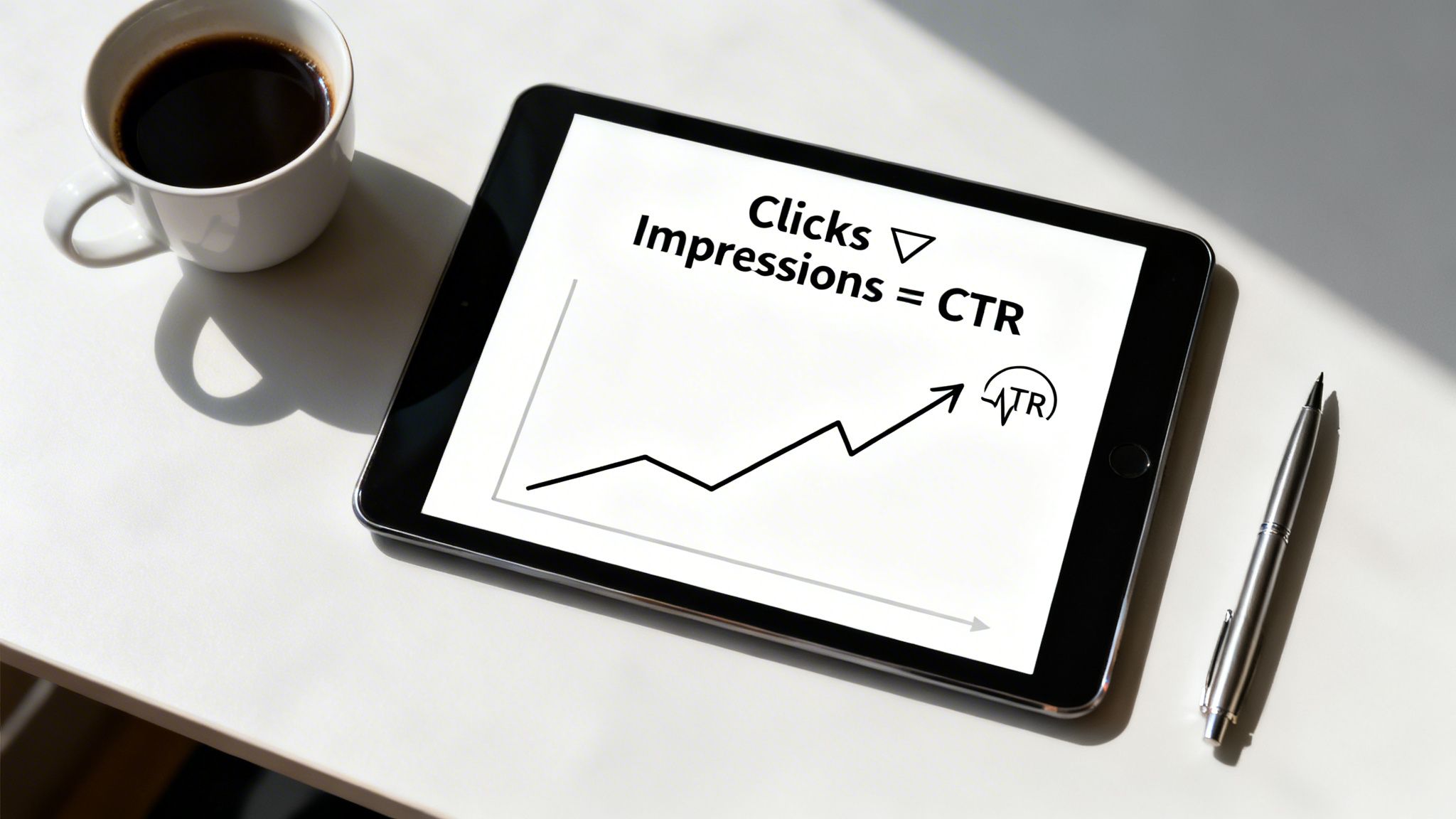
Before we dive into benchmarks, let's get the basic definition out of the way. Your click-through rate (CTR) is just a simple formula: the number of clicks your ad gets, divided by the number of times it’s shown (impressions).
Clicks ÷ Impressions = CTR
But thinking of it as just a number is a huge mistake. CTR is one of the most important health metrics for your campaigns. Think of it as a pulse check—it tells you exactly how well your message is resonating with your audience.
A high CTR means your ad and targeting are hitting the mark. A low one means you're being ignored. It’s the clearest, fastest signal that your creative is either working brilliantly or failing spectacularly. We cover the fundamentals in more detail in our guide on what click-through rate is.
Setting a realistic baseline
So if there's no magic number, where do you start? You look at context. A good CTR varies wildly depending on the channel, industry, and even the keyword you're bidding on.
To give you a rough starting point, here are some general benchmarks you can expect across major marketing channels. Remember, these are averages—your mileage will vary.
Quick CTR benchmarks by channel (2026 average)
| Channel | Average CTR | Context |
|---|---|---|
| Search Ads | 3.17% | Varies hugely by intent. Branded terms should be much higher. |
| Display Ads | 0.46% | Often lower due to passive viewing. Focus on relevance. |
| Social Ads | 1.30% | Highly dependent on platform, creative, and audience targeting. |
| Email Marketing | 2.50% | Generally higher because it's a permission-based audience. |
These numbers are a decent sanity check, but they aren't the law. The real goal isn't to hit some universal benchmark but to constantly push your own baseline higher.
Let’s get pragmatic. Is a 2% CTR good?
For a hyper-competitive Google Ads keyword, maybe. For your own branded search term, it’s terrible. For a display ad on a random website, it could be excellent. For an email campaign to a loyal list, you should be aiming for 2% to 5% or more.
That’s how you build real momentum and scale your campaigns effectively—by beating your own numbers, week after week.
Why CTR is more than just a vanity metric
Let's get one thing straight: anyone who dismisses click-through rate as a vanity metric fundamentally misunderstands how to make money online. It’s a bad take, and it's an expensive one.
A high CTR is the single clearest signal you have that your message is connecting with your audience. It tells you you’re relevant.
On platforms like Google Ads, relevance isn’t just a nice-to-have; it's the entire economic model. Relevance is money. A higher CTR directly feeds into a better Quality Score, and that’s where the magic really starts for your budget.
The virtuous cycle of a high CTR
So why should you care about some internal score Google gives you? Because Google’s business is built on rewarding relevance.
A higher Quality Score is your reward for giving a searcher a great answer to their query. In return, the platform gives you two things every marketer desperately wants:
- Better Ad Placement: Your ads get shown more prominently—often above competitors who are bidding more than you.
- Lower Cost-Per-Click (CPC): You literally pay less for each click, making your entire campaign more efficient and profitable from the ground up.
This isn’t some complicated theory. It's a powerful virtuous cycle that is the absolute bedrock of paid search economics.
A better CTR earns you a higher Quality Score, which lowers your CPC and stretches your ad spend further. Chasing a better CTR isn’t about ego; it’s about making your budget work harder and outmaneuvering the competition.
A low CTR is a direct signal to platforms like Google that your ad is irrelevant. The platform will then penalize you with higher costs and worse visibility, effectively taxing you for being a poor match for its users.
Think about that. A weak CTR means you are actively paying a premium to be ignored. It’s the equivalent of shouting into the void and paying for the privilege.
The opposite is also true. A strong CTR gives you an incredible advantage. It lets you win better ad positions for less money, which directly maximizes your return on ad spend (ROAS) and drives real growth.
Improving your CTR is one of the most direct ways to improve your bottom line. It’s not vanity—it’s just smart business. 🚀
CTR benchmarks across key digital platforms
Alright, let's talk about the numbers you're probably here for. But first, a word of caution: treating these benchmarks as absolute rules is a great way to misdiagnose your campaign performance. Think of them as a compass, not a GPS. Your industry, offer, and creative will cause huge variations.
What counts as a good click-through rate is entirely dependent on the platform. User intent is everything. Someone actively searching on Google for a solution is in a completely different headspace than someone scrolling their Facebook feed or browsing professional updates on LinkedIn.
This isn't just a vanity metric. A high CTR has a direct, positive impact on your ad account's health, improving your Quality Score and, in turn, lowering what you pay for each click.
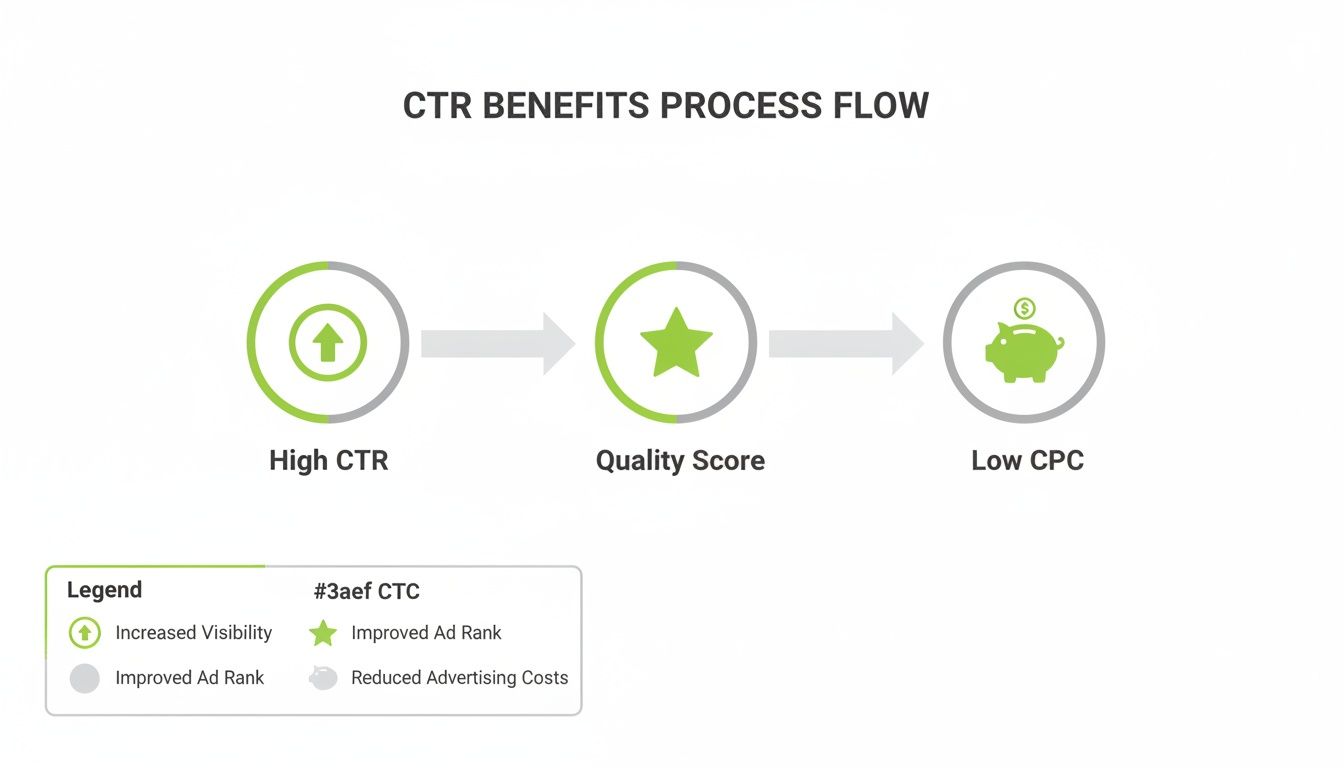
The real insight here is that improving your CTR creates a flywheel effect. It makes your entire advertising budget work harder. You’re not just getting more clicks; you’re paying less for them.
Benchmarks for key platforms
On Google Search, you'll see an average CTR around 3%, but this number is heavily inflated by branded searches. For competitive, non-branded keywords, hitting anywhere from 1.5% to 2% is often a solid performance, especially as AI Overviews continue to reshape the results page.
Social media is an entirely different game. The average click-through rate on Facebook ads can vary wildly, proving just how much the platform's context shapes user behavior.
Recent data shows a wide performance gap across social platforms. A 0.90% average CTR is considered respectable on Facebook, while Instagram often sits a bit lower at 0.68%. LinkedIn is a fascinating case; while its overall average is a modest 0.52%, certain formats like Conversation Ads can pull in a massive 12% CTR by tapping into a more direct, professional engagement model.
It all points to one clear conclusion: a one-size-fits-all CTR target is useless.
A 1% CTR could be a massive win for a B2B software ad in the LinkedIn feed but a complete failure for a travel ad on Facebook, where industry averages can exceed 2.75%. Context is everything.
Here’s a more grounded look at what you can aim for:
- Google Search Ads: A 3% CTR is a good starting goal. If you're consistently hitting 5% or more on your non-branded keywords, you're in great shape.
- Facebook/Instagram Ads: Aim for 1%. Anything above that is solid, and if you’re reaching 2%, your creative and targeting are probably working very well together.
- LinkedIn Ads: For standard sponsored content, anything over 0.50% is respectable. The real wins often come from high-intent formats that encourage more direct interaction.
Ultimately, the only benchmark that truly matters is your own. Your goal should be to continuously improve your own numbers, period. For a more detailed breakdown, check out our guide on click-through rate benchmarks by industry.
Winning the click in a crowded SERP
Let's be blunt. Google's search results page isn't some friendly flea market. It's a warzone for attention, and you're outgunned.
You aren't just up against other ads. You're fighting organic results, People Also Ask boxes, shopping carousels, and now, the giant AI Overview that's eating the top of the page.
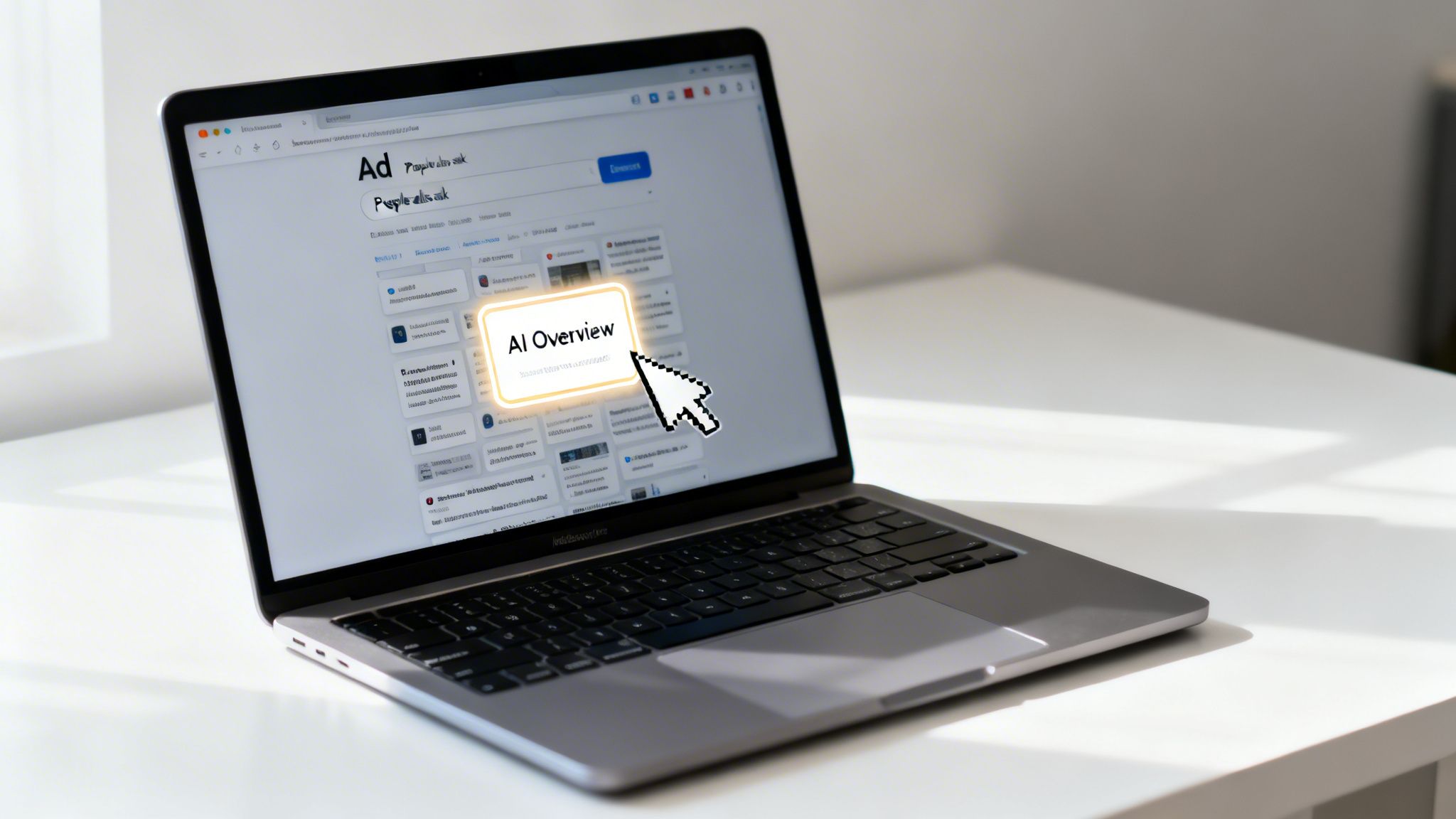
Winning here means changing your entire mindset. Having a good ad isn't good enough anymore. Your ad has to be the most relevant, most obvious answer to a user's problem just to get noticed.
The cliff of ad positions
The value of each ad position isn't a gentle slope. It’s a cliff. The difference between being in position #1 and position #3 isn't a small step down; it's a freefall in visibility and clicks. We're all wired to look at the top, and Google's design just reinforces that instinct.
We're talking about a world where the top organic result can pull a CTR of nearly 40%, while your paid ad sits right there, lucky to get a fraction of that attention. Fresh 2026 data shows just how brutal this drop-off is. The first organic result can see a CTR between 38.9% and 42.9%, while position #2 plummets to 18.7-29.5%. By the time you get to position #10, you're looking at a pathetic 1.6%. You can see the full breakdown in this report on Google CTRs by ranking position.
The AI overview problem
As if that wasn't enough, AI Overviews now squat on roughly a third of all search pages. These generated summaries are sucking up clicks that used to go to the top organic and paid links, pushing the average top paid search CTR down to around 1.5% in 2026. This isn't just a minor shift; it’s a fundamental rewiring of how people get answers.
This isn't meant to discourage you. It's meant to ground you in reality. In this environment, generic ads and one-size-fits-all landing pages are a death sentence for your budget. You’re just paying to be ignored.
To win, your ad has to be so hyper-relevant it feels like the only logical choice. It has to perfectly match what search intent is because the fight for that single click has never been more intense.
Anything less is just burning cash. 🤷♂️
Practical ways to actually improve your CTR
Alright, enough theory. Let's get into what actually works. Boosting your click-through rate isn't some dark art; it's a process of pulling the right levers. You don't need a massive budget, just a ruthless focus on what matters.
And it all boils down to one simple, powerful idea: relevance. Your only job is to be the most obvious, most helpful answer to whatever a user is searching for at that exact moment. Everything else is just noise.
Obsess over message match
The single biggest driver of CTR is message match. This means drawing a straight, unbroken line from the keyword they searched, to the ad they saw, to the landing page they hit. It should feel like a single, seamless thought.
Bidding on AI accounting software and then dumping users on a generic Our Services page is just lazy. It shatters the user's trust and screams that you don't actually have what they want. They'll bounce, and Google will hammer your Quality Score for it.
The second a user has to ask, is this what I was looking for? you've lost. Your ad and landing page headline need to be a near-perfect mirror of the search query. This is the highest-leverage thing you can possibly work on.
Write creative that stops the scroll
Relevance earns their attention, but your creative has to earn the click. In a sea of boring, look-alike ads, your copy needs to have a pulse. It has to interrupt the scroll and spark a little urgency or curiosity.
To make your ads impossible to ignore, focus on a few key things:
- Powerful Headlines: Pack them with numbers, brackets, and specific dates to stand out. "7 Ways to Cut AWS Costs in 2026" is a world away from "Cloud Cost Savings."
- Emotional Triggers: Don't just list what your product does; sell what it does for them. Hit on their pain points like Tired of Wasting Ad Spend? or their ambitions like Build Your First AI App in 10 Minutes.
- Stronger CTAs: Tell people exactly what to do next. Learn More is weak. It’s a cop-out. Be direct and confident with Get Your Free Demo, Request Your Quote, or Start Your Free Trial.
Maximize your real estate
Finally, use every tool Google gives you to take up more space and give people more reasons to choose you. Ad extensions are free real estate on the search results page—not using them is malpractice.
When you combine perfect message match, creative that connects, and all the ad extensions you can get your hands on, you create an ad that doesn't just show up—it dominates. That's how you win the click. 🔥
How to scale CTR improvements with AI and automation
Let’s be real. Everything we just covered—obsessing over message match, writing brilliant creative, A/B testing every little thing—is a complete nightmare to do by hand.
It's one thing to get it right for your top 10 keywords. But when you're managing hundreds or thousands? That's when you hit a wall. This is where modern tech gives you a serious, almost unfair, advantage.
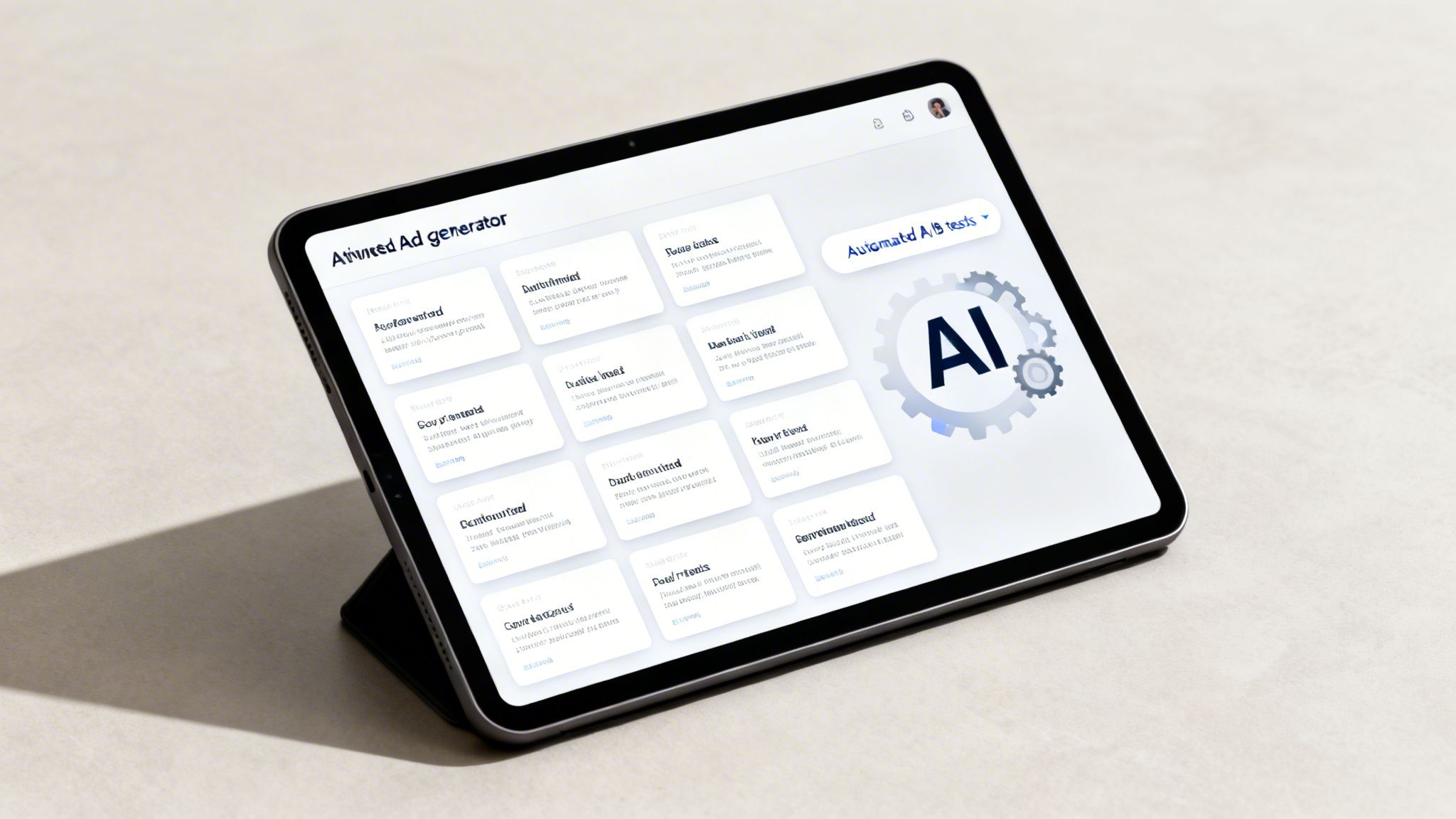
No human can realistically create a unique, hyper-relevant ad and a perfectly matching landing page for every single keyword. It's impossible. But it’s exactly what AI is built to do. This is the problem I’m obsessed with solving with my company, dynares.
An AI-powered system can generate thousands of ad and landing page variations in an instant, each one tailored to a specific keyword and the intent behind it. This is how you scale the tactics that actually work, instead of just talking about them.
Putting AI to work for better CTR
Instead of getting bogged down in manual campaign tweaks, an automated system can take on the grunt work. This opens up a level of precision that used to be reserved for huge companies with massive teams.
An AI system can inject keywords at scale, run A/B tests automatically, and optimize budgets intelligently.
This isn't about replacing marketers. It's about giving them superpowers. It’s about taking the soul-crushing, repetitive work off their plates so they can finally focus on strategy and growth. 🚀
This idea of matching content to intent also applies to organic search. Understanding things like ChatGPT ranking factors is becoming just as crucial for winning the click there, too.
Ultimately, automation shifts the question from what is a good click-through rate? to how high can our CTR go when our relevance is always perfect? That's a much more exciting problem to have. We’ve written more about how to use these kinds of Google Ads automation tools to your advantage.
Alright, let's clear the air on a few common click-through rate questions I get all the time. There's a lot of conflicting advice out there, so here are some straight answers based on what I see in real accounts.
Is a high CTR always a good thing?
Not always, and this is where a lot of people get it wrong. A high CTR is a great signal, but if those clicks aren't converting, you're just paying for an audience of window shoppers. It's a classic mistake.
Think about it. An ad with the headline Free Laptops for Everyone! would probably get an unbelievable CTR. But you’d just be burning your budget on clicks from a completely unqualified audience that goes nowhere.
Your goal isn't just a high CTR. It's a high CTR from a qualified audience that converts. Always look at your click-through rate next to your conversion rate and cost-per-acquisition (CPA). If your CPA is climbing while your CTR goes up, something is seriously wrong.
How long should I wait to judge my CTR?
You have to be patient here. Don't check your stats after a few hours and start making drastic changes based on a handful of clicks—that’s just noise, not data. You need a statistically significant sample before you can make a real call.
For a new Google Ads campaign, I have a general rule of thumb. I wait for at least 100 clicks or a few thousand impressions before I really pass judgment on an ad or keyword.
For your lower-traffic keywords, that might mean waiting a week or more. The point is to gather enough data so you're confident the performance isn't just random luck. Making decisions too early is a recipe for a trashed budget.
My CTR is low. What’s the first thing I should fix?
If your CTR is in the gutter, the first place to look is almost always your keyword-to-ad relevance. Seriously, don't overthink it. Go straight to the source.
Is the exact keyword you're bidding on showing up in your ad headline? If someone searches for blue running shoes and your ad just says Great Shoe Deals, you've already failed the most basic relevance test. Of course they aren't going to click.
If your message match is solid, the next thing to check is your offer or call-to-action (CTA). It might just not be compelling enough to beat the competition. Look at the other ads on the page—what are they offering? Your ad needs to give someone a better reason to click than the three ads sitting right next to it.
Building campaigns with perfect message match at scale is exactly why I'm building dynares. It automates the creation of hyper-relevant ads and landing pages for every single one of your keywords, driving up your CTR and conversion rates without the manual grind. Check it out at https://dynares.ai.


