
Alright, let's cut through the noise. You're trying to build a business, not collect a library of marketing acronyms.
So, what’s the one number that acts like a pulse check for your paid ads? It’s your Click-through rate (CTR). It’s a simple percentage that tells you how many people who saw your ad actually cared enough to click it.
Think of it less as a metric and more as a direct signal from your market. It tells you, in no uncertain terms, if your message is landing or just becoming part of the digital wallpaper.
What is click-through rate in plain english?

Imagine your ad is a storefront window display on a busy street. Thousands of people walk past it every day—those are your impressions.
Your CTR tells you what percentage of those people were intrigued enough by your display that they stopped, opened the door, and walked inside. Those are your clicks.
A high CTR means your window display is working. A low one means you're just another shop people are walking past without a second glance.
The CTR at a glance table
To make it even clearer, here’s a quick breakdown of this core metric. It’s the first real feedback loop you have in any campaign.
| Metric Component | What It Means | Example |
|---|---|---|
| Impressions | The total number of times your ad was shown. | Your ad appeared 1,000 times. |
| Clicks | The number of times people actually clicked on your ad. | 50 people clicked your ad. |
| CTR Formula | (Clicks ÷ Impressions) x 100 | (50 ÷ 1,000) x 100 = 5% CTR |
The beauty of CTR is its simplicity. No complex calculus, just a straightforward health check on your creative, targeting, and overall message.
Why this metric is non-negotiable
Look, I get it. We're all chasing conversions and revenue. But you can't get a conversion without first getting the click. CTR is the first domino that has to fall for a campaign to have any chance of success.
It’s your campaign's early warning system.
- It screams relevance (or irrelevance): A high CTR is a direct signal to platforms like Google that your ad is a great match for what people are searching for.
- It directly impacts your costs: Better relevance almost always leads to a higher Quality Score, which means lower ad costs and better ad positions. More on that soon.
- It tells you when your creative is stale: If you see a sudden drop in CTR, it’s a good bet your ad has run its course and the audience is no longer paying attention.
Across all industries, the average CTR for Google Search Ads is around 3.17%. That shows just how powerful a high-intent channel can be. People are actively looking for solutions, and a good ad gets the click.
But remember, the goal isn't just any click; it's the right click. A sky-high CTR from a totally irrelevant audience is just an expensive way to burn through your budget. That’s why crafting compelling PPC ad examples that resonate with your ideal customer is so critical.
When you nail that, you don't just get clicks—you get qualified prospects, and your entire funnel starts to work a whole lot better.
Why CTR is your secret weapon in Google Ads
If you think CTR is just a vanity metric, you’re leaving a serious amount of cash on the table. In the world of Google Ads, click-through rate is king. It’s not just about getting attention; it’s a direct lever on your profitability.
Many founders get this wrong. They see a low CTR, shrug, and move on to chasing conversions elsewhere. That’s a fundamentally flawed approach. Ignoring your CTR is like trying to drive a supercar with the handbrake permanently engaged—inefficient, expensive, and frankly, a bit dumb.
The quality score connection
The single most powerful component CTR influences is your quality score. Think of Quality Score as Google's internal rating of your ad's relevance and quality. A high score isn't just a pat on the back; it’s a literal discount on your advertising costs.
That's right, Google financially rewards you for being relevant. A higher CTR signals to Google that users find your ad genuinely useful for their search query. This positive signal feeds directly into a higher Quality Score.
Your CTR is the first and most important vote of confidence you get from the market. It tells Google’s algorithm that your ad isn't just taking up space—it's actively solving a user's problem.
The virtuous cycle of a high CTR
This creates a powerful chain reaction that directly impacts your bottom line. It's a simple, beautiful, and profitable loop that too many advertisers completely miss. It works like this:
- Higher CTR signals relevance to Google. When more people click your ad compared to your competitors, it’s clear you're offering something compelling.
- Relevance boosts your quality score. Google’s primary goal is to give users what they want. By demonstrating you can do that, you earn a better score.
- A higher quality score lowers your cost-per-click (CPC). This is the magic. You can now win the same ad auctions for less money than your competitors, stretching your budget further.
- Lower CPC improves your ad rank. Even with a lower bid, your ad can appear in a higher position, giving you even more visibility and clicks.
This isn’t just theoretical. A high CTR directly translates to a better return on ad spend (ROAS). You pay less for each click, get better ad placement, and attract more qualified traffic—all from focusing on this one crucial metric. It’s the engine of any successful PPC campaign. We’ve gone deep into the mechanics of this, and you can learn more about what Google Quality Score really cares about in 2026 if you want to master this system.
What a good CTR actually looks like
Let's get real about numbers, because 'good' is a uselessly vague word in marketing. What you really need is a reality check. Benchmarks tell you if you're leading the pack, just keeping pace, or falling embarrassingly behind.
A 3% CTR might sound low, but in a specific B2B tech niche, that could be a massive win. Meanwhile, someone in Arts & Entertainment might see average CTRs pushing past 13%. It's all relative, and context is everything. Your job is to know your battlefield.
The great divide: Search vs. display
The single biggest factor dictating a "good" click-through rate is the channel. This all comes down to one simple, powerful concept: intent.
- Search ads: This is high-intent territory. Someone typing ‘emergency plumber near me’ isn't just browsing; they have a problem and they want it solved now. They are primed to click.
- Display ads: This is low-intent. Your ad shows up while someone is reading a blog or watching a video. You're an interruption, so the bar for getting that click is much, much higher.
This chart shows how a high CTR on search kicks off a positive feedback loop in Google Ads, ultimately bringing your costs down.
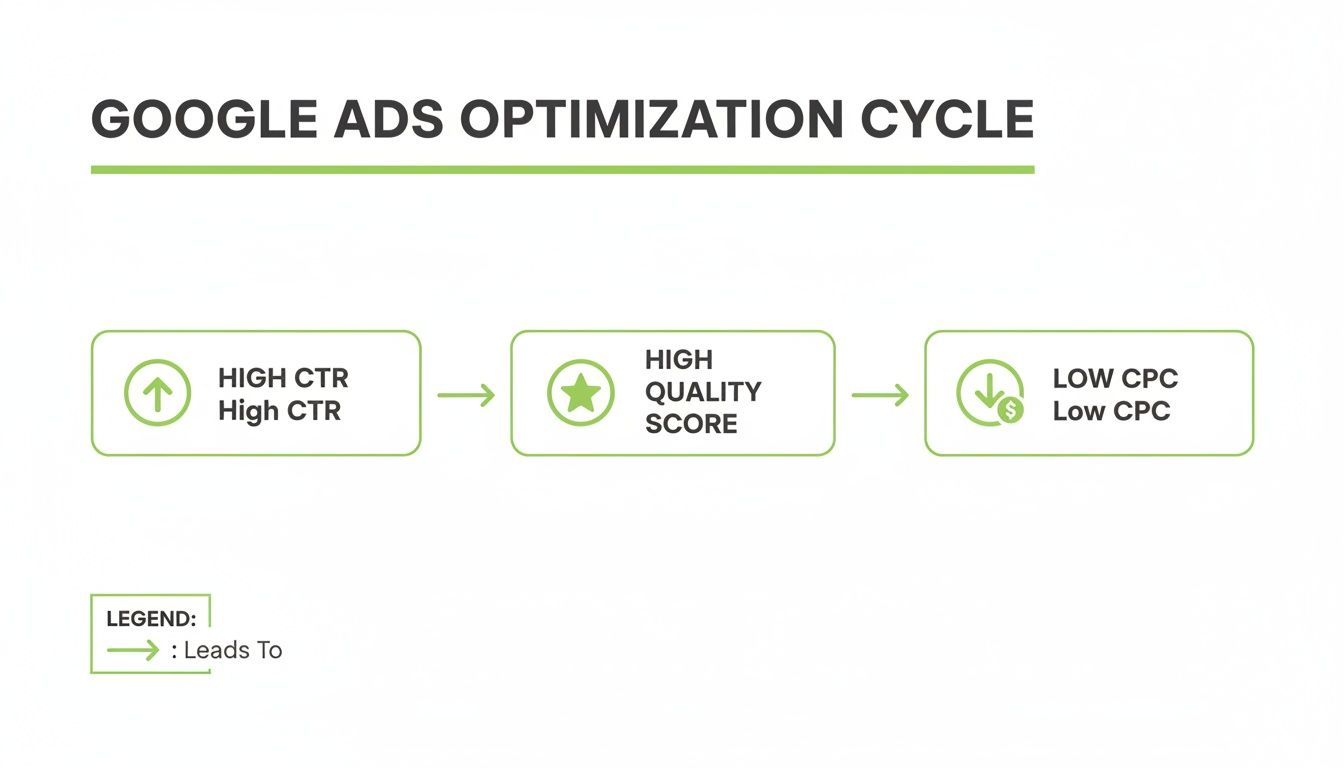
The key takeaway here is that a strong CTR is the first domino to fall. It leads directly to a better Quality Score and a much more efficient ad budget.
Average CTR benchmarks by channel
To see just how much user intent impacts performance, look at the typical CTRs across different advertising channels. The gap is significant.
| Channel | Average CTR | Typical User Intent |
|---|---|---|
| Google Search Ads | 3.17% - 6.66% | High (actively seeking a solution) |
| Google Display Ads | ~0.46% | Low (passive browsing, not solution-aware) |
| Social Media Ads | ~1.3% | Variable (discovery, social proof, some intent) |
| Email Marketing | 2.5% - 4.7% | Warm (already familiar with the brand) |
As you can see, Display ads lag far behind Search because you're catching people in a completely different frame of mind. However, for PPC teams managing campaigns at scale, layering in Display with retargeting can be a smart play for nurturing top-of-funnel traffic. When paired with Search's much stronger CTR, it can help lower overall account CPCs. You can learn more about how to interpret these CTR benchmarks on quimbydigital.com.
Stop asking, 'What is a good CTR?' Instead, ask, 'What is a good CTR for my industry, on this channel, for this specific campaign goal?' That’s the only question that matters.
Your goal isn't just to meet the average; it's to crush it. Use these benchmarks as your starting line, not your finish line. Set ambitious but grounded goals based on where you are today and where the data says you can realistically go. Anything less is just lazy marketing.
How Google's AI overviews change the game for CTR
The ground is shifting under our feet in the search results, and let's be blunt: Google's AI Overviews are a massive disruption. If your entire strategy still hinges on organic traffic alone, you're playing a dangerous game. It's time for a reality check.
For a growing number of searches, people get their answer without ever needing to click a link. This isn't a minor algorithm update; it’s a fundamental change in how people use Google. Recent data shows that for queries with AI Overviews, organic CTR has cratered from 1.76% to just 0.61%.
That's a staggering 61% drop, and you can bet paid CTR is feeling the pressure too. You can read the full analysis on AIO's impact on seerinteractive.com to see just how deep the rabbit hole goes.
But this isn't a doomsday scenario. It's a huge opportunity for savvy advertisers to pull away from the competition. As organic results get shoved further down the page, the real estate at the top—where your paid ads live—becomes exponentially more valuable. This is the moment to double down.
Why your ads are now prime real estate
With organic links losing their prized position, your paid ads have become the new beachfront property on the SERP. Think about it for a second:
- Top-of-page visibility is almost guaranteed: While organic listings are left fighting for scraps below the AI-generated summary, your ads can sit right at the very top, grabbing immediate attention.
- Commercial intent is stronger than ever: A user who reads an AI summary and still scrolls down looking for a link is showing incredibly strong intent. They didn't get what they needed from the summary and are now actively looking for a solution. They're looking for you.
This new reality demands a laser focus on ad relevance. A generic, "good enough" ad just won't cut it anymore. Your ad copy has to be ridiculously compelling to pull that click away from the instant gratification of the AI's answer.
If you're looking for an edge here, understanding what AI copywriting can do is a smart first step. In this new world, a high CTR isn't just a nice-to-have metric—it's your most important survival tool.
Practical ways to radically improve your CTR
Alright, enough with the theory. Let's get our hands dirty.
Improving your CTR isn’t about tiny, insignificant tweaks; it’s about making smart, decisive changes that actually move the needle. Too many PPC managers are still getting the absolute fundamentals wrong, and it's costing them.
The key is relentless alignment. Your keyword, your ad, and your landing page must tell one cohesive, compelling story. If a user searches for "B2B SaaS accounting software" and your ad talks about general business tools, you’ve already lost. That disconnect kills your click-through rate before it ever has a chance.
Nail the ad copy and extensions
Your ad copy is your frontline pitch. It needs to speak directly to the searcher's immediate pain point or desire. It should be so relevant that clicking feels like the only logical next step. Stop writing generic copy and start answering the user’s unspoken question.
Then, you need to dominate the screen. Use every single relevant ad extension Google gives you. Sitelinks, callouts, structured snippets—use them all. They make your ad bigger, more informative, and push competitors further down the page. It's free real estate, and not using it is just lazy.
People click on ads that look like the most complete, authoritative answer to their query. Ad extensions are your best tool for projecting that authority instantly. It’s a simple visual trick that works wonders.
Master your negative keywords
This is the one tactic that so many people ignore, and it’s costing them a fortune. Negative keywords are your defense against irrelevant impressions that are absolutely murdering your CTR. If you sell premium marketing software, you should be adding words like “free,” “jobs,” and “course” to your negative keyword list.
Every time your ad shows to someone looking for a free tool, you get an impression with zero chance of a click. This directly drags down your CTR, hurts your Quality Score, and wastes your budget. Be ruthless with your negatives.
Here are a few quick wins you can implement right now:
- Solve a specific problem: Write headlines that mirror the search query. If they search for a problem, your headline should promise the solution.
- Use numbers and urgency: "Save 25%" or "Get Your Free Demo Today" are direct and create a reason to act now. It's basic, but it works.
- Dominate with extensions: Add at least four sitelinks and a few callouts to every single campaign. No excuses.
Ultimately, your goal is to create an unbroken chain of relevance from search to click to conversion. For an even deeper dive, our guide on how to improve Google Ads performance covers this in more detail.
And if you’re selling on other platforms, many of these principles still apply; for Amazon-specific tactics, you can explore detailed strategies to improve your Amazon CTR.
Stop tinkering and start scaling your ads with automation
Let's be honest for a second. Trying to manually optimize your CTR across hundreds or thousands of keywords is a fool's errand. It's a slow, tedious, and ultimately unwinnable game. You're fighting a battle of inches when you should be building a system that covers miles.
The future of high-performance PPC isn't about working harder; it’s about architecting smarter systems. This is where real leverage comes from—powered by automation and AI. It's how you stop being just a campaign manager and start being the architect of a genuine growth engine.
Moving beyond human limitations
Picture this. Instead of one decent ad serving 50 different keywords, you have 50 unique, hyper-relevant ads. But it doesn't stop there. Each of those ads sends traffic to a unique landing page built to perfectly match the searcher's exact intent.
That level of granularity is humanly impossible to manage. No team, no matter how skilled, can create and maintain that level of message-matching at scale. It’s just not a game you can win by hand.
But for technology? It's effortless.
This isn't just about tweaking your click-through rate. It's about fundamentally redesigning how you approach paid acquisition. It’s the difference between handcrafting one perfect ad and building a factory that produces thousands of them.
The true power of automation in PPC
This isn't about replacing human strategists; it's about augmenting them. Automation frees up your best people from the mind-numbing task of manual A/B testing, letting them focus on high-level strategy, creative angles, and real growth initiatives. The machine handles the repetitive execution, while you handle the vision.
This approach gives you a massive competitive advantage by unlocking:
- Radical relevance: Automatically generate a unique ad and landing page for every single keyword, ensuring your message perfectly matches user intent every time.
- Unbeatable scalability: Go from managing a few dozen ad groups to effortlessly running thousands of unique user journeys without burning out your team.
- Continuous optimization: Let the system automatically A/B test variations of ads and pages, learning in real-time what works and redirecting budget to the winners.
This is how you finally get off the hamster wheel of endless tinkering. It's how you build a paid acquisition machine that not only improves what a click-through rate means for your business but also scales predictably and profitably. It’s time to stop just working in your campaigns and start working on them.
Wrapping up: Your top CTR questions, answered
Alright, let's wrap this up by tackling some of the questions I get asked all the time about click-through rate. No fluff, just straight answers so you can get back to building something that works.
Does a high CTR always mean a successful campaign?
Absolutely not. This is probably the most common trap people fall into.
A high CTR is a fantastic signal that your ad is relevant and compelling—you’ve earned the click. But if those clicks aren't turning into actual leads or sales, you’re just paying for expensive traffic.
Think of CTR as getting people through the door of your shop. It’s a crucial first step, but your landing page and your offer have to close the deal. Always, always look at your CTR next to your real business metrics like Cost Per Acquisition (CPA) and Return On Ad Spend (ROAS). Otherwise, you're just celebrating a vanity metric.
How long should I wait before judging my CTR?
Don't be impatient. Making a call on an ad after just a few hours is a classic rookie mistake. You need enough data for the numbers to mean something.
As a rule of thumb, I don’t even think about making a change until an ad or keyword has at least 100 impressions. A few hundred is even better. For a brand new campaign, give it a few days to a week. Let the algorithm do its thing and give yourself enough data to see real patterns, not just random noise. Patience pays off here.
Can a CTR be too high?
It's rare, but yes, it can happen. An unusually high CTR—say, 30% or more—can sometimes be a red flag pointing to a deeper problem.
It might mean a few things:
- Your copy is misleading: You could be making a promise in your ad that your landing page can't possibly deliver on. This gets you tons of unqualified clicks and a terrible conversion rate.
- Your targeting is way too narrow: You might be hitting a tiny, super-engaged audience but completely missing the broader market you need to actually scale your business.
- You're getting bot traffic: Sometimes, weirdly high numbers are a sign that non-human clicks are messing with your data.
If you see a sky-high CTR paired with an awful conversion rate, it's time to dig in. The numbers need to tell a story that makes sense together.
Optimizing this manually is a battle you can't win at scale. At dynares, we built a platform that automates the creation of high-intent ads and matching landing pages for every keyword. Stop tinkering and start building a real growth engine at https://dynares.ai.


