
Let's be direct. Using a competitor keyword strategy isn't just another tactic on a long list; it's a fundamental survival skill for anyone serious about Google Ads.
You are, in essence, letting your competitors spend their budget to find what works. Your job is to take that intel, execute it better, and do it for less.
Why competitor spying is no longer optional
Honestly, if you're not dissecting your competitors' Google Ads strategy in 2026, you might as well be setting your marketing budget on fire. We're in an era where a single click can cost more than a flight to Lisbon. It's that intense. This isn't just 'competitor analysis' anymore. It's a core survival tactic.
I’ve spent years navigating this brutal landscape of rising CPCs and endless bidding wars. The key is a simple mindset shift: stop seeing what your competitors are doing as a threat. Start seeing it as a goldmine. They are spending their own money to validate which keywords have the highest intent. All you have to do is pay attention.
The goal is to take their data and build a smarter, more efficient growth engine for yourself. To do that, you need a system. This isn't about peeking over their shoulder; it's about establishing a winning competitive analysis framework that turns their ad spend into your market intelligence.
The soaring cost of ignoring the competition
The economic case for this is painfully clear. The Google Ads auction has never been fiercer. We see keywords in high-stakes industries like legal services and finance commanding jaw-dropping costs-per-click. It's not an exaggeration to see clicks going for over $1,500.
A recent full Ahrefs analysis highlighted just how extreme it's become, with a term like 'Wrongful death lawyers Los Angeles' hitting $1,050 for a single click. That kind of price tag is the direct result of a fierce battle for the top few spots on Google's first page. It forces advertisers to either bid higher or get pushed out entirely.
This reality means you can't afford to guess. You have to use data to guide every single move, and your competitors are one of the richest data sources you have. This isn't about being sneaky; it's about being smart with your capital. By digging into what your rivals are betting on, you can find profitable keywords you completely missed, sidestep wasteful spending on terms that look good but don't actually convert, and pinpoint exactly how to position your offer as the superior alternative. For any PPC manager today, this is one of the highest-leverage activities you can do. If you're looking for more actionable tips on this, our other guides offer some great Google Ads advice.
Alright, let's stop talking theory. It’s time to get our hands dirty and figure out exactly what keywords your competitors are betting their budgets on. This isn't about exporting a messy CSV and calling it a day. We're building an intelligence report. Reverse-engineering their campaign structure, estimating their spend, and finding the ad copy that actually pulls clicks.
Let's be honest: most tools just give you a giant, overwhelming list of keywords. Most marketers stare at it and have no idea what to do next. The goal here is a repeatable workflow you can use immediately. This is how you stop guessing and start hunting. 🎯
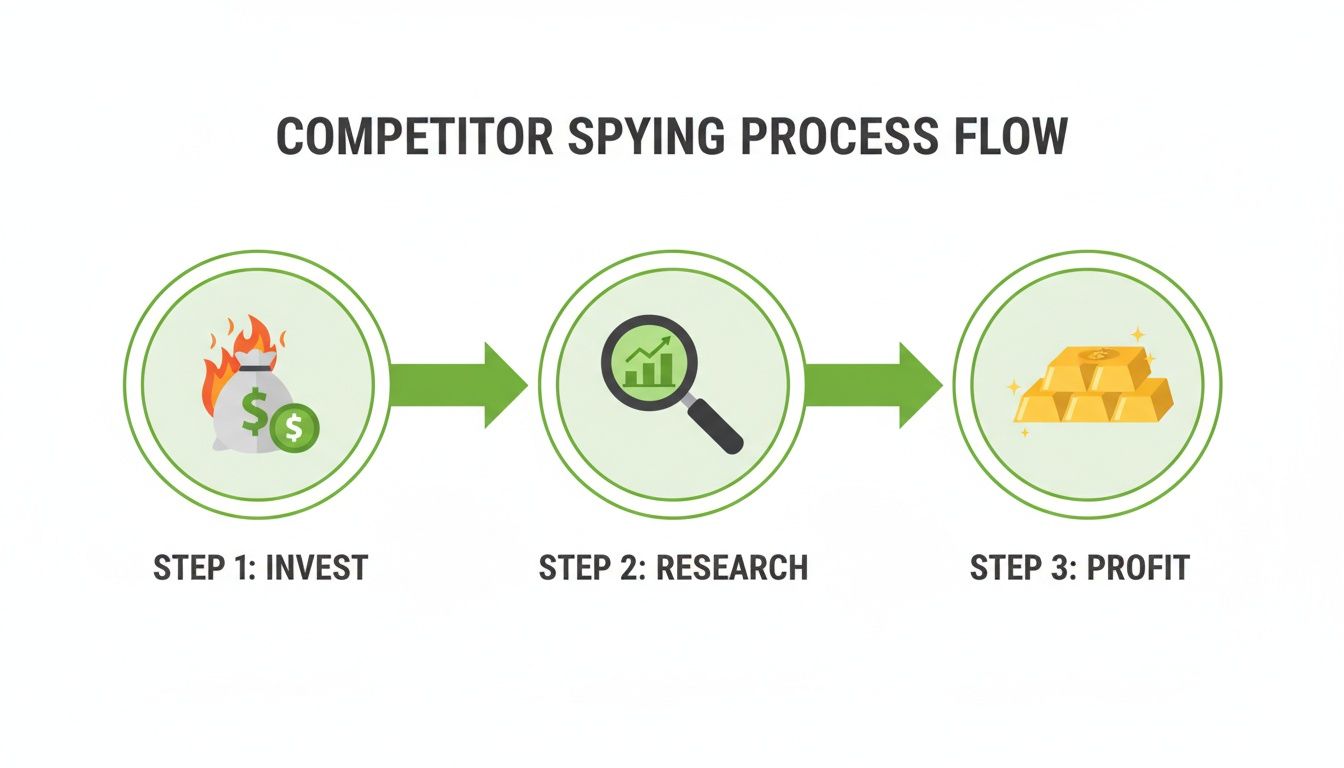
The idea is simple. Your competitors burn cash testing the market. You watch what works, ignore what doesn't, and cherry-pick the gold for your own campaigns.
The right tools and a process that works
You'll find dozens of platforms that promise the world, but I stick to a couple that actually deliver. For raw power and depth, my go-to is Ahrefs, but Semrush is a rock-solid alternative. Honestly, the tool is less important than the process. Don't get stuck in analysis paralysis—just pick one and master it.
Here’s my stripped-down process for pulling out actionable intel:
- The initial domain dump: Start by plugging your top three to five competitors' domains into the tool’s paid search section. Instantly, you’ll see the keywords they bid on, the ads they're running, and the landing pages getting the traffic.
- Filter for the heavy hitters: Don't get lost in the long tail just yet. Filter for keywords driving the most traffic. These are their workhorse terms—the ones they’ve already spent a fortune optimizing.
- Analyze their angles: Now look at the ads tied to those top keywords. What pain points are they hitting? What value props do they highlight? This is free market research, paid for by your competition.
This kind of analysis isn't optional anymore. By 2026, the top advertisers are locking down 50-75% of the impression share on prime commercial keywords, leaving everyone else to fight for scraps. You can expose their entire playbook—every term they bid on, their estimated CPCs, and where they might be leaving a gap for you. For example, high-intent searches for professional services show insane CPCs, forcing marketers to get surgically precise with their bids. For more on this, you can check out the latest Google Ads statistics and trends on strataigize.com.
I once found a competitor spending a tiny amount on a super-specific, long-tail keyword: "integrating CRM with legacy accounting software". It looked insignificant on the surface, but the buyer intent was off the charts. We built a targeted campaign around it, and it became one of the most profitable lead sources for a SaaS product I was scaling. They did all the hard work; we just paid attention.
This initial analysis is just the start. The next step is sorting this raw data into something you can actually use. Before we dive into that, if you need a refresher on the fundamentals, check out our guide on how to perform keyword research.
Should you bid on competitor brand names
Alright, let's talk about the spicy stuff: bidding on your competitor's brand name. This is where people get nervous, so let's just clear the air. It can be an incredibly powerful move, but it’s often misunderstood. Get it wrong, and it’s a brilliant way to burn cash. Get it right, and you can steal market share right from under their nose.
First, the legal question. Is it even allowed? Yes. As long as you aren’t deceptive, Google generally allows you to bid on an adword competitor keyword. Just don't try to pass yourself off as them—that's trademark infringement territory, and it’s a fast track to getting your ads disapproved. I’m a founder, not a lawyer, but the practical advice is simple: be upfront about who you are and why you're the better choice.
The real question isn't "can you," but "should you." And the answer, like most things in PPC, is: it depends.
When it's a smart move
This isn't about starting a war; it's about seeing a market opportunity. I've found this tactic works best in a few specific scenarios. If you tick these boxes, it might be time to get aggressive.
- You have a genuinely superior product: If you can honestly offer a better solution—better features, better service, better pricing—bidding on their name is a direct invitation for their dissatisfied customers to find you.
- They're a big, slow incumbent: Large companies are often terrible at PPC. Their ad copy is generic, their landing pages are slow, and their campaigns are a mess. You can be more nimble, creating highly relevant ads and pages that win on Quality Score, even if they have a bigger budget.
- Their brand is a synonym for the category: Think of when people search "Salesforce" when they just mean "CRM," or "Hootsuite" when they're looking for social media tools. You’re not stealing a customer; you're inserting yourself into the research phase for a user who might not even know alternatives exist.
This isn’t about being petty. It's about giving potential customers a choice at the exact moment they’re looking for a solution. Your ad copy needs to be crystal clear. Use headlines like "A Better Alternative to [Competitor]" or "Tired of [Competitor]? See Why We're Different." This acknowledges the user's search, respects their intelligence, and positions you as a compelling option, not a cheap knockoff.
When it's a dumb way to burn cash
On the flip side, there are times when this is a complete waste of money. It becomes an ego-driven move that delivers nothing but a high invoice from Google. Avoid it if this sounds like your situation:
- You're an unknown brand: If nobody knows who you are, a user searching for a trusted brand is very unlikely to click your ad. You haven't earned their trust yet. The click-through rate will be low, your Quality Score will suffer, and your CPCs will be sky-high.
- Your product is a 1-to-1 match: If there's no clear differentiator—no better features, no better price, no better service—you’re just paying a premium for low-intent clicks. Why would they switch if you're just a carbon copy?
- The competitor is highly aggressive: If they have a savvy digital marketing team, they will notice and they will fight back. This can escalate into a bidding war where the only winner is Google's bank account. Your money is almost always better spent on non-brand keywords where you can win cleanly.
The bottom line is simple. Use this tactic surgically, not as a blunt instrument. Test it with a small, controlled budget. Track your return on ad spend religiously. And be ready to kill the campaign if it’s not making you money. That's not just good PPC; it’s good business.
Building your campaign to outmaneuver competitors
So you have a list of competitor keywords. Great. Now for the part where almost everyone messes up. Most marketers take that list, dump it into a new campaign, flip on broad match, and then act surprised when their budget evaporates with nothing to show for it. A keyword list is not a strategy. It's just an ingredient.
The real goal isn't just to bid on their name; it's to be more relevant for their own terms than they are. This sounds bold, but it's completely doable if you get the structure right. A surgically precise campaign setup is how you earn a higher Quality Score, which directly translates to lower costs and better ad ranks.
Match types, bids, and negatives
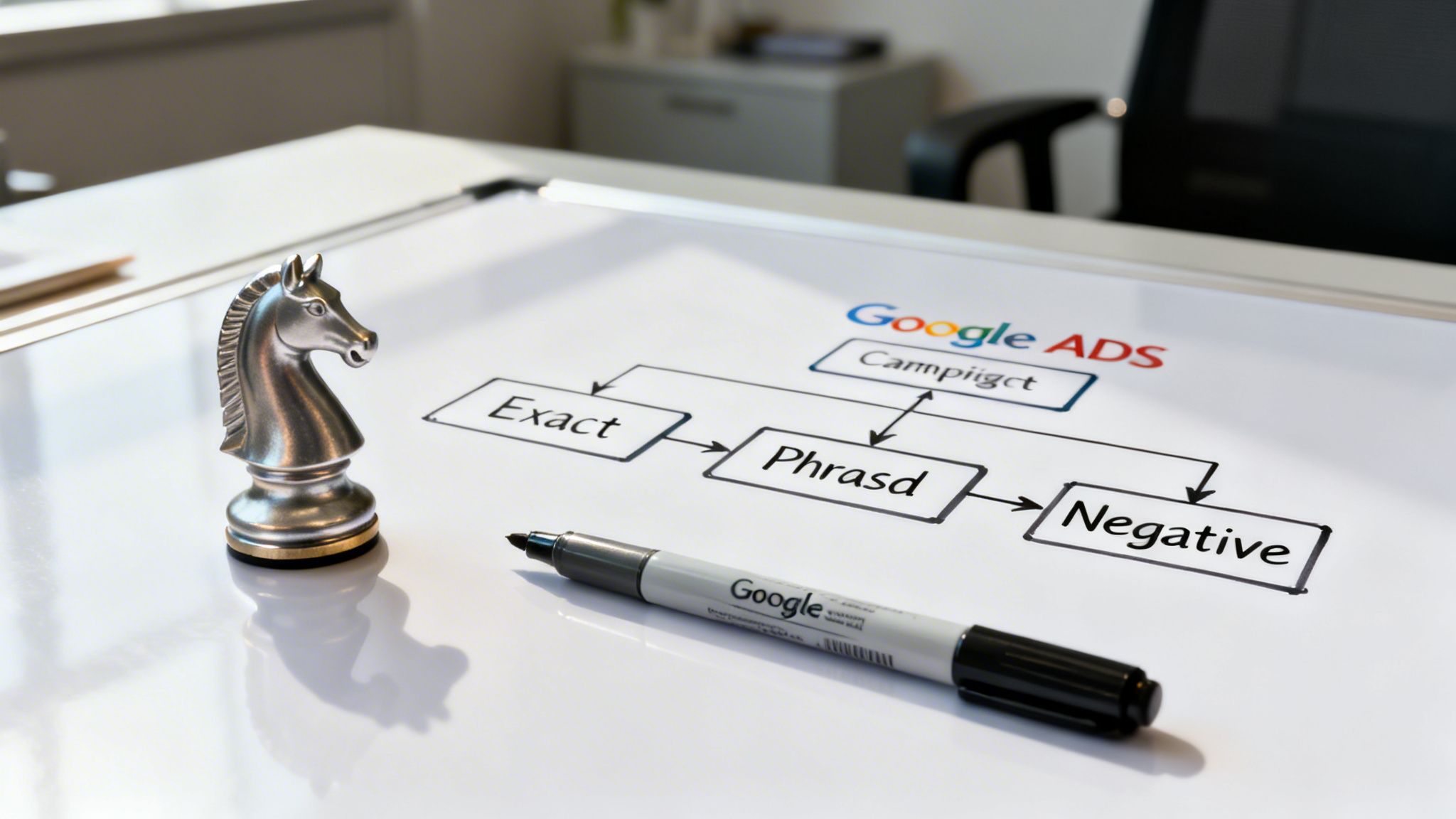
Let’s get into the mechanics of your adword competitor keyword setup. First rule: get your hands off broad match. It's the fastest way to light money on fire by matching your ads to totally irrelevant searches. Precision is the whole game here. This is where solid AdWords management proves its worth, making sure your targeting and bids are sharp from day one.
A clean, tight campaign structure does more than save you money. It sends a clear signal to Google that you know exactly who you're after. That focus is the foundation of a superior Quality Score.
Crafting ads that convert
Your ad copy is where the battle is won or lost. It has to instantly acknowledge why the person is searching and give them a better reason to click your ad instead of the one they were looking for. Generic messaging is a death sentence here.
Be direct in your headline. Something like "Looking for [Competitor]? Try This" or "A Better [Competitor] Alternative" cuts straight to the point. It meets the searcher in their context and positions you as an immediate, superior option. In the description, you highlight your strengths against their known weaknesses. Are they notorious for bad customer support? Talk about your 24/7 human help. Is their product overpriced? Emphasize your value or total cost of ownership.
You have about three seconds to change someone's mind. They were literally looking for someone else. Make every character work to convince them that clicking your ad is the smarter move. For a deeper look at the whole process, check out our guide on Google Ads campaign optimization.
Here’s where most marketers completely blow it. They manage to steal a click from a competitor, only to dump that high-intent visitor onto their generic homepage. It’s a fundamentally dumb move, and it wastes a staggering amount of money. Why? Because you have about three seconds to convince that person they made the right choice. If your landing page doesn't instantly validate their click, they're gone. And they aren't coming back.
The problem is laziness. Brands send this incredibly specific traffic to a one-size-fits-all page, and then wonder why bounce rates are through the roof. The message gets diluted, the user gets confused, and your return on ad spend tanks.
Your landing page is a weapon. use it.

A high-converting competitor landing page isn't about fancy design; it's about surgical precision. Its only job is to prove you are the better choice, right now. Forget the fluff. This is where 90% of marketers fail, but it's where you can win.
Building a page that converts a competitor's customer
Your page needs to be built with one clear purpose: to acknowledge the user's original search and immediately present a better path.
Here are the non-negotiable components:
- A direct alternative headline: Don't be subtle. Your H1 needs to hit them over the head. "Looking for a [Competitor Name] Alternative?" or "Tired of [Competitor Name]? See Why Teams Are Switching." This shows you understand their journey.
- A crystal clear value proposition: What makes you the smarter choice? Is it price? Features? Better support? State it plainly, right below the headline.
- A simple comparison chart: This is your knockout punch. Create an honest, easy-to-scan table comparing your offering to theirs. Highlight where you win, but don't be afraid to be transparent. It builds incredible trust.
- Targeted social proof: This is crucial. Feature testimonials from customers who switched from that specific competitor. Logos are good, but a quote that says, "We left [Competitor] for this and never looked back," is pure gold.
Stop counting leads. start tracking revenue.
Alright, let's talk about the final piece of the puzzle. This is where you graduate from simply "running PPC" to building a predictable profit engine. Counting leads is for amateurs. We track revenue.
By 2026, this isn't a "nice-to-have"—it’s table stakes. The Google Ads auction is ruthless. With CPCs in some sectors like legal and finance hitting $1,215 and the average CPC climbing 18% year-over-year, you cannot afford to guess. Especially when 43% of users are buying products they see in relevant ads, you have to know your exact ROI. For a deeper dive on these rising costs, check out this brutally honest 2026 keyword analysis on blog.mean.ceo.
It's not enough to know a keyword generated a lead. You have to know if that lead turned into €5,000 or €50. This is the difference between scaling a campaign and just running it.
This means setting up value-based conversions in Google Ads. You need to pass the actual deal value from your CRM back into your Ads account, tying real money to the specific adword competitor keyword that brought in the business. This is how you close the loop. It’s how you prove these campaigns are a profit center, not just an expense. It shows you which competitor terms are driving growth and which are just expensive, low-quality clicks.
To get started on this critical setup, you can follow our complete guide to Google Ads conversion tracking setup.
Got questions? let's get real.
When it comes to bidding on competitor terms, I see the same questions pop up again and again. It’s easy to get stuck overthinking the details, so let's cut through the noise with some straight answers. No fluff. Just what works.
How much of my budget should I gamble on competitor keywords?
There's no magic spreadsheet formula for this. The right way to think about it is as a high-risk, high-reward experiment. You have to be willing to lose a little to prove you can win a lot. Start small. I always tell clients to carve out 10-15% of their total search budget for a dedicated competitor campaign. Treat it like a separate P&L. Its only job is to prove it can be profitable.
Your goal is to track cost-per-acquisition (CPA) and return on ad spend (ROAS) for these specific campaigns completely separately from your brand and non-brand efforts. If the ROAS is positive and beating your core campaigns after a month or two, you have a green light. If it’s a cash fire, you either get smarter or you kill it. This is about finding new, profitable acquisition channels, not ego. Let the numbers tell you whether to scale or stop.
What's the best tool for spying on competitor keywords?
Honestly, the "best" tool is the one you'll actually use every week. Don't get lost in a sea of feature comparisons. For pure firepower and unearthing a massive list of what your rivals are bidding on, my first stop is almost always Ahrefs, with SEMrush being another killer option.
But don't you dare overlook the goldmine hiding in plain sight: Auction Insights inside your Google Ads account. This report is brilliant because it’s not theory—it’s reality. It shows you exactly who you’re up against in the live auction, what your impression share is, and how often you're outranking them.
The real trick is to use them together. One tells you what's possible; the other tells you what's happening. You need both.
Can I really compete with a huge competitor on Google Ads?
Yes. Full stop. The fear of big budgets is the most common reason people fail before they even start. You can't outspend them. So you have to out-think and outmaneuver them. Big companies are often slow, bogged down in bureaucracy, and shockingly inefficient. Their weakness is your strength.
You win by being nimble. Here’s how:
- Go granular. Target hyper-specific long-tail keywords they ignore because the search volume is "too low" to make it onto their quarterly reports.
- Be more relevant. Create tailored, high-converting landing pages for each ad group while they're stuck sending traffic to a generic, one-size-fits-all corporate page.
- Obsess over Quality Score. Superior relevance between your keyword, ad, and landing page means you can often pay a lower CPC even when their max bid is higher.
Your edge is speed and relevance. A massive battleship takes miles to turn. You're a speedboat. Use that agility to run circles around them. It's not about the size of your budget; it's about the precision of your attack.
At dynares, we built a platform to give you that speedboat agility. It automates the creation of hyper-relevant ads and landing pages for every single keyword, giving you an almost unfair advantage in achieving a high Quality Score at scale. If you're ready to stop being outspent and start out-smarting the competition, see how dynares can help.


