
Let's cut the fluff. You want to know the average cost per lead by industry, and the blunt answer is: there's no single magic number. A lead for a B2B SaaS platform lives in a completely different universe than one for a local car wash. It's just that simple.
But to give you a ballpark, you can generally expect to pay anywhere from €30 to over €200 per lead, depending entirely on your sector.
The unfiltered truth about industry CPL benchmarks
Alright, you're here for the numbers, so let's get to them. But first, a quick reality check.
The whole idea of a single 'average cost per lead' is a myth. The price you pay for a lead boils down to what you're selling, who you're selling it to, and how much competition you're up against. These benchmarks aren't just data points; they're about understanding the why behind the figures.
Think of this as your baseline—the starting point you need before you can even think about optimization. It helps you set realistic goals so you aren't chasing ghosts or, even worse, leaving money on the table.
Why the huge price differences?
The variance in CPL across industries is massive, and it all comes down to a few core economic drivers. Industries with high-value customers can afford to pay more for a lead because the potential return is huge. It's not complicated.
- Customer lifetime value (LTV): A law firm can easily justify paying a premium for a lead because a single client could be worth tens of thousands over their lifetime. An e-commerce store selling t-shirts can't play that same game.
- Sales cycle length: B2B tech often has long, complex sales cycles involving multiple decision-makers. The marketing effort required to nurture that one lead is intensive, justifying a higher upfront cost.
- Market competition: The more businesses bidding on the same keywords and audiences, the higher the cost. It's no secret that high-stakes industries like finance and legal are notoriously competitive, which drives up ad prices for everyone involved.
This chart gives you a quick visual of just how dramatic that difference can be.
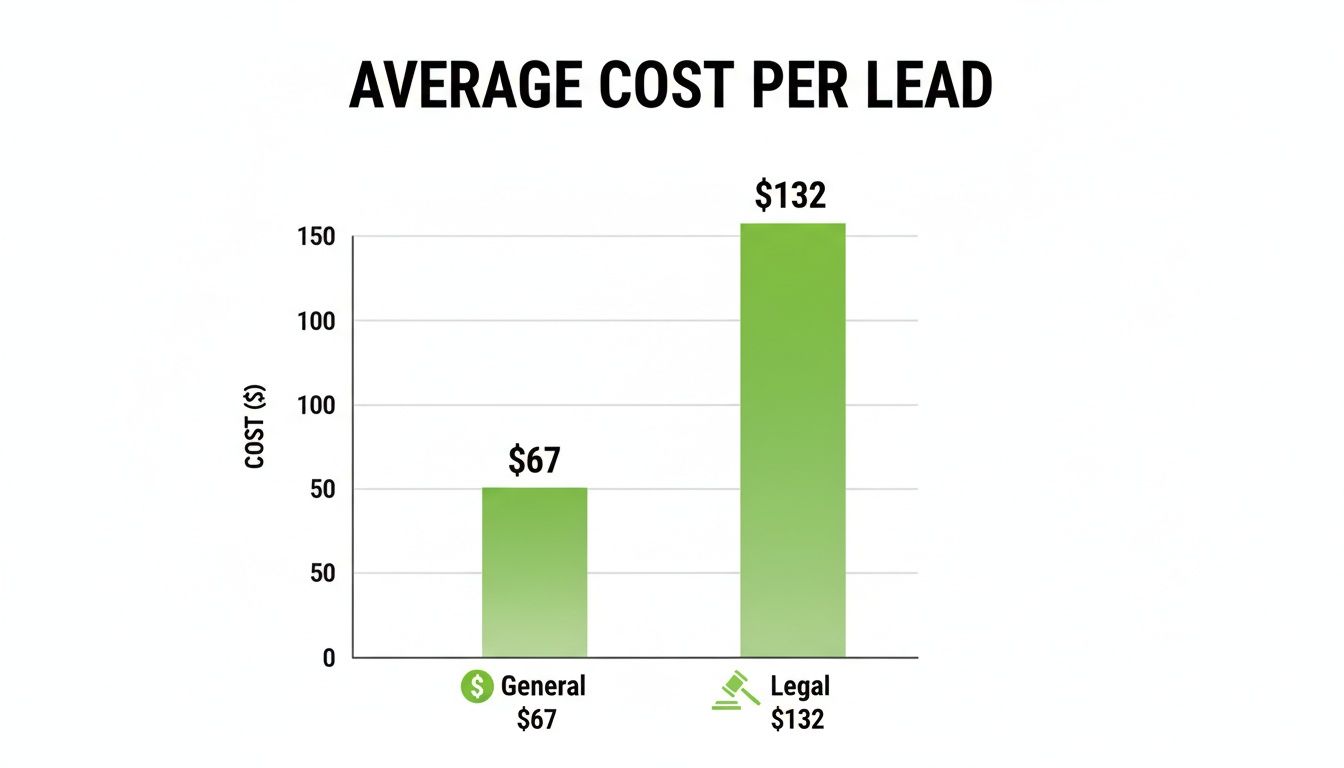
As you can see, specialized, high-value sectors can have a CPL that's nearly double the general average. It’s a perfect illustration of how much industry context really matters.
Average CPL benchmarks across key industries (Google Ads)
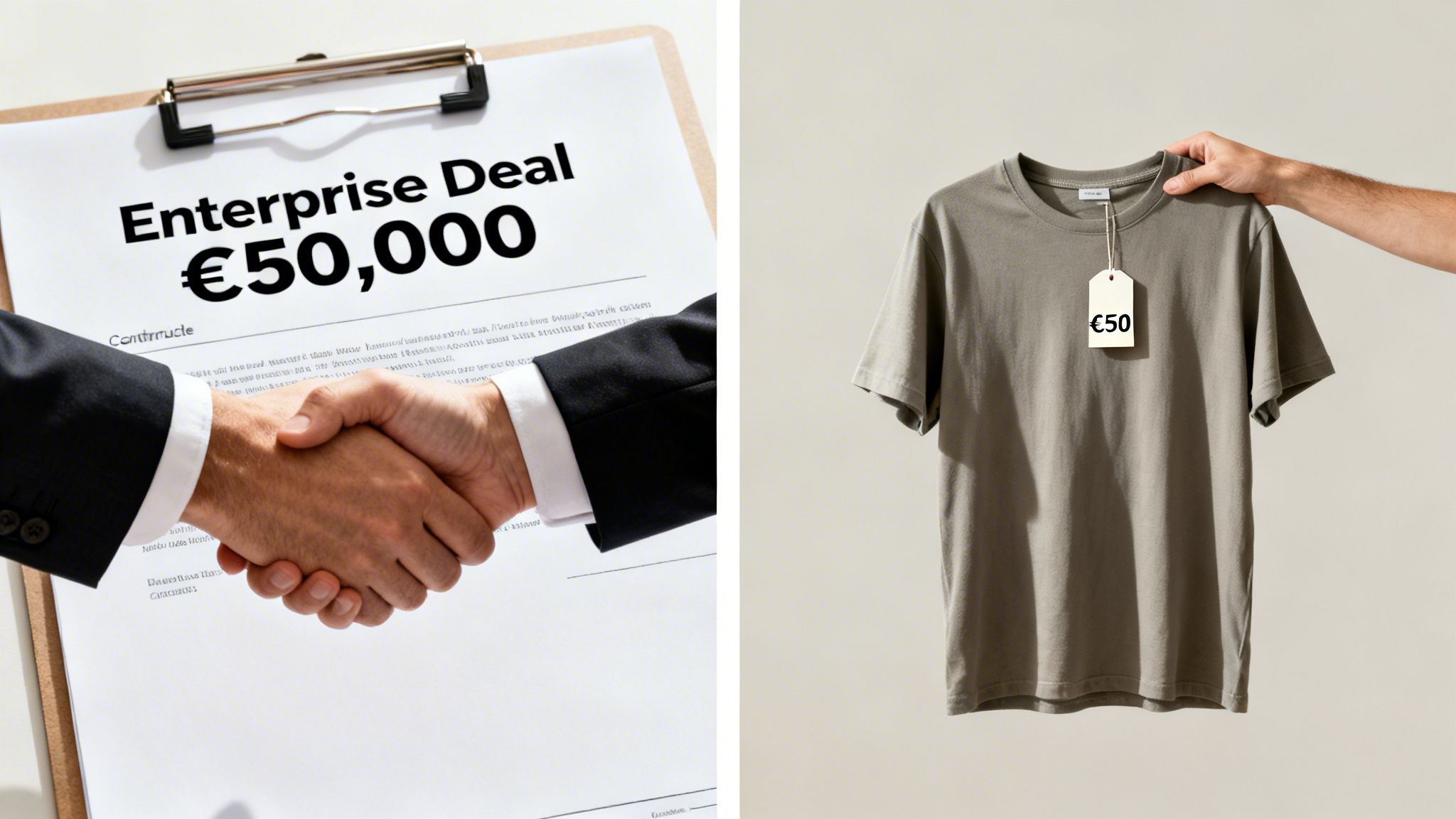
To give you a clearer picture, here’s a snapshot of recent cost per lead data for various industries. This shows the wide variance in what businesses are paying for leads on search.
| Industry | Average CPL (Low End) | Average CPL (High End) |
|---|---|---|
| Technology/SaaS | €120 | €200+ |
| Finance & Insurance | €80 | €150 |
| Legal | €110 | €160 |
| Healthcare | €75 | €125 |
| B2B Services | €90 | €140 |
| Real Estate | €60 | €110 |
| Education | €55 | €95 |
| Home Services | €45 | €85 |
Source: Data compiled from various industry reports and marketing analytics platforms (2023-2024).
Keep in mind these are just averages. Your actual costs will be influenced by your specific niche, audience targeting, and ad quality. But it's a solid reference point for what's 'normal' in your space.
And this trend is only accelerating. Between 2023 and 2024, the average cost per lead from search ads shot up by roughly 25% across most industries—a clear sign of growing competition. Legal services, for instance, saw CPLs climb from around €111 to over €131 in that period, reflecting the intense demand for qualified prospects.
Ultimately, a CPL number without context is useless. It’s a vanity metric until you stack it up against your conversion rates and customer value. If you're struggling to figure out if your numbers are healthy, a great next step is to understand what is a good conversion rate for your specific industry.
Why some leads cost a fortune and others are dirt cheap
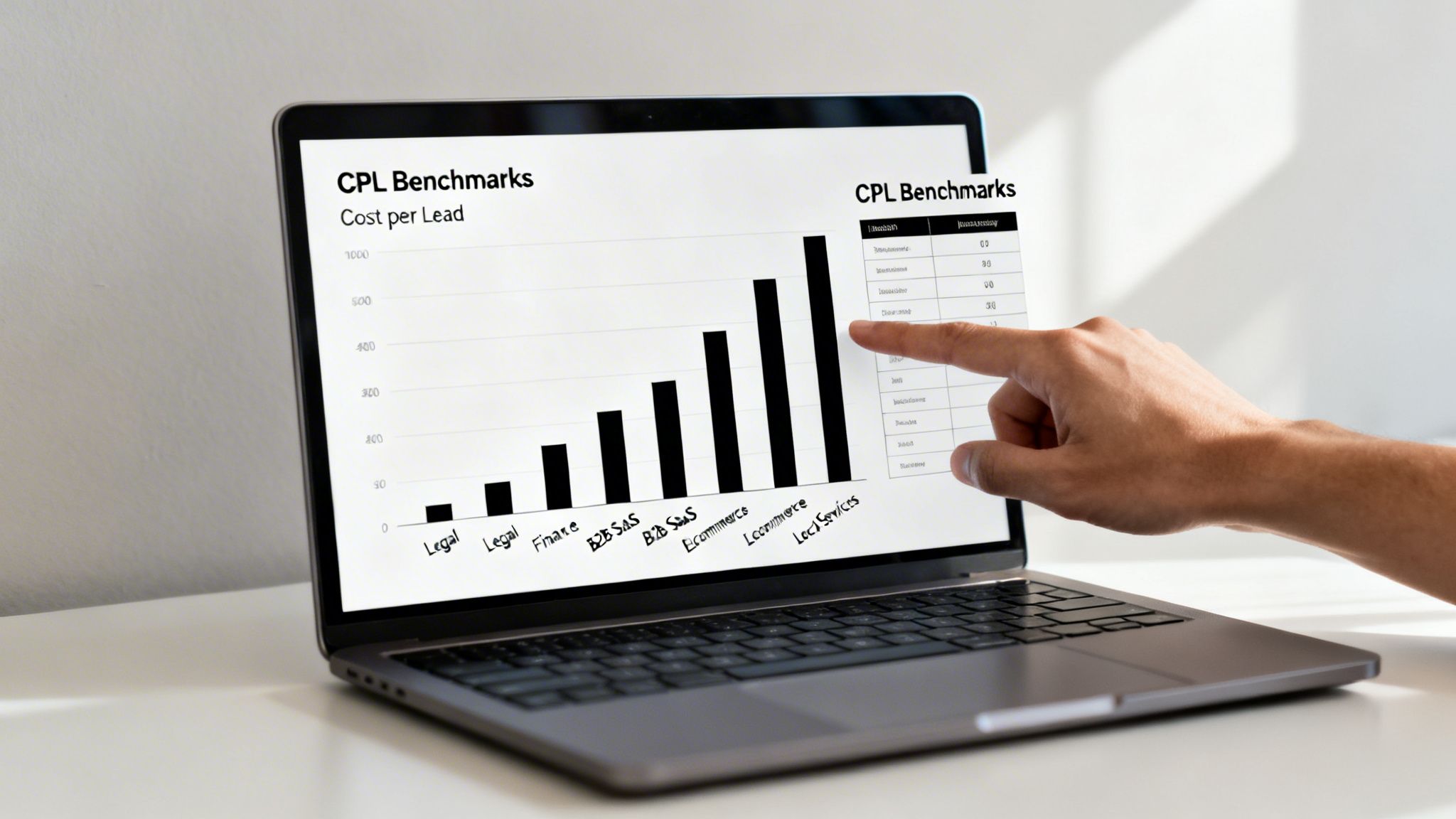
Let's get one thing straight. If you're comparing the cost of a lead for a €50,000 enterprise software deal to a lead for a €50 t-shirt, you're not just comparing apples and oranges—you're comparing apples and rocket ships.
It's a fundamentally different game. Blaming your ad platform for the price difference is just lazy.
The reason a law firm can justify paying €150 for a single lead while an e-commerce store can't is pure economics. The potential payoff for that law firm is astronomical. Before you can ever know if your CPL is 'good', you have to be brutally honest about the unit economics of your own business. It all starts there.
The big three CPL drivers
Your cost per lead isn't random; it's a direct reflection of your market dynamics. Three factors are doing most of the heavy lifting when it comes to determining your costs.
- Customer lifetime value (LTV): This is the king. A business with a high LTV can—and must—be willing to pay more to acquire a customer. This is why SaaS and financial services have such high CPLs; a single 'yes' can pay dividends for years.
- Sales cycle length: The longer it takes to close a deal, the more marketing touchpoints are needed. For B2B companies with six-month sales cycles, that initial lead cost is just the entry fee for a long-term nurturing process.
- Market competition: If you're in a crowded space, you're going to pay a premium. More competitors bidding on the same audience means higher costs for everyone. Simple supply and demand.
Intent is everything
Beyond the big-picture economics, the single biggest lever on your day-to-day lead cost is user intent. You're not just bidding on keywords; you're bidding on a person's state of mind at a specific moment.
Think about it. The keyword 'emergency plumber' is a desperate cry for help from someone with a credit card in hand, ready to solve a painful, urgent problem. They aren't price-shopping; they're problem-solving. That lead is pure gold. 🔥
On the flip side, someone searching for 'how to fix a leaky faucet' is in research mode. They might become a customer eventually, but right now, they're looking for free information, not a €300 invoice.
The price you pay for a lead is a direct tax on the urgency and commercial intent of the searcher. The more pain they're in and the more ready they are to buy, the more you and your competitors will pay to reach them.
This distinction is critical. Targeting high-intent keywords will always be more expensive, but it's often far more profitable. Trying to save money by only targeting low-intent, informational keywords is a classic rookie mistake that fills your pipeline with tire-kickers who never intended to buy in the first place.
You have to pay to play where the real business gets done.
How to calculate and track your CPL like a pro
If you're spending money on ads and you don't know your CPL, stop. Seriously. Stop what you’re doing and figure it out. Flying blind with your budget is one of the fastest ways to burn cash, and it’s a mistake I see smart founders make all the time.
This isn’t just about doing division. It’s about building a reliable system to track your cost per lead so you can make smart, scalable decisions.
The basic formula and why it’s not enough
At its core, the math is dead simple. Anyone can do this.
Total Ad Spend / Total New Leads = Cost Per Lead (CPL)
So, if you spent €5,000 on Google Ads last month and got 100 new leads, your CPL is €50. Easy, right? But this number is completely useless if the inputs are garbage. The real work isn't the math; it's making sure your data is clean and consistent.
First, define what a 'lead' actually is
This is the first place people get tripped up. You have to be ruthlessly consistent about what you count as a 'lead'. Is it a form fill? A demo request? A newsletter signup? A phone call?
Pick one or two primary conversion actions and stick with them. A demo request is not the same as an ebook download. One shows high commercial intent, while the other is likely just top-of-funnel research. Lumping them together messes up your CPL and hides what’s actually working.
If you change your definition of a lead every other month, you can't compare performance over time. You completely lose the ability to spot trends. And if your conversion tracking isn't firing correctly, your lead count is wrong, and your CPL calculation is pure fiction.
Don't make this rookie mistake
Here's the most critical part: looking at CPL in a vacuum is a massive error. A low CPL means nothing if the leads are junk. A high CPL might be fantastic if those leads turn into huge deals.
You need to view CPL as one piece of a bigger picture. Always pair it with other key metrics to get a true sense of your campaign’s health:
- Lead-to-close rate
- Customer lifetime value (LTV)
- Sales cycle length
This is how you move from just counting leads to actually making money. It gives you the clarity to know that a €100 CPL that closes at 20% is infinitely better than a €30 CPL that closes at 2%. (Hint: it is, by a huge margin).
Understanding the math is just the first step. For a deeper dive, check out our guide on how to calculate cost per lead for more advanced scenarios and examples. This is the practical, hands-on work that separates the amateurs from the pros.
B2B vs B2C CPL is a tale of two different worlds
Let’s be direct: generating a lead for a B2B tech company is a completely different universe than for a B2C ecommerce brand. The costs, the channels, the entire mindset—they're worlds apart. It’s not just a small gap; it’s a fundamental split in how you should think about your marketing budget.
If you’re coming from a B2C background and see B2B CPLs for the first time, you might think the numbers are a typo. A CPL that would be a home run in ecommerce—say, €15—would be an absolute disaster for most SaaS businesses. It’s a giant red flag that you're attracting the wrong crowd entirely.
Why the massive gap in CPL?
The chasm between B2B and B2C lead costs isn't random. It’s a direct result of the core economics of what’s being sold and who’s doing the buying. The stakes are just monumentally higher in B2B, and that translates directly into higher costs to get your foot in the door.
A single enterprise deal in B2B can easily be worth hundreds of thousands of euros. Compare that to selling a pair of shoes. The potential ROI on that one deal justifies a much higher upfront investment.
B2B sales don't happen with a single click. They often involve months of nurturing and sign-off from entire committees. Your CPL is just the price of admission for this long-term, relationship-building marathon.
In B2B, you're not targeting 'people who like running'. You're targeting 'VPs of Engineering at fintech companies with 500+ employees in the DACH region'. Reaching that one specific person is expensive, but it's also incredibly efficient when you get it right.
This is exactly why a platform like LinkedIn, despite its sticker shock, can be a goldmine for B2B. You’re paying a premium for surgical precision. Meanwhile, Meta Ads can be brutally efficient for B2C brands trying to reach a massive consumer base at a lower cost.
The numbers tell the story
The data paints a stark picture of this divide. Across B2B sectors, paid channels average around $310 per lead, while organic channels come in significantly lower at $164. LinkedIn advertising, a prime example of this premium B2B playground, averages $110 per lead—that's 57% higher than what you might pay on Google Search for a similar campaign. You pay more because the targeting and lead quality are supposed to be better. You can dig deeper into these numbers by exploring insights on B2B CPL benchmarks on sopro.io.
On the flip side, consumer-facing businesses operate in a different reality. Their blended CPL averages just $91, and a platform like Meta can deliver leads for as little as $27.66.
This isn't about one channel being 'better' than another. That's a dumb way to look at it. It’s about using the right tool for the right job and understanding the economics of your specific market.
Getting your head around the B2B vs. B2C difference is mission-critical. It shapes your budget, your channel strategy, and your expectations. For those of us deep in the B2B world, mastering the art of the high-stakes lead is everything. A great place to start is our deep dive into B2B PPC advertising strategies.
Smart ways to lower CPL without getting junk leads
Alright, let's get into the part that actually impacts your budget. Everyone wants to slash their CPL, but generating a firehose of junk leads just to hit a number is a classic rookie mistake. The real goal here is efficiency, not just cheapness.
This isn’t about finding some secret hack. It’s about a disciplined, systematic approach to improving the entire journey, from the ad a user sees to the form they finally fill out.
The three pillars of CPL reduction
Sustainable CPL reduction really comes down to mastering three core areas. Get these right, and your costs will naturally fall while your lead quality climbs.
- Improve your quality score: Think of this as Google's rating of how relevant your ads and keywords are. A higher score means Google sees you as a better answer to a user's search, and they literally reward you with lower ad costs. It’s non-negotiable.
- Refine your targeting: Be ruthless about who you're targeting. This means zeroing in on high-intent keywords that signal someone is ready to buy, not just browsing. It also means aggressively using negative keywords to stop wasting money.
- Optimize the landing page experience: This is where most campaigns fall apart. You can have the best ad in the world, but if it sends traffic to a generic, slow, or confusing landing page, your money is going straight down the drain.
The landing page is your biggest lever
Let’s be blunt: your landing page is the single biggest point of leverage you have for lowering CPL. A small improvement in your landing page conversion rate can have a massive impact on your bottom line. If you double your conversion rate, you effectively cut your cost per lead in half. Simple.
This is where technology can completely change the game. Instead of funneling all your hard-won traffic to one generic page, you can create hyper-relevant landing pages for every single keyword or ad group.
Imagine a user searches for 'AI software for financial modeling'. Instead of landing on a generic 'Our AI Platform' page, they hit a page that screams, 'The #1 AI Software for Financial Modeling', complete with copy and case studies that speak directly to their pain points. That's how you win.
This level of personalization used to be impossible to manage at scale. Now, with AI-driven platforms like dynares, you can generate thousands of perfectly matched ad-and-landing-page combinations automatically. This drives up relevance, which boosts your Quality Score and conversion rates, directly pushing your CPL down. It’s all about creating a seamless, one-to-one experience from search to conversion.
Actionable tactics to implement today
Ready to get your hands dirty? Here are a few practical steps you can take right now to begin chipping away at your CPL without trashing your lead quality.
- Conduct a negative keyword audit: Dive into your search terms report in Google Ads and find all the irrelevant queries chewing up your budget. Add them as negative keywords immediately.
- A/B test your ad copy: Constantly test different headlines and descriptions. Focus on a crystal-clear call-to-action and highlight what makes you different. Even small wins here compound.
- Optimize for the right conversions: Make sure you're tracking the actions that actually lead to revenue. Stop optimizing for newsletter signups if what you really need are demo requests.
This isn't just about spending less; it's about spending smarter. By focusing on relevance and the user experience, you create a far more efficient marketing engine. To build on this, explore our other guides on how to create leads that are both high-quality and cost-effective.
The future of lead generation is smarter, not bigger
Let's zoom out. The whole game of lead generation is changing, fast. For years, the default strategy was basically brute force—throw more budget at it, buy more keywords, run more ads. That era is thankfully coming to an end.
The future is all about precision, relevance, and automation. AI-driven platforms aren't some shiny object anymore; they're quickly becoming the core engine for high-performing marketing teams. It’s a fundamental shift.
From manual labor to strategic oversight
Here's my vision for where this is all headed, because it’s exciting stuff. We're moving away from a world where smart marketers spend 80% of their time on tedious, manual tasks and into a future where they can finally focus on strategy and growth.
This isn't just about efficiency; it's about unlocking human potential. Imagine a world where every single search query gets its own unique, perfectly tailored ad and landing page, generated in milliseconds. A world where A/B testing is continuous and the system learns and optimizes based on actual revenue, not just vanity lead counts. A world where campaign management is strategic oversight, not a daily grind of tweaking bids.
This isn't science fiction. This is what new tech is enabling right now. Platforms are emerging that can handle the high-volume, repetitive work that burns out even the best teams.
The old way was about trying to outspend your competition. The new way is about outsmarting them with technology. It's a move from sheer volume to intelligent, targeted action. This frees up marketers to do what they do best: understand customers, craft compelling stories, and build a brand people actually care about.
The takeaway is simple. The tools are here to help us build smarter, more personalized campaigns at a scale that was impossible just a few years ago. The future of lead generation isn't about bigger budgets; it's about bigger ideas, powered by smarter systems. Let’s build it. 🚀
A few common questions about CPL
Let's quickly tackle a few of the questions that always pop up when we're talking about cost per lead.
What is a good cost per lead?
Honestly, there’s no magic number. A 'good' CPL is totally relative to your industry, your business model, and especially your customer lifetime value (LTV).
A €150 CPL might be fantastic for a law firm closing high-value cases, while a €15 CPL could be amazing for an e-commerce store. The only question that really matters is: is your CPL profitable?
How can I lower my CPL quickly?
The fastest way to slash your CPL is to tighten up the relevance between your ad, your keyword, and your landing page. When those three things feel like they were made for each other, your Quality Score goes up, and Google rewards you with lower costs.
Another quick win? Get aggressive with your negative keywords. Stop wasting money on clicks from people who were never going to convert in the first place.
Is CPL more important than CPC or CTR?
Yes and no. Think of metrics like Cost Per Click (CPC) and Click-Through Rate (CTR) as important leading indicators—they tell you if your ads are getting attention.
But CPL is the business metric. A super low CPC is completely useless if none of those cheap clicks turn into actual leads. CPL gives you the clearest signal of whether your campaign is actually making money or just spinning its wheels.


