
Build an Email List with Paid Search: The 2026 Playbook
Build an Email List with Paid Search: The 2026 Playbook
Most advice on how to build an email list is stuck in 2017.
Start a blog. Post every day. Make a generic ebook. Add a popup. Pray.
That advice isn’t wrong. It’s just painfully slow, low-intent, and badly matched to how modern buyers behave. If you’re a founder, PPC manager, or agency operator, you don’t need more vague top-of-funnel noise. You need a list made of people who were already looking for a solution when they found you.
That’s why I’d start with paid search, not organic content. Organic is fine once the machine is running. It’s a terrible place to begin if you want speed, signal, and control.
Forget organic, start with paid intent
The common playbook says you should earn attention first and collect emails later. I think that’s backwards.
If someone types a commercial or problem-aware query into Google, they’re telling you exactly what they want. That signal is worth far more than another random social follower who liked a clever post and forgot you five minutes later.

Most list-building content still leans on popups, gated blog posts, and social distribution. That misses a big opportunity. An ipullrank analysis of quality email list tactics highlights the underserved angle clearly: integrating paid search for high-intent lead capture is overlooked, even though organic methods often plateau at 2-5% site-wide opt-in rates while PPC-driven lists from high-intent searches can deliver 3x higher engagement.
That tracks with what I’ve seen in the wild. High-intent traffic behaves differently because the user didn’t stumble into your funnel. They raised their hand first.
Why the usual advice breaks down
Blog-first list building sounds noble. It also burns time.
You publish articles for months, maybe longer. Then you distribute them on LinkedIn or X. Then you send traffic to a broad newsletter signup page. Then you wonder why the leads are weak.
The problem isn’t email. The problem is intent mismatch.
Someone reading a broad awareness post may be curious. Someone searching for a specific solution usually has a job to get done now. If I can choose between those two audiences, I’ll take the second one every day.
Organic traffic is rented from algorithms and search volatility. A high-intent email captured from paid search becomes a first-party asset you control.
What paid search does better
Paid search gives you three things organic rarely gives you early on:
- Immediate signal. You know which keywords produce subscribers, not just pageviews.
- Cleaner positioning. Your ad, page, and form can match one problem instead of trying to speak to everyone.
- Faster learning. You can kill weak offers quickly and keep budget on what attracts serious buyers.
That last point matters more than people admit. Building a list is not about collecting addresses. It’s about building a pipeline of future revenue.
If you want a broader primer on fundamentals, Machine Marketing has a useful guide on how to build an email list from scratch. My disagreement is only with sequencing. I wouldn’t start there with content-heavy tactics if I needed traction fast.
The mindset shift that actually matters
Stop treating email signup as a passive website event.
Treat it like a designed acquisition system.
That means you buy intent. You route it to a page built for one query. You offer something tightly matched to that query. You collect first-party data with permission. Then you follow up based on what the person wanted.
That’s not a marketing hack. That’s basic respect for the buyer.
Build your high-conversion lead capture engine
Once you’ve decided to buy intent, the next mistake is sending that traffic to a mediocre page with a lazy offer.
That’s how people waste ad spend and then blame Google Ads.
The average website visitor-to-email subscription rate is only 1.95%, even though the email audience is enormous. The same source notes the global email user base is projected to reach 4.73 billion in 2026, with 376.4 billion emails sent daily (CodeCrew’s roundup of email marketing stats). So yes, email is massive. No, that doesn’t mean your page deserves conversions.
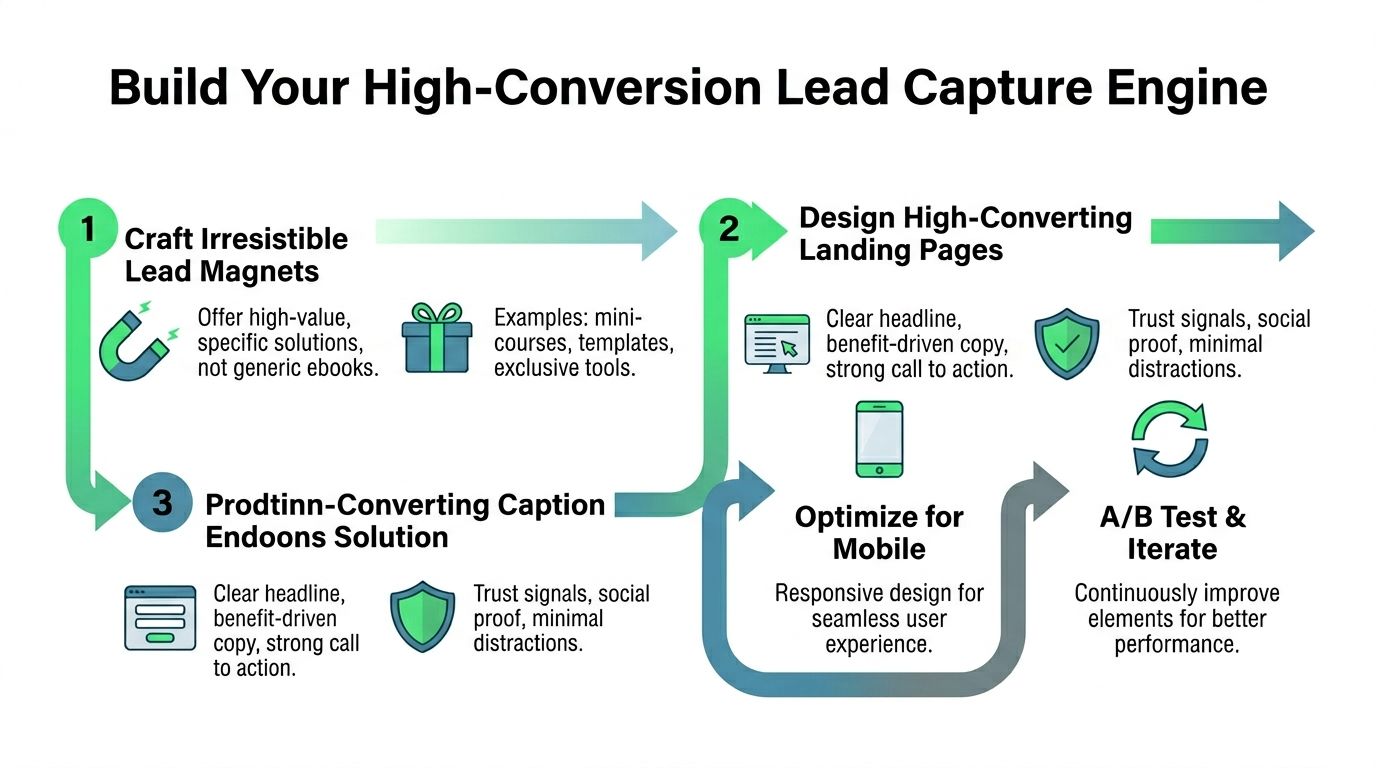
Start with an offer people actually want
Nobody wants your bloated 40-page PDF unless it solves an immediate problem.
Paid search traffic converts best when the offer feels like the next logical step after the search. If the keyword is specific, the lead magnet should be specific too.
A few formats usually beat generic ebooks:
- Checklist. Great for operational queries. Fast to consume, easy to act on.
- Template. Strong for B2B and services because people want shortcuts, not theory.
- Calculator or estimator. Useful when the search has cost, efficiency, or ROI intent.
- Mini teardown or audit framework. Strong when the buyer is evaluating performance gaps.
Message match is the whole game
If your ad says one thing and your page says another, conversions die.
This is why generic landing pages underperform. A person searching for help with lead gen forms should not land on a broad page about digital growth. They should land on a page that mirrors the search intent, the pain, and the immediate benefit.
Here’s the simplest version:
| Element | What to do | What to avoid |
|---|---|---|
| Headline | Match the search problem directly | Clever brand slogans |
| Subhead | Explain the outcome in plain English | Abstract positioning fluff |
| Form CTA | Promise one clear next step | Multiple competing offers |
| Page layout | Remove navigation and distractions | Full website menus and sidebars |
If you want a practical reference for the form itself, this guide to lead capture form best practices is worth a look.
Practical rule: one keyword theme, one landing page, one offer, one primary CTA.
Keep the form short, but not stupid
People love saying ask for less. Fine. Usually true.
But don’t confuse low friction with low intelligence. If one extra field helps you qualify leads or route them into the right follow-up, it can be worth it. The point is to ask only what improves downstream performance.
A decent rule of thumb is simple. Collect the minimum data required to deliver the offer and trigger the right next step. Nothing more.
Build pages at scale, not by hand
Scaling pages presents a common challenge.
It’s easy to build three polished pages manually. It’s miserable to build and maintain hundreds of keyword-specific pages across clients, offers, and regions. That’s where AI-assisted page generation becomes useful, not because it replaces strategy, but because it removes repetitive production work.
What a strong page usually includes
- A headline tied to the search term
- A concrete promise, not a vague value proposition
- A single CTA button
- A short form
- A few trust signals, if relevant
- Zero escape hatches unless they support conversion
Bad lead magnets versus good ones
Let’s make this painfully clear.
| Weak offer | Better offer |
|---|---|
| Ultimate guide to marketing | Google Ads lead audit checklist |
| Subscribe for updates | Get the exact template used to qualify paid leads |
| Free ebook | Keyword-specific calculator, script, or worksheet |
The best paid-search offers feel less like content marketing and more like useful tools.
That’s what you’re building here. Not a newsletter vanity funnel. A conversion engine.
Fuel the engine with Google Ads
A lot of teams sabotage list growth before the first click.
They target broad keywords, write fluffy ad copy, and send mixed signals to the platform. Then they conclude paid search is expensive. No. Bad campaign design is expensive.

Post-privacy-shift, first-party data matters more than ever. A Klaviyo piece on email marketing strategy gaps notes that 62% of marketers report a 35% ROAS uplift from email-PPC loops with AI automation. It also highlights that 70% of leads originate from ads, and that PPC-sourced lists have 2.5x lower churn than social-derived ones because the purchase intent is stronger.
That’s the case for Google Ads. Not traffic for traffic’s sake. Better subscribers.
Pick keywords with buying intent, not ego intent
If your goal is to build an email list that later drives revenue, stop chasing broad awareness terms unless you have money to burn.
You want searches that imply urgency, comparison, implementation, or evaluation. Those users are usually closer to action and far more willing to exchange an email for something useful.
Think in buckets:
- Problem-aware keywords. Searches tied to a clear pain point.
- Solution-aware keywords. Searches for methods, templates, or workflows.
- Commercial investigation keywords. Searches where buyers compare tools or approaches.
Avoid the vanity trap. Big-volume keywords look exciting in screenshots and often perform terribly in real accounts.
Structure like an adult
Most wasted ad spend comes from messy campaign architecture.
Don’t dump everything into one campaign and hope smart bidding figures it out. Give the system clean inputs. Tightly themed ad groups still matter because they improve message match between search term, ad, and landing page.
A practical setup usually works like this:
- Separate themes by intent, not by internal org chart
- Write ads that qualify, not just attract
- Map each ad group to a matching page
- Use negatives aggressively to cut junk traffic
If you want a detailed breakdown of campaign setup patterns, this article on Google Ads lead generation is useful.
Ad copy should filter people out
Many marketers are too lenient.
Your ad shouldn’t try to please everyone. It should attract the right searcher and repel the wrong one. That protects budget and improves lead quality.
A good ad for list building does three things:
| Job | What it looks like |
|---|---|
| Matches the query | The headline mirrors the user’s problem |
| Sets the expectation | The description explains the resource or next step |
| Pre-qualifies the click | The copy makes clear who the offer is for |
If your offer is for agencies, say agencies. If it’s for SaaS founders, say SaaS founders. Vague ads invite expensive curiosity clicks.
Here’s a helpful walkthrough if you want to see campaign thinking in action:
Budget for learning, not for fantasy
Early budget decisions don’t need to be heroic. They need to be disciplined.
You’re buying enough data to learn which keyword clusters, offers, and pages deserve more investment. That means a test budget should be concentrated, not spread thin over a giant keyword list.
The fastest way to waste budget is to test too many variables at once and then pretend the data means something.
Launch fewer ad groups. Keep the offer tight. Let the clicks tell you where intent is strongest. Then expand.
Use paid search to create a better list, not just a bigger one
That’s the part most generic guides miss.
A list full of random low-intent subscribers becomes a deliverability and engagement problem later. A list sourced from specific, high-intent searches is easier to segment, easier to nurture, and easier to monetize without turning into spam.
If I had to choose between bigger and better, I’d choose better every time.
Connect the pipes with tracking and automation
This part isn’t glamorous. It’s also where a lot of revenue leaks out.
If your form submissions aren’t tied back to keyword, ad group, and landing page, you’re flying blind. If your leads sit in inboxes or spreadsheets before someone uploads them, you’ve built a hobby, not a system.
Track the full path
You need to know which search, which ad, and which page produced the subscriber.
That starts with clean event tracking. Use Google Tag Manager to fire the form submission event, pass the right parameters, and keep naming consistent across pages and campaigns. If your setup gets messy here, reporting becomes fiction very quickly.
For a practical walkthrough, this guide on how to use Google Tag Manager is a solid reference.
Send data where it can actually be used
A submitted form should go straight into your ESP or CRM. No manual exports. No “we upload those every Friday.” That kind of workflow breaks the moment volume increases.
The handoff should include more than just email address if you captured meaningful context. Source data, campaign labels, and the page or topic tied to the signup all become useful later when you segment and personalize.
A simple automation chain usually looks like this:
- Ad click to landing page. The visitor arrives with campaign context attached.
- Form submission to CRM or ESP. The subscriber record is created instantly.
- Welcome email triggered immediately. The promised asset gets delivered without delay.
- Source metadata saved. The subscriber enters the right audience path from day one.
Fix the first email
Most welcome emails are lazy.
The user just trusted you with their email. Don’t send a bland confirmation note that feels automated in the worst possible way. Deliver the asset quickly, restate the benefit, and make the next step obvious.
A strong first email should do three jobs:
| Part | What it should do |
|---|---|
| Delivery | Give them the thing they asked for right away |
| Expectation setting | Tell them what kind of emails they’ll get next |
| Next action | Point them to one useful follow-up action |
Reliability beats cleverness
This is not the place for creative improvisation.
Use boring, dependable integrations. Test them repeatedly. Submit your own forms. Break the workflow on purpose and see what fails. If you can’t trust your data flow, every optimization decision downstream becomes shaky.
If one lead can disappear between ad click and CRM entry, more will. Systems fail quietly before they fail publicly.
The upside is simple. Once the plumbing works, list building becomes far less manual. You stop chasing exports and start analyzing what’s driving valuable subscribers.
Refine the machine with segmentation and workflows
Collecting emails is easy. Sending relevant emails is a common challenge.
A single undifferentiated list is lazy marketing. It creates weak engagement, more unsubscribes, and wasted acquisition value. If you paid to acquire intent, you should preserve that intent in the follow-up.

This isn’t optional. DragApp’s email statistics roundup reports that segmented campaigns drive a 760% increase in revenue compared with non-segmented campaigns. It also states that segmented campaigns get a 14% higher open rate, generate 58% of all email-generated revenue, and that customers are 50% more likely to continue their buyer’s journey when emails match behavior and demographics.
Segment by acquisition intent first
Segmentation often occurs too late and too vaguely.
They wait until they’ve sent months of generic emails, then they create broad buckets like prospects and customers. That’s weak. The best segmentation often starts at signup.
If someone joined from a keyword about lead quality, don’t dump them into the same sequence as someone who joined from a keyword about campaign automation. Those are different problems. Treat them differently.
A simple starting framework:
- Keyword theme. What problem did they search for?
- Offer consumed. Which asset did they request?
- Landing page angle. What promise convinced them to subscribe?
That gives you enough signal to write follow-up emails that feel relevant instead of mass-produced.
Build short workflows, not giant labyrinths
Marketers love overcomplicating automation.
You do not need a 27-step masterpiece on day one. You need a few clear sequences tied to intent. Short workflows are easier to maintain and usually perform better because they stay focused.
Here’s a practical model:
| Segment example | First follow-up | Later follow-up |
|---|---|---|
| Problem-specific searcher | Educational email tied to the exact pain point | Case-style explanation or tool comparison |
| Template seeker | Usage tips and implementation advice | Related workflow or deeper resource |
| Commercial evaluator | Comparison content and decision support | Demo, consultation, or product education |
Clean the list before it becomes a problem
List quality matters as much as list growth.
The same DragApp source cites MailerCheck data showing that only 67.8% of emails are valid on average across more than 33,000 analyzed email lists, with common issues including 13.9% catch-all addresses and 12.4% mailboxes not found. It also notes that 59% of unsubscribers leave because they receive too many emails, while 43% leave because the information is no longer relevant or they don’t remember signing up.
That’s the hidden cost of sloppy list building. Poor hygiene and irrelevant messaging make acquisition less valuable over time.
So yes, remove inactive contacts. Use double opt-in when appropriate. Keep frequency sane. Send emails that still match why the person subscribed in the first place.
The boring but essential stuff measurement and compliance
Creative gets attention. Measurement gets scale.
If you buy traffic from Google Ads to build a list, you need to know which keywords produce subscribers who click, reply, book, and buy. Everything else is noise. Open rate is especially weak now because privacy features distort it, so stop treating it like a decision metric.
Measure the funnel with commercial intent in mind, not email vanity.
Track these:
- Cost per lead. What each subscriber costs by campaign, ad group, and keyword.
- Qualified engagement. Clicks, replies, booked calls, or product actions that show the lead was worth collecting.
- Landing page conversion rate. A direct read on whether your AI-generated page and offer match the search term.
- Lead-to-revenue performance. The metric that tells you whether list growth is profitable or just expensive database inflation.
If your reporting still stops at form fills, fix that first. This guide on how to measure marketing ROI lays out the right framework.
Test with discipline
Testing matters more in a paid acquisition model because every bad assumption costs cash.
Martech’s analysis of A/B email testing failures found that many marketers skip testing entirely, and it also explains why weak sample sizes and sloppy test design produce false winners. That is how teams burn budget for months while telling themselves they are optimizing.
Keep the process tight:
- Test one variable at a time. Subject line, CTA, form copy, headline, or offer.
- Judge tests on clicks and conversions. Those metrics connect to business outcomes.
- Wait for enough volume. Small samples create fake certainty.
- Record every result. Good teams build a testing memory. Bad teams rerun the same failed ideas every quarter.
A paid list-building engine improves through repetition, not hunches.
Compliance is part of performance
Compliance is not legal theater. It is list quality control.
If the signup promise is vague, the wrong people opt in. If unsubscribing is buried, spam complaints rise. If consent records are sloppy, your team creates risk for no upside.
Use plain rules:
| Compliance area | Good practice |
|---|---|
| Consent | Use explicit opt-in language |
| Expectation | State what emails they will receive and how often |
| Identity | Show clearly who is sending the emails |
| Exit | Include a visible, one-click unsubscribe path |
| Data handling | Store, sync, and route subscriber data responsibly |
Respect GDPR, CAN-SPAM, and the operational rules tied to the regions you sell into. Then go a step further and make the form copy brutally clear.
Clear consent improves deliverability. Clear expectations improve retention. That is why disciplined operators treat measurement and compliance as revenue work, not admin work.
If you want to build an email list with paid search without drowning in manual page creation, campaign setup, and reporting glue, take a look at dynares. It’s built for PPC managers, agencies, and lean growth teams that want keyword-specific ads, landing pages, forms, and tracking working together as one system instead of a patchwork mess.
x4
$0.18
$0.23
dynares let us go from generic pages to keyword-specific experiences without hiring developers or rebuilding our stack. Our search traffic converts at over 79% now, CPC is down, and we can test new ideas in minutes instead of weeks.


x8
-68%
+581%
dynares helped us turn paid traffic into a much more efficient lead generation engine. In just four months, we significantly increased lead volume while bringing down cost per conversion.


Create reusable, modular page layouts that adapt to each keyword. Consistent, branded, scalable.

From ad strategy breakdowns to AI-first marketing playbooks—our blog gives you the frameworks, tactics, and ideas you need to win more with less spend.
Discover Blogour platform to drive data-backed decisions.