
Generate Leads Email Marketing: Boost Your ROI
Generate Leads Email Marketing: Boost Your ROI
Most advice on generate leads email marketing is still stuck in 2018.
It tells you to write a newsletter, toss a popup on the site, offer a generic ebook, and wait for magic. That's dumb if you're paying for traffic. If you're running Google Ads, every click costs money, every form fill carries intent, and every generic follow-up burns value you already paid for.
Email is not a side channel. It's the second half of acquisition.
If your paid team brings in a lead from a high-intent keyword and your email system throws that person into the same flow as a random blog subscriber, you've broken the funnel before sales even had a chance. That's the core mistake. Not bad subject lines. Not weak design. Broken intent handoff.
Stop treating email like a separate channel
The cleanest way to waste ad spend is simple. Buy intent on Google. Capture the lead. Then send everyone the same welcome email and weekly newsletter.
That approach looks organised inside a dashboard. Commercially, it's a mess.

Email works absurdly well when teams use it properly. Email marketing generates an average return of $36 for every $1 invested, a 3,600% ROI, and 59% of marketers identify email as their single biggest source of ROI, according to CodeCrew's 2025 email marketing statistics roundup.
The problem isn't email. The problem is isolation.
Why the old playbook fails
A PPC lead is not just an email address. That person clicked a specific keyword, saw a specific ad, landed on a specific page, and expressed a specific problem.
When you ignore that context, your nurture gets bland fast.
This typically happens:
- Paid search does the hard work: The visitor arrives with clear commercial intent.
- The form strips context away: Campaign, keyword, and landing page data never make it into the CRM or ESP.
- Email turns generic: The lead gets a broad sequence that could apply to anyone.
- Sales gets weaker conversations: Reps inherit colder leads and blame lead quality.
That's not a lead generation issue. It's an operations issue.
Practical rule: Every lead should carry its acquisition context into email automation. If the handoff loses intent data, the funnel loses revenue.
What to do instead
Treat email like infrastructure, not content.
That means your paid and email systems should share data, naming logic, and conversion goals. The ad promises something. The landing page confirms it. The form captures who the lead is and where they came from. The email sequence continues the same conversation.
If you want a useful breakdown of the stack behind that approach, this overview of lead generation technology is a good place to tighten the plumbing before you obsess over copy tweaks.
A lot of marketers still act like email is for retention and PPC is for acquisition. That's neat in theory and wrong in practice. In reality, paid search creates the moment. Email decides whether that moment compounds or dies in a queue.
If you want better leads, stop asking email to rescue a disconnected funnel. Build it into the funnel from the start.
Your lead magnet must match user intent
The generic ebook isn't dead because ebooks are bad. It's dead because many organizations offer the wrong one to the wrong person at the wrong moment.
Someone searching for a solution to fix paid search performance doesn't want your broad thought leadership PDF. They want the fastest path to an answer. If the ad says one thing and the lead magnet says something else, you've created friction before the first email even lands.
Often, lead capture grows lazy at this point. Teams build one asset, slap it everywhere, and call it a funnel. It isn't a funnel. It's a bucket.
Generic offers attract generic leads
Broad lead magnets feel productive because they scale. They also flatten intent.
A person who clicks an ad for "Google Ads ROAS dashboard" should not get the same offer as someone reading a top-of-funnel blog post about marketing trends. Those are different buyers in different moments.
There's a useful stat behind this. While 75% of marketers use lead magnets like ebooks, the most effective strategies tailor these offers. Personalized offers can achieve open rates over 31%, according to Warmly's lead generation statistics roundup.
That matches what most operators learn the hard way. Specificity wins.
What strong intent-matched magnets look like
The best lead magnet is often just the next logical step after the click.
If the keyword is commercial, the offer should feel operational. If the keyword is educational, the offer should remove confusion. Keep the jump small.
A few examples that usually outperform generic PDFs:
- For high-intent solution searches: Offer a paid search audit checklist, ROAS calculator, implementation worksheet, or comparison template.
- For competitor terms: Offer a migration guide, side-by-side feature breakdown, or switching checklist.
- For pricing or demo-adjacent terms: Offer a buyer's checklist, stakeholder deck template, or ROI justification framework.
- For broader educational searches: Offer a tactical guide that solves one narrow problem well.
The offer should answer this question immediately. Why should I give you my email right now?
If your answer is "to get updates," that's weak. If your answer is "to help you solve the exact thing you searched for," you're on the right track.
Your page and form should continue the ad conversation
A bad signup flow feels like a trap. A good one feels like progress.
That means no random fullscreen popup five seconds after arrival. Put the offer inside the page logic. Match the headline to the ad. Match the form copy to the promise. Reduce the number of fields unless you absolutely need more.
A solid reference point is this guide on how to create a landing page. The key idea is simple. Relevance has to survive every step, not just the click.
A lead magnet shouldn't be a bribe. It should be the natural continuation of the search intent that brought the visitor there.
One more thing. Stop hiding weak offers behind fancy design. A glossy mockup won't save a mismatched asset.
If you want a quick visual walkthrough on building better conversion paths, this helps:
A simple decision filter
Before launching any new lead magnet, ask these three questions:
| Question | If the answer is no |
|---|---|
| Does it match the keyword or ad promise? | Rewrite the offer or create a new one |
| Does it help with an immediate problem? | Narrow the scope |
| Would a sales rep gladly send it manually? | It's probably fluff |
A lot of generate leads email marketing advice focuses on quantity. More forms. More assets. More subscribers.
I don't buy it.
You don't need more magnets. You need fewer, sharper ones tied to actual intent.
Build a segmented list not a giant crowd
A big email list impresses junior marketers and nobody else.
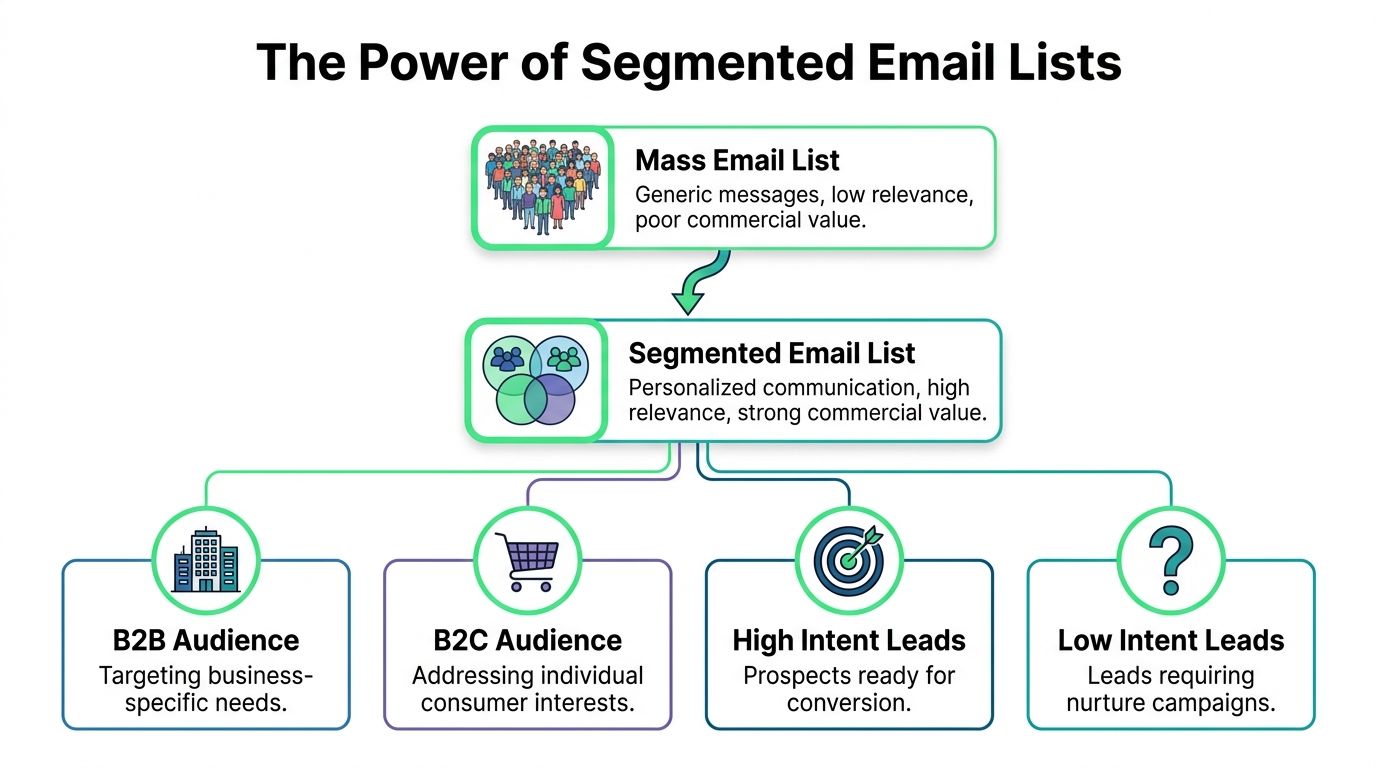
If your list is one undifferentiated mass, your messaging gets vague, your click quality drops, and sales starts saying the leads are rubbish. They're usually right. The issue is not volume. The issue is relevance.
Segmented email campaigns can increase revenue by as much as 760%, and even simple segmentation leads to 100.95% higher click-through rates compared to non-segmented campaigns, according to Porch Group Media's email marketing statistics.
That should end the debate.
Start with source, not demographics
Demographics matter. They're rarely the best first cut for paid acquisition.
The first segment I care about is where the lead came from. Source tells you what the person was doing when they raised their hand. That is usually more actionable than job title alone.
Break your list by commercial context:
- Campaign intent: Brand, non-brand, competitor, pricing, problem-aware.
- Keyword theme: Audit, software, agency, automation, reporting, migration.
- Landing page topic: Calculator, comparison page, checklist, webinar, case-study page.
- Offer claimed: Downloaded audit template, booked a consult, requested a walkthrough.
This is not over-engineering. This is preserving buying intent.
Add behavioural signals next
Once the lead is in your system, behaviour becomes the second segmentation layer.
What they do after signup often tells you more than what they said on the form. That includes which links they click, which pages they revisit, whether they consume educational content or jump straight to pricing, and whether they ignore everything until the fourth email.
Use tags and automation rules for things like:
- Visited bottom-funnel pages: Send proof, implementation detail, or objection-handling emails.
- Engaged with educational content only: Keep nurturing. Don't rush the sales pitch.
- Clicked product-specific links: Move them into a product-focused sequence.
- Went cold after the asset delivery: Try a tighter follow-up tied to the original offer.
A list becomes valuable when it behaves less like storage and more like a routing system.
Let subscribers self-segment
You don't need creepy data collection to get clarity. Sometimes the cleanest move is to ask.
A single form field, preference option, or link choice can split people into useful groups quickly. For example, ask whether they want help with reporting, lead quality, campaign buildout, or conversion tracking. That answer shapes the next email immediately.
This works especially well in niches where the audience already knows the problem but not the best path forward.
If you're working with gated audio or creator campaigns, the logic is similar. A tool like Premierely's secure SoundCloud email gate is a good example of capture mechanics that connect access with intent, instead of treating every opt-in as the same kind of subscriber.
Segmentation is not a database exercise. It's a messaging advantage.
A practical segmentation model
Here's a model I like because it stays simple enough to maintain.
| Layer | What to capture | Why it matters |
|---|---|---|
| Acquisition | Campaign, keyword theme, landing page | Preserves original buying intent |
| Conversion | Form type, asset claimed, CTA clicked | Tells you what value they wanted |
| Behaviour | Email clicks, page revisits, content paths | Shows current interest level |
| Qualification | Sales readiness, product fit, owner notes | Improves handoff to sales |
Many organizations fail at segmentation because they start with too many categories or zero categories. Both are bad.
Start with lead source. Add offer type. Add behaviour. That's enough to make your email feel relevant instead of robotic.
What not to segment by first
Avoid wasting your first segmentation pass on attributes that sound professional but don't change the email.
Company size can matter. Industry can matter. Geography can matter. But if none of those factors change the next message, they belong lower in the priority stack.
Your segments should answer one practical question. What should this person receive next?
If you can't answer that, the segment is vanity.
Craft a welcome sequence that converts
The average "thanks for subscribing" email is one of the laziest pieces of marketing on the internet.
Someone raises their hand. Shows intent. Gives you permission to enter the inbox. And the brand responds with a receipt.
That's weak.
A welcome sequence should feel like a guided first conversation, not an automated shrug. The first few days matter because the lead still remembers why they signed up. Waste that window and you force the next email to work twice as hard.
70% of marketers stop after sending a single email, effectively ignoring 76% of potential leads. A well-timed follow-up can generate 220% more replies, and a 4-email sequence can convert 84% of nurtured leads, according to Email Vendor Selection's lead generation statistics.
The bad version
Let's say someone signs up for a Google Ads audit checklist.
Bad sequence:
Email 1: Thanks for subscribing. Here's the PDF.
Email 2: Here's our latest company news.
Email 3: Book a demo.
Email 4: Still interested?
This sequence ignores the original problem. It asks for commitment before building trust. It turns a warm lead into background noise.
The version that works
Now take the same lead and handle the first 72 hours properly.
Email 1 arrives immediately. It delivers the checklist, reminds them what they signed up for, and sets expectations. One CTA. One job.
Email 2 lands later with extra practical value. Maybe it's a short teardown, a tactical article, or a plain-language explanation of what many teams miss when diagnosing paid search waste.
Email 3 bridges to the product or service naturally. Not with hype. With relevance. If the checklist exposed gaps, show the path to fixing them.
Email 4 asks for the smallest useful next step. A reply, a quick audit request, a walkthrough, a consult. Not a giant leap.
A sample structure for the first week
- Day 0 delivery email: Give them the asset fast. Restate the problem it solves. Keep the CTA focused.
- Day 1 value email: Add a tactical insight they didn't ask for but will appreciate.
- Day 3 problem framing email: Show the cost of doing nothing, using plain language and a real scenario.
- Day 5 action email: Ask for a reply, booking, or product step tied to the original intent.
Notice what's missing. No company chest-beating. No bloated founder story. No ten-link newsletter menu.
Operator mindset: Each welcome email should earn the next one.
Write like a person, not a platform
This part gets ignored because marketers love tooling more than tone.
The best welcome sequences sound like one competent human helping another human move forward. Short paragraphs. Clear CTA. No jargon fog. No over-designed nonsense if plain text would do the job better.
And yes, persuasion matters. If your email copy is soft, unclear, or packed with abstract language, the sequence won't convert no matter how smart the automation looks. This breakdown of examples of persuasive writing is useful if your emails sound polished but still don't make people act.
One simple test
Read every email in your sequence and ask this:
Would I send this manually to a lead I wanted to close?
If the answer is no, fix it.
Most welcome flows fail because they confuse automation with permission to be boring. Automation should scale relevance, not generic filler.
If you're serious about generate leads email marketing, your welcome sequence is not admin. It's the first sales conversation that happens without a rep in the room.
Connect your paid channels to your email engine
At this point, many teams lose the plot.
Paid search and email sit in different tools, often owned by different people, with different dashboards and different goals. The PPC manager optimises clicks and form fills. The email team optimises opens and clicks. Sales complains about lead quality. Finance wants revenue answers. Everyone is technically doing their job, and the system still underperforms.
You fix that by connecting the data flow.

Integrating PPC and email nurturing is an underserved strategy that can boost conversion rates by 20-30%. Agencies that retarget PPC abandoners with dynamic emails matching ad intent report a 15% higher ROAS, according to AmericanEagle's write-up on email lead generation tactics.
That uplift doesn't happen because email suddenly becomes magical. It happens because relevance survives the handoff.
Pass campaign context into the form
A lead form should collect more than name and email behind the scenes.
At minimum, pass through the campaign, ad group, keyword theme, landing page, and offer claimed. Hidden fields, URL parameters, CRM properties, and tag rules exist for a reason. Use them.
If someone converts from a competitor campaign, your email should not read like they found you through a generic content article. If someone came in through a pricing keyword, send material that helps them justify purchase, compare options, or move toward a buying conversation.
That's the whole game. Continue the intent, don't reset it.
Build automation around expressed intent
Once the lead lands in your ESP or CRM, trigger sequences by acquisition data and behaviour together.
A few examples:
- Competitor campaign lead: Send comparison-oriented emails, migration guidance, and objection handling.
- Pricing keyword lead: Send ROI framing, implementation detail, and buying-committee material.
- Top-of-funnel educational lead: Send tactical content first, then gradually move toward product relevance.
- Abandoned form or partial signup: Retarget with a message that mirrors the page they left.
Tooling plays a key role here. HubSpot, ActiveCampaign, Mailchimp, Customer.io, Google Tag Manager, and your CRM can all play a role if the data model is clean.
One platform built around this workflow is dynares, which generates keyword-matched landing pages, forms, and Google Ads assets, and can upload conversion values back into Google Ads. That's useful when you want the same intent structure carried from search term to page to lead record to downstream optimisation.
Close the loop back into Google Ads
A lot of marketers stop after the email send. That's half the system.
If email nurtures a lead into a qualified opportunity or customer, that conversion data should flow back into Google Ads. Otherwise the ad platform keeps optimising for cheap form fills instead of valuable outcomes.
Not all leads are equal. One keyword theme may drive lots of submissions and poor downstream quality. Another may drive fewer submissions and stronger revenue. If you don't feed outcome data back into paid media, Google can't learn the difference.
Your ad account should learn from what happens after the form, not just from the form itself.
A practical workflow
Here's the basic operating model:
| Step | What happens | Why it matters |
|---|---|---|
| Click | User arrives from a specific campaign and keyword theme | Captures declared intent |
| Landing page | Message matches the ad and presents a relevant offer | Preserves momentum |
| Form submission | Hidden fields pass source data into CRM or ESP | Prevents context loss |
| Email nurture | Sequence adapts to source and behaviour | Increases relevance |
| Sales or product action | Lead qualifies, books, buys, or progresses | Produces real outcome data |
| Feedback loop | Conversion value returns to Google Ads | Improves future bidding |
This is not complex because marketers love complexity. It's necessary because disconnected systems produce blurry decisions.
What this changes in practice
When paid and email are connected, you stop asking vague questions like "How did the newsletter perform?"
You start asking better ones.
Which keyword themes create leads that respond well to nurture? Which landing pages attract subscribers who progress? Which offer types lead to demos, not just downloads? Which sequences help sales, and which ones waste inbox space?
That shift matters more than any subject line trick.
Generate leads email marketing becomes much more powerful when you stop treating the inbox as a generic follow-up channel and start using it as the continuation of paid intent. That's where revenue discipline enters the picture.
Measure what matters and optimize relentlessly
Open rates are fine for diagnostics. They're terrible as a north star.
If your team celebrates opens while pipeline quality drops, you've built a reporting culture around the wrong outcome. It feels good because the numbers move fast. It tells you very little about whether the business is growing.
The KPIs worth caring about
I care about metrics that connect email activity to commercial movement.
Track things like lead-to-MQL rate, MQL-to-SQL progression, reply quality, demo bookings, opportunity creation, closed revenue, and time-to-conversion by segment. Those numbers force honesty. They also expose where your funnel breaks.
For a more grounded framework, this guide on how to measure marketing ROI is useful because it pushes measurement beyond engagement and toward business impact.
Test the mechanism, not just the wrapper
Most email A/B testing is painfully shallow.
Teams test subject lines because it's easy. Fine. Do that. But the bigger wins usually come from testing the offer, sequence logic, CTA style, and the timing between messages.
Here are tests that matter:
- Offer angle: Checklist versus calculator versus comparison page.
- CTA intent: Book a call versus reply with a question versus request an audit.
- Sequence depth: Short sequence for hot leads, longer sequence for education-heavy leads.
- Message order: Problem framing before proof, or proof before product explanation.
If your testing only touches copy polish, you're tweaking paint while the engine misfires.
Keep deliverability boring and solid
This part isn't sexy. It pays the bills.
If your domain setup is sloppy, your list hygiene is bad, or your sending behaviour looks erratic, your nurture system falls apart. The copy can be sharp. The offer can be strong. None of it matters if the inbox placement is poor.
Use a basic checklist:
- Authenticate properly: Make sure your email authentication setup is complete and monitored.
- Protect list quality: Remove junk, obvious spam traps, and stale records.
- Control sending cadence: Don't lurch between silence and huge blasts.
- Watch engagement by segment: Cold pockets of the list can drag reputation down.
The best-performing email in your account is worthless if mailbox providers never let people see it.
Build reporting around decisions
Good reporting doesn't just describe what happened. It tells you what to do next.
If leads from one keyword cluster open emails but never book, maybe the traffic intent is weak. If another segment clicks less but converts later at a higher rate, maybe you should stop judging it like newsletter traffic. If one welcome sequence generates better sales conversations, that should affect both email and media budgets.
This is the part many teams skip because it requires shared ownership. Marketing wants campaign metrics. Sales wants meetings. Paid media wants conversion data. Leadership wants revenue clarity.
They're all right.
So build one view that connects them. Otherwise you'll keep arguing over which dashboard is "correct" while the actual funnel leaks in plain sight.
Email isn't dead it's just disconnected
Email isn't dead. It's just badly wired in most companies.
People blame the channel, yet the core problem is the handoff. Paid search captures intent. Forms strip context. Email sends generic drivel. Sales gets colder leads than they should. Then everyone wonders why performance stalls.
The fix is not another newsletter redesign.
The fix is to connect the systems you already have. Match the lead magnet to the click. Segment by source and behaviour. Build a welcome sequence that earns attention. Pass ad context into email. Push revenue signals back into Google Ads.
That's how you stop playing the vanity metrics game and start building a real acquisition machine.
Do that well, and email stops being an afterthought. It becomes the compounding layer on top of your paid spend.
If you're building Google Ads funnels and want the landing pages, forms, tracking, and revenue feedback loop to work together without duct-taping five tools, take a look at dynares. It helps teams generate keyword-matched pages and connect conversion data back to paid search so email nurturing can sit inside a tighter revenue system.
x4
$0.18
$0.23
dynares let us go from generic pages to keyword-specific experiences without hiring developers or rebuilding our stack. Our search traffic converts at over 79% now, CPC is down, and we can test new ideas in minutes instead of weeks.


x8
-68%
+581%
dynares helped us turn paid traffic into a much more efficient lead generation engine. In just four months, we significantly increased lead volume while bringing down cost per conversion.



Create reusable, modular page layouts that adapt to each keyword. Consistent, branded, scalable.

From ad strategy breakdowns to AI-first marketing playbooks—our blog gives you the frameworks, tactics, and ideas you need to win more with less spend.
Discover Blogour platform to drive data-backed decisions.