
Let's be blunt: real estate PPC is where good money goes to die. Most campaigns are just expensive donations to Google's quarterly earnings report, not a serious plan to generate leads. It’s a familiar story: agents throw cash at broad keywords, send all that pricey traffic to their generic homepage, and then wonder why their phone isn't ringing. It's dumb.
Why most real estate PPC is a complete mess
I see it all the time. Smart, driven real estate pros getting absolutely taken to the cleaners by bad Pay-Per-Click strategies. This isn't about pointing fingers; it's about facing the ugly truth of a market where just showing up gets you nowhere. You're not just bidding against the agent down the street—you're up against Zillow and other portals with nine-figure marketing budgets.
The gap between the pros and the amateurs is huge. A few agents are systematically pulling in high-quality leads at a predictable cost. Everyone else is just burning cash with nothing to show for it. It's pure chaos.
And this isn't a niche problem. The entire industry is betting big on paid search. A staggering 82% of real estate marketers plan to increase their PPC budgets in 2026, making it their top channel for growth. This is all happening as global ad spend blows past $1 trillion and Google continues to own 94% of the search market. You're playing in a very big, very expensive sandbox.
The anatomy of a broken campaign
So, what does a broken campaign actually look like? It's not some complex technical failure. It's just lazy. It's a series of small, avoidable mistakes that snowball into a total disaster.
It usually starts with bidding on ridiculously broad keywords like "homes for sale" with zero geographic focus. That's the digital equivalent of putting up a billboard in another country. You'll get clicks, sure, but from people who will never, ever become a client.
The next cardinal sin is the destination. You spend good money to get someone to click your ad for downtown luxury condos, and you dump them on your homepage. Now they have to start their search all over again. It’s a jarring experience that basically tells them you don't value their time.
Here are the most common ways I see agents torpedo their own PPC success:
- No negative keywords: They're paying for clicks from people searching for 'real estate jobs' or 'rental properties'. You can avoid this by simply understanding what negative keywords are and putting them to work.
- One-size-fits-all ads: The same boring ad copy is used for every single keyword, whether someone is searching for 'first-time buyer programs' or 'waterfront estates'.
- Ignoring conversion tracking: They're flying completely blind, with no idea which keywords or ads are actually generating leads. You might as well just set your budget on fire. 🔥
To make sure your investment actually pays off, you need a clear picture of how paid search fits into your bigger marketing picture. It's worth exploring the classic SEO vs. PPC debate to align your strategy with your goals.
This blueprint is about fixing these fundamental problems. It’s time to stop funding Google’s bottom line and start funding your own growth.
Building a high-intent keyword strategy
Let's get straight to the part that makes or breaks every real estate PPC campaign: your keyword strategy. This isn't optional, and it's where most accounts bleed money.
If you think you can just download a generic list of real estate keywords and call it a day, you’re setting yourself up for failure. It’s lazy, and it’s expensive.
The real job is to build a strategy that understands user intent. There's a world of difference between someone searching 'real estate investment tips' and someone typing '3 bedroom homes for sale in austin texas'. The first person is browsing. The second is ready to sign papers. Treating them the same is a rookie mistake that costs a fortune.
I break keywords down into tiers based on how close a person is to actually making a move. This isn't some abstract marketing theory; it's how you put your budget behind the searches that will actually generate revenue.
Mapping keywords to commercial intent
You have to get inside your future client's head. What, exactly, are they typing into Google when they get serious about buying or selling? The entire goal is to capture the highest-intent traffic first. These are the people who become leads, not just website visitors.
Here’s a practical way to think about it:
- High intent (ready to transact): These are your money-makers. They are specific, combining location, property type, and action-oriented words. Think ‘luxury condos for sale downtown miami’ or ‘find a real estate agent in scottsdale az’. These searches are screaming "I need help now."
- Mid intent (active research): This group is still in the comparison phase. They're trying to figure out the market and their options. Searches like 'best neighborhoods in dallas for families' or 'average home price denver co' fall here. They’re valuable, but they need a bit more convincing before they convert.
- Low intent (early awareness): These are the researchers just starting their journey. They use broad, informational queries like 'how to buy your first house' or 'current mortgage rates'. For a PPC campaign focused on immediate ROI, you should spend almost nothing here. It's a black hole for your budget.
This is exactly where most campaigns fall apart. It almost always starts with a poor plan and a focus on broad, vanity keywords.
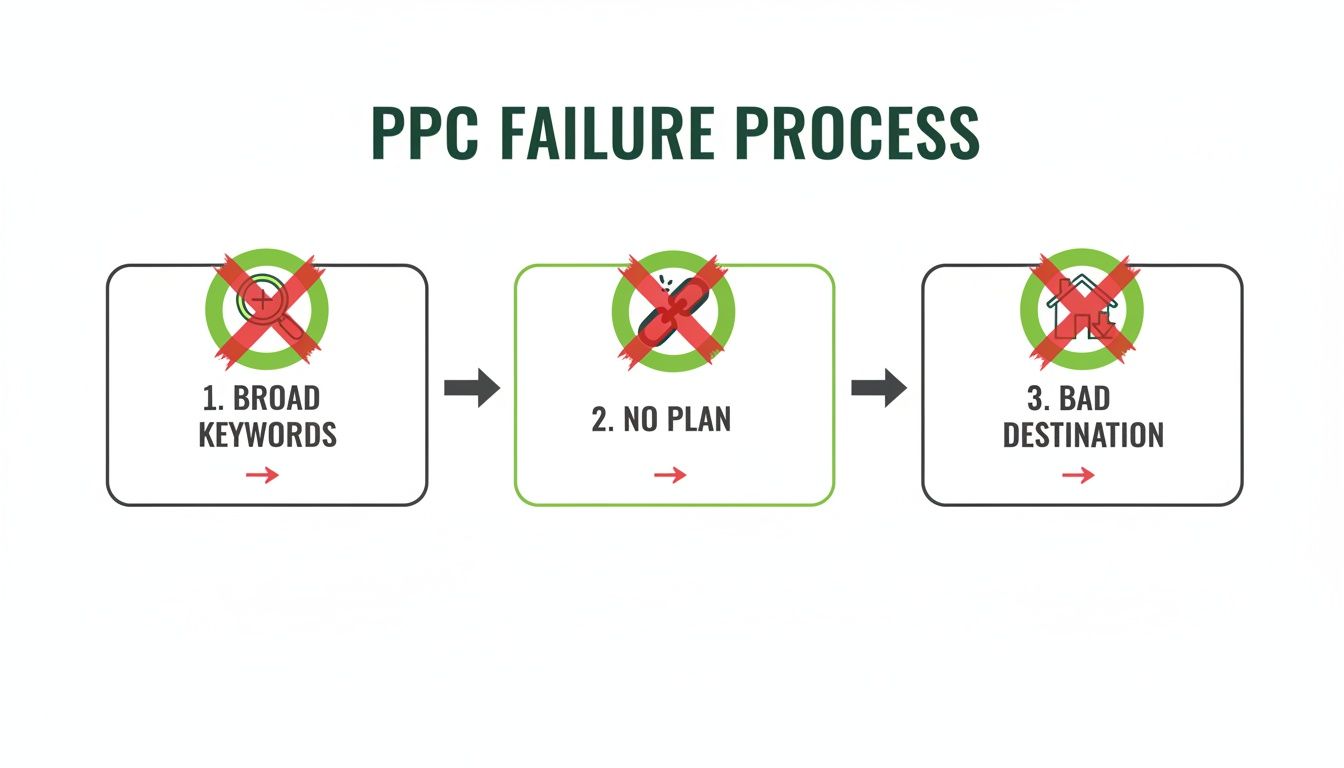
The point is, failure in PPC isn't an accident. It’s the predictable result of chasing expensive, vague traffic without a relevant landing page to send it to.
Uncovering the long-tail gold
Most of your competitors are in a bidding war over the same handful of obvious, expensive keywords like 'homes for sale'. The real opportunity—and profit—is in the long-tail. These are longer, more specific search phrases that have less volume but convert at a much higher rate.
And people get specific. Industry data shows 43% of buyers start their home search online, and they don't stay general for long.
Finding these gems is a mix of common sense and using the right tools. Just think about all the ways someone might narrow their search: by a specific school district, near a major employer, or with a must-have feature like a 'home with a pool' or 'house with a fenced yard'. Long-tail keywords tell you exactly what a person wants, which lets you write hyper-relevant ads that send them to a hyper-relevant page. This is the secret to high Quality Scores and ridiculously low costs-per-click.
If you need a more detailed process for digging these up, check out our full guide on how to perform keyword research.
The power of hyper-granular ad groups
Once you've done your keyword research, you need to structure your campaigns properly. This is where most people get lazy again. They'll dump all their 'condo' related keywords into one massive ad group and hope for the best.
Don't do that.
The right way is to build hyper-granular, tightly themed ad groups. This means you have separate ad groups for 'downtown condos', 'beachfront condos', and 'pet-friendly condos'.
Why bother? Because this structure lets you write ad copy that perfectly matches the search query. When someone searches for 'pet-friendly condos', they see an ad that mentions pets. They click it and land on a page showing condos that allow pets. The whole experience feels seamless, like you read their mind.
Yes, it's more work upfront. But a highly-structured account is the only way to build a real estate PPC machine that is both profitable and scalable. This is the blueprint.
The ad-to-landing-page connection that converts
Let’s be direct. Sending traffic from a beautifully crafted real estate PPC ad to your generic homepage is one of the fastest ways to waste money. It’s like inviting someone over for a steak dinner, then asking them to go find the cow in your backyard. You’re creating friction, eroding trust, and killing your conversion rates before you even have a chance.
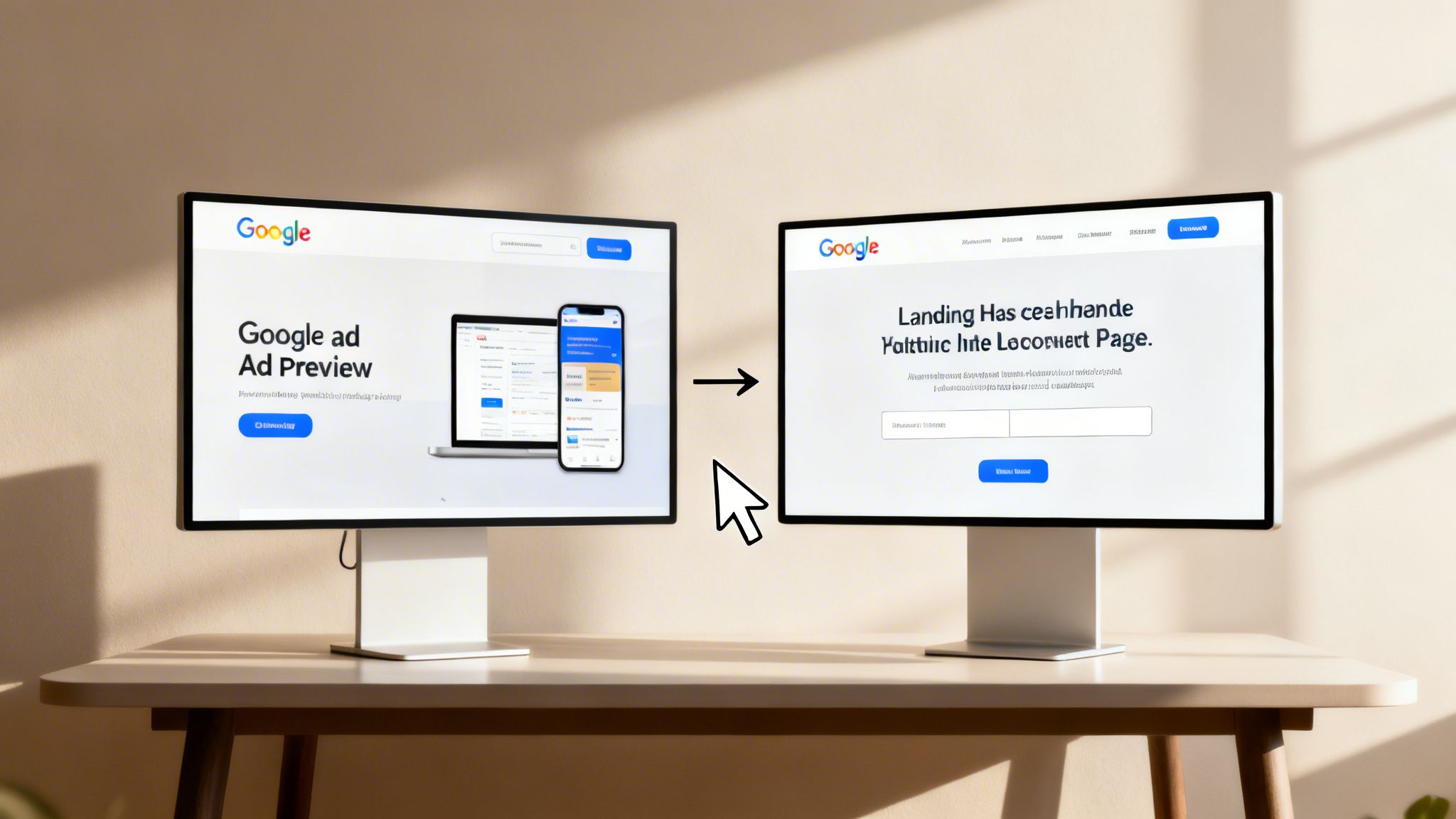
This is where the magic really happens—or where it all falls apart. The connection between your ad and your landing page needs to be seamless, a perfect one-to-one match. A user clicks an ad for "luxury penthouse apartments downtown" and they must land on a page exclusively about "luxury penthouse apartments downtown." Not your 'About Us' page. Not your general listings page.
It sounds obvious, but in 90% of the new accounts I audit, this is the first fundamental mistake I find.
The whole game is about maintaining what we call "ad scent." The user is following a trail—the scent of their original search query—from the Google results page to your ad, and finally to your landing page. If that scent breaks at any point, they get confused, frustrated, and hit the back button. And your money is gone.
The anatomy of a high-converting landing page
Forget fancy designs and long, flowery paragraphs. A high-converting real estate landing page is a ruthlessly efficient tool built for one thing: capturing a lead. It’s a machine, not a brochure. The entire goal is to make the user feel like they’ve found exactly what they were looking for, making the decision to give you their contact info almost effortless.
Here’s the no-fluff anatomy of a page that actually works:
- A mirror-image headline: The headline on your landing page has to echo the promise of your ad. If the ad says "View New Condos in Midtown," the headline better be damn close to that.
- Compelling visuals: High-quality photos or a video tour of the specific property type you advertised. Don't show a suburban colonial if the ad was for a downtown loft.
- A dead-simple form: This is critical. Only ask for the absolute minimum you need to qualify the lead. Name, email, and phone is usually plenty. Every extra field you add will cause your conversion rate to drop.
This entire strategy is about building trust and removing friction. To see how these pieces all come together in practice, we have a deep dive on creating a converting landing page that turns clicks into clients.
Ad scent mismatch: the conversion killer
The gap between a generic experience and a perfectly matched one is where campaigns either win or die. When a user feels that disconnect, they bounce. When everything aligns, they convert. It’s that simple.
The table below breaks down the stark difference between the common mistake and the winning strategy.
| Component | Mismatched Experience (The Common Mistake) | Matched Experience (The Winning Strategy) |
|---|---|---|
| Headline | "Your Trusted Local Real Estate Experts" | "Explore Luxury Condos in Downtown Austin" |
| Hero Image | Stock photo of a generic happy family | High-res photo of the specific condo building/interior |
| Body Copy | General text about the agency's history | Bullet points on amenities, views, and lifestyle benefits |
| Call to Action | "Contact Us" | "See Available Units & Pricing" |
| User Feeling | "Is this the right place? I'll look elsewhere." | "This is exactly what I was searching for." |
That mismatched experience is the default for most advertisers. It feels safe and easy. It's also incredibly expensive, because you're paying for clicks from users you immediately confuse and lose. The matched experience, on the other hand, makes the user feel understood and delivers on the ad's promise instantly.
Scaling the ad-to-page connection
I know what you're thinking. "Building a dedicated landing page for every single ad group sounds like a nightmare." And if you were doing it manually, you’d be right. It’s not scalable.
This is where technology gives you an almost unfair advantage. Modern PPC platforms were built to solve this exact problem. For example, a system can instantly generate thousands of perfectly coordinated ads and matching landing pages, all tailored to specific keywords and user intent. It’s about creating that seamless experience at scale, something that used to require a massive team.
The future of real estate PPC isn't about manually building one perfect campaign. It's about using technology to build thousands of them, automatically testing and optimizing for what drives real revenue. That's how you win.
This automation is becoming non-negotiable. With a projected $562 billion U.S. investment boom in real estate by 2026, competition is getting fierce. As an agency or entrepreneur, you're already feeling the rising CPCs in the ad auction. AI-driven platforms flip the script by creating intent-matched experiences at scale, which boosts your Quality Scores and actively lowers your costs. You can dig into more of these exciting trends in the real estate market outlook from CBRE.
Mastering bids, budgets, and what actually matters
Running a real estate PPC campaign without proper tracking is like flying a plane blind. You’re burning fuel, you have no idea where you’re going, and you’re absolutely going to crash. It’s expensive, it's dumb, and it's completely avoidable.
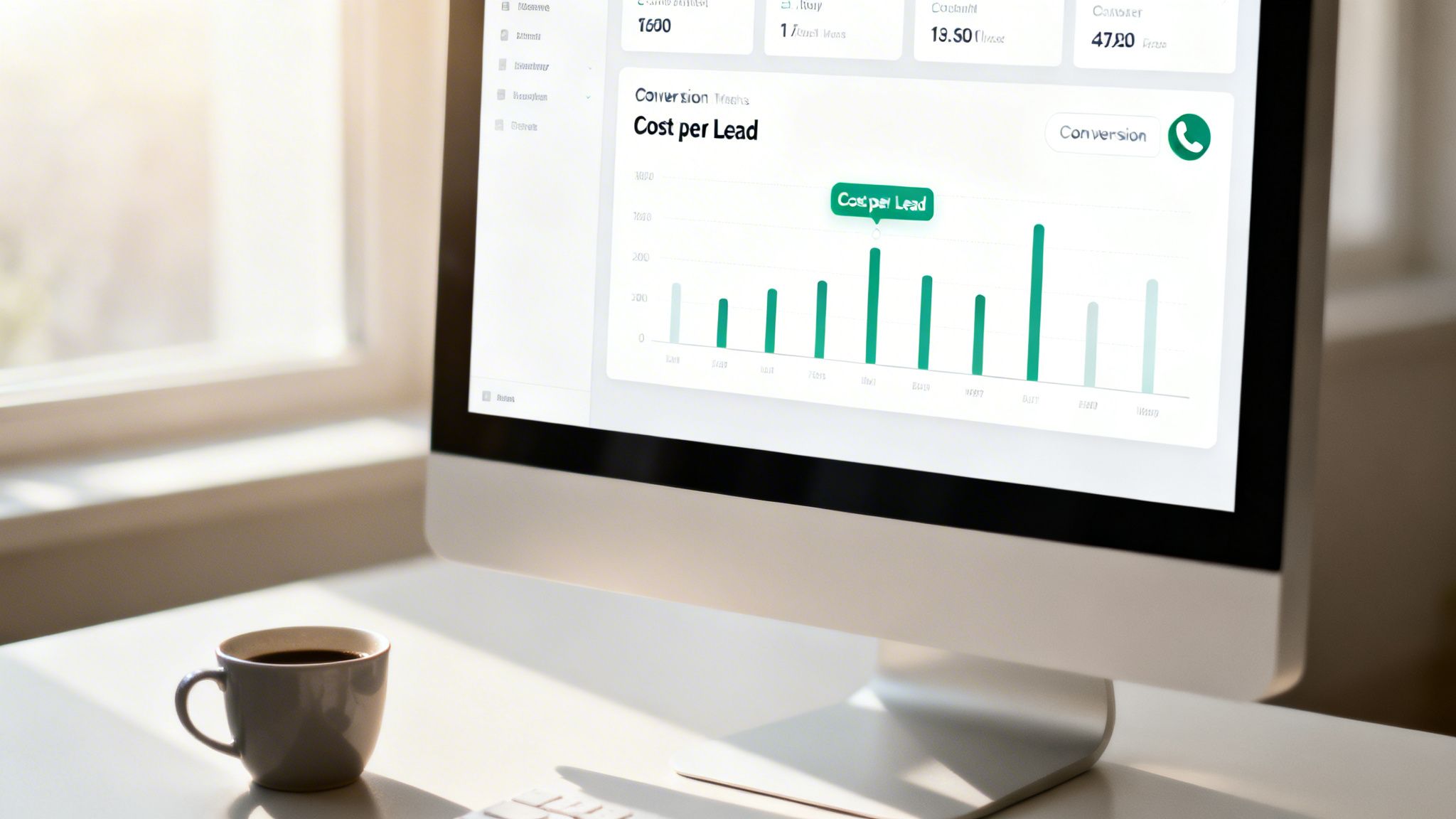
This is where we stop guessing and start making decisions based on data. We’re going to stop obsessing over vanity metrics like clicks and impressions and focus on what actually grows your business: qualified leads and return on ad spend.
Tracking the metrics that grow your business
First things first: setting up conversion tracking. If you aren’t tracking conversions, you’re not doing marketing; you’re just gambling. And the house always wins. We need to measure every meaningful action a potential client takes on your site.
Using a tool like Google Tag Manager is non-negotiable here. It lets you set up tracking for all the important stuff without having to constantly bother a developer. If you need the nitty-gritty, we break it down in our guide on the essentials of Google Ads conversion tracking setup.
You should be tracking far more than just a form submission. Think bigger.
- Phone calls: Track calls made directly from your ads and your landing pages. A phone call is often a sign of a very high-intent lead.
- Key button clicks: Someone clicking the "Schedule a Viewing" or "Apply for Financing" button is a huge signal. Track that.
- Form submissions: The obvious one, but make sure you’re tracking which forms on which pages are driving leads.
Once you have this data flowing, you can finally see which keywords, ads, and landing pages are actually making you money. This is the foundation for everything else.
The real game-changer: value-based bidding
Okay, now for the next level. Tracking all conversions is good, but treating them all as equal is a rookie mistake. Not all leads are created equal, so why would you tell Google they are?
This is where value-based bidding changes everything. It’s about teaching Google’s algorithm what’s truly valuable to your real estate business.
Think about it. A lead who downloads a generic 'first-time homebuyer guide' is not the same as a lead who fills out a form inquiring about a $750,000 luxury condo. The first lead might be worth $20 to you in potential pipeline. The second could be worth $2,000. By assigning dynamic values to these conversions, you give the algorithm a much clearer target.
Running your campaigns without conversion values is like telling your assistant to 'get leads' without telling them you prefer million-dollar listings over rental inquiries. You’ll get leads, but they won’t be the ones that build your business.
This unlocks the ability to move beyond simple bid strategies like Target CPA (Cost Per Acquisition) and into much more powerful territory. With value-based data, you can use Maximize Conversion Value. This strategy tells Google’s AI to go find the people who are not just likely to convert, but likely to become your most valuable clients. This is how you truly optimize for Return On Ad Spend (ROAS), not just lead volume.
Smart bidding and budgeting like a pro
Once you have clean tracking and value data, choosing a bid strategy becomes much simpler. Don't overcomplicate it.
- Maximize conversions: Use this when you're starting out. Your main goal is to get as many leads as possible within your budget to feed the algorithm data.
- Target CPA: Once you have enough conversion data (at least 30 conversions in 30 days), you can switch to this. You tell Google how much you're willing to pay for a lead, and it will try to hit that target.
- Maximize conversion value: This is the end goal. Once you’re passing value data back to Google, this strategy will optimize your bids to get the highest possible return from your ad spend.
And what about your budget? Stop allocating it based on guesswork or "what feels right." Allocate your budget based on performance.
If your 'Downtown Condos' campaign has a 5x ROAS and your 'Suburban Homes' campaign is barely breaking even, where do you think you should put more money? It’s not rocket science, but you'd be surprised how few people actually do it.
Your budget should be fluid. Be prepared to shift funds to winning campaigns and cut the losers without mercy. That’s how you build a scalable, profitable real estate PPC engine.
Scaling your wins with automation and smart reporting
So, you’ve finally cracked the code. Your real estate PPC campaigns are bringing in leads, and you’ve found a formula that works. That’s the good news. The bad news? You’ve just uncovered a brand new problem: how do you scale that success without hiring an entire team of campaign managers to live inside Google Ads?
The answer isn’t just throwing more people at it. It’s about building smarter systems and leaning on the right technology.
Manually tweaking a few ad groups is one thing; trying to do that for hundreds is a recipe for burnout. This is the point where you have to graduate from being a day-to-day campaign tinkerer to a high-level strategist who oversees a well-oiled machine. The real goal is to build a system that constantly learns and expands on what’s profitable, freeing you up to think about the big picture.
Letting the robots do the heavy lifting
Let's be real—a huge chunk of PPC management is just plain tedious. A/B testing ad copy, pausing keywords that aren't converting, adjusting bids… it’s repetitive work that a machine can frankly do better, faster, and more consistently than any human. This is where you need to embrace automation not as a replacement for your brain, but as a powerful tool to amplify its impact.
Google Ads has some incredibly powerful built-in features, and Automated Rules are the perfect place to start. Think of these rules as your first line of defense. They handle all the basic, reactive grunt work, so you can spend your time on proactive strategy and creative thinking.
The point of automation isn't to abdicate responsibility; it's to delegate the mundane. You want to automate the tasks so you can focus on the strategy. A machine can pause a bad keyword, but it can't devise a new market entry plan.
Building a dashboard that actually tells a story
The default reports inside Google Ads are a data dump. They tell you what happened, but they almost never tell you why or what to do about it. A truly useful report connects your ad spend directly to your actual business goals and tells a clear story.
It’s time to stop obsessing over vanity metrics like click-through rate (CTR) in a vacuum. Your dashboard needs to zero in on the KPIs that matter to a real estate business. This often means pulling data from your CRM to get the full picture from click to close.
I always recommend building a custom dashboard—whether in Looker Studio or even a well-organized Google Sheet—that tracks the metrics that drive your business: Cost per Qualified Lead, Lead-to-Close Rate, and Return on Ad Spend (ROAS).
Getting this level of insight requires systems. To truly scale your PPC and focus on high-level strategy, understanding why real estate agents need to hire a virtual assistant can be a game-changer for handling the administrative load and keeping your reporting accurate. This kind of support helps you build and maintain the very systems that give you this level of insight, without getting buried in spreadsheets yourself.
Alright, let's cut through the noise. When I talk to realtors about PPC, the same questions always pop up. Everyone's looking for a simple formula, but the truth is usually a bit more nuanced.
So, here are some straight answers based on my time in the trenches. No sugarcoating.
How much should a realtor spend on Google Ads?
This is the big one. And anyone who gives you a single magic number is selling you something. There is no magic number. It's like asking, "how long is a piece of string?" The real answer depends entirely on your market, your goals, and your stomach for risk.
That said, if you're just starting, you need a budget that gives you enough data to actually learn something. I always tell agents to aim for at least 100-200 clicks per month in their target area. Anything less, and you're just not gathering data fast enough to make smart decisions. You'll be flying blind for months.
A much better approach is to work backward. Don't start with a budget; start with a goal.
Stop asking "What should I spend?" and start asking "What do I need to make?" If you know your average commission and your target revenue, you can calculate an acceptable cost per acquisition. That number, not some arbitrary budget, should be your north star.
For example, if your average commission is €10,000 and you want to close one deal from PPC per month, you can decide how much you're willing to pay for that deal. If you're happy with a 5x return, your target CPA for a closed deal is €2,000. If you know your lead-to-close rate is 5%, you can afford to pay up to €100 per lead.
This is how you build a business case for your ad spend, not by picking a number out of thin air.
Is Facebook Ads or Google Ads better for real estate?
This isn't a "versus" battle; it’s a "both, and" situation. They do completely different jobs, and pitting them against each other is a fundamental misunderstanding of marketing. Smart agencies use both, but for very distinct purposes.
- Google Ads is for capturing demand. It’s unmatched for getting in front of people with high, immediate intent. Someone typing "three-bedroom house for sale in Lisbon" into Google isn't casually browsing—they are actively looking to transact. You use Google to be the answer when someone has a question.
- Facebook Ads is for creating demand. It’s brilliant for building awareness and reaching potential buyers or sellers before they even begin their active search. You can target users based on life events (like 'newly engaged' or 'recently moved'), interests, and behaviors. You use Facebook to plant the seed.
Think of it like fishing. Google Ads is dropping a line right where you know the fish are biting. Facebook Ads is chumming the water to attract fish to your area in the first place. One captures intent; the other creates it. Using both is how you build a dominant, long-term pipeline.
What are the most common mistakes in real estate PPC?
I see the same handful of costly mistakes over and over again. It's frustrating because they are all completely avoidable. Most floundering real estate PPC campaigns aren't failing because of some complex algorithm mystery; they're failing because of sloppy fundamentals.
Here are the top three ways people burn their money: sending all traffic to the homepage, forgetting about negative keywords, and flying blind with no conversion tracking. The last one is the deadliest sin of all. If you haven't set up proper conversion tracking for forms, calls, and key clicks, you have no idea what’s working. You're just throwing money into a black box and hoping for the best—and hope is not a strategy.
At dynares, we built a platform to solve these problems by automatically creating hyper-relevant ads and landing pages at scale, ensuring you never waste a click. See how dynares can build your high-converting campaigns.


