
Let's be direct. Most search engine marketing campaigns are a bonfire of cash. They attract window shoppers, generate leads that go nowhere, and leave you wondering where the money went.
If that stings a little, you're not alone.
Why most search engine marketing campaigns fail
I’ve seen this movie before, both in my own companies and with founders I advise. The problem isn't Google Ads—it’s still the single best platform for capturing intent. The problem is almost always a broken strategy and lazy execution.
It’s a system problem, not a channel problem.
Too many marketers are still chasing vanity metrics like clicks and impressions. They spray a generic message across thousands of keywords, point everyone to the same landing page, and then act surprised when the ROI is garbage. This is dumb.
A winning campaign isn't about bidding on keywords; it's about engineering a predictable system that turns a search query into revenue. As a European entrepreneur building tech, I believe in cutting through the noise. Success in paid search isn't about secret hacks. It's about building an intelligent, scalable system—especially in B2B, where one good lead can be worth thousands.
We have to focus on what’s actually broken:
- Flawed execution: Most campaigns are built on a shaky foundation. The account structure is a mess and the only goal is 'get more leads,' which is not a strategy.
- Wrong audience: Generic ads and landing pages attract low-intent traffic, wasting your budget on people who will never buy from you.
- Burned cash: Without proper tracking, you're flying blind. You have no idea which keywords are making you money and which are just costing you. If you're not sure how to fix this, check out our guide on how to measure marketing ROI.
We're going to tear down that outdated, manual approach. This playbook is about building a modern framework that treats every single keyword like its own unique conversation.
It's time to turn your SEM from a frustrating cost center into a predictable revenue engine. 🚀
Everyone wants to jump straight to launching ads. Don't.
Before you spend a single euro, you have to build the foundation. This is the unglamorous, tedious part that most people skip, and it's precisely why their search engine marketing campaigns flame out. Getting this right from day one is what separates the pros from the amateurs who just light cash on fire.
It all starts with keyword research, but not the old-school way of just chasing high search volume. You have to go deeper and figure out the intent. What problem is the person on the other side of that search bar actually trying to solve? If you need a refresher on the mechanics, we have a whole guide on how to perform keyword research.
This early work is non-negotiable because it dictates your entire account structure. A messy, poorly thought-out structure is a direct path to wasted ad spend and miserable performance.
It’s a simple, painful journey that looks a lot like this.
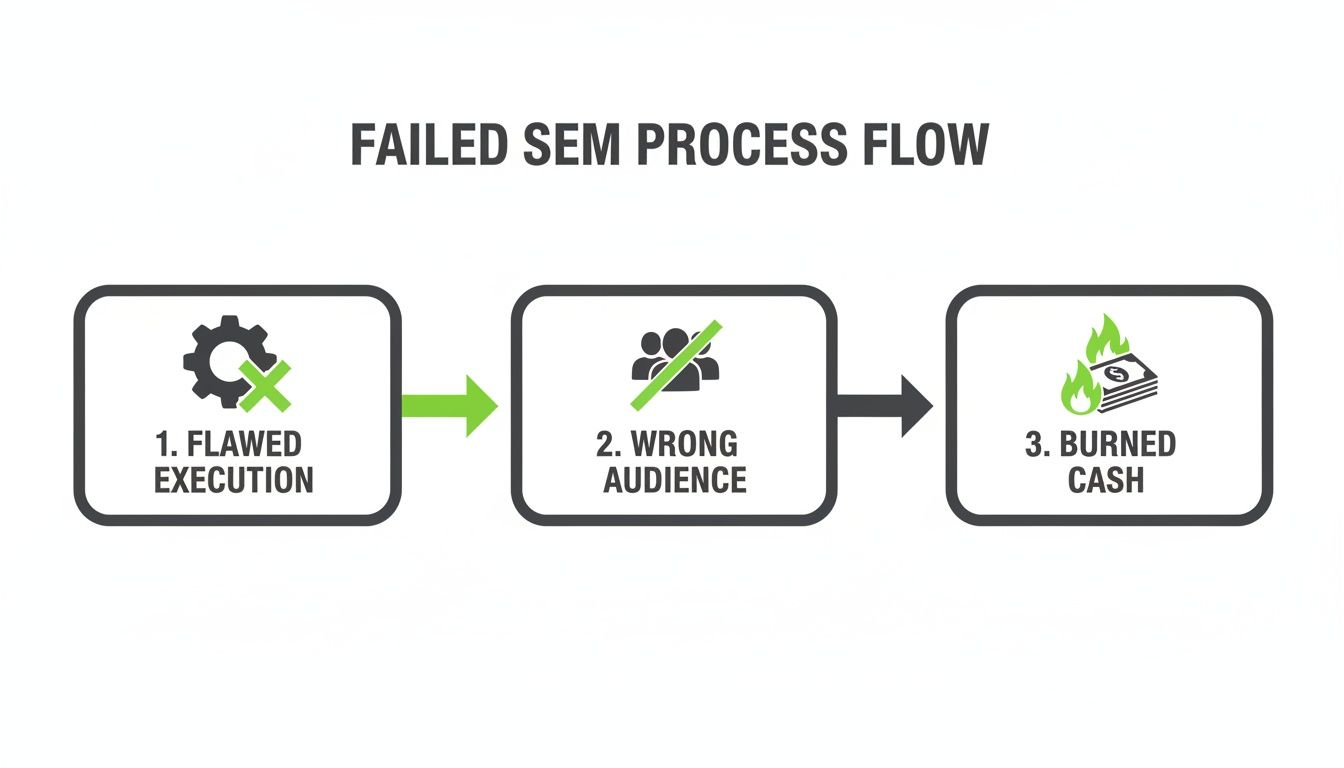
The flowchart is blunt, but it's true: flawed execution sends you straight to the wrong audience, and all you get back is a bill for burned cash.
Map the path from search to sale
A great campaign feels like a seamless conversation. Your ad, your landing page, and even the thank-you message all need to speak the same language, directly answering the initial search.
This means you have to map out the entire customer journey. Don't just obsess over the click; think about what happens before and after.
Each stage demands a different message. Shoving a pricing ad in front of someone just starting their research isn't just ineffective—it's dumb. You have to meet them where they are.
Build for scale, not for starters
Forget the ancient advice of stuffing 20-30 keywords into one ad group. That’s a recipe for terrible Quality Scores and ads that feel completely irrelevant to the searcher. We need to be way more granular.
The goal is to build a structure that’s designed for scale right from the jump. My go-to method is a modern take on Single Keyword Ad Groups (SKAGs), supercharged with automation. The principle is simple: one core search intent gets one hyper-relevant ad and one perfectly matched landing page. This creates an insane level of relevance.
The magic of a hyper-granular structure is that it forces you to create a perfect message match. When the keyword, ad, and landing page are all in perfect sync, Google rewards you with a higher Quality Score, which means a lower cost-per-click (CPC) and better ad positions.
This isn't about hand-crafting thousands of ad groups—that's a one-way ticket to burnout. It's about designing a system where that level of personalization can be automated. We’re building a machine, not just a one-off campaign.
Get your tracking right before you spend a cent
Let me be blunt: if you can't measure it, don't do it. Running a campaign without rock-solid tracking is like flying a plane blindfolded. You might stay airborne for a bit, but you're definitely going to crash.
Tracking isn't an afterthought. It's a prerequisite. Before you even think about going live, your conversion tracking has to be completely dialed in. This means you need to be able to track on-site conversions like form fills, offline conversions from your CRM, and use a smart attribution model beyond 'last click'.
The scale of paid search is immense. By 2026, global ad spend on search is projected to hit $351 billion, with Google still holding a dominant 89.62% of the market. This isn't some niche channel; it's a primary growth engine where a tiny edge in data makes all the difference.
Creating ads and landing pages that convert
So, you’ve built a rock-solid campaign foundation. Now comes the part where most search engine marketing campaigns either fly or die: the ad and the landing page.
Why do most of them fail? Honestly, it’s because they’re generic and lazy. A user searches for a specific, painful problem, and we serve them a one-size-fits-all solution. It's a dumb, inefficient approach that wastes your budget.
The truth is, a high click-through rate means nothing if the landing page doesn't convert. You're just paying Google to send traffic to a dead end. The entire game is about creating a perfect, unbroken line of relevance—what I call message match—from the keyword to the ad copy to the landing page headline. When that connection is seamless, conversions happen.

Ditch the one-size-fits-all approach
The old way of doing this was to build one landing page and hope it worked for a dozen different ad groups. That model is broken. The future of high-performance SEM is hyper-personalization, but done at a scale that's humanly impossible to manage manually.
This is where technology, especially AI, becomes a true unfair advantage. Platforms like what we're building at dynares can automate this entire process. Imagine generating thousands of unique, high-intent landing pages and ad variations, each one perfectly tailored to a specific search query.
That's not a far-off vision; it’s what’s required to win today. We're not just building campaigns anymore. We're building a machine that gives every user precisely what they asked for, instantly.
Anatomy of a landing page that actually works
A landing page has one job: get the user to take a specific action. That's it. It’s not your homepage, it’s not a brochure, and it definitely shouldn't have a navigation bar that lets them wander off. Every element must push the user toward that one conversion goal.
Here are the non-negotiable elements your page must have:
- A killer headline: It must immediately confirm the user is in the right place. If they searched for 'best CRM for small startups,' your headline should be something like 'The #1 CRM Built for Small Startups,' not 'Powerful CRM Solutions.'
- Compelling copy: Speak directly to the pain point that drove the search. Forget features; focus on the outcome. How will your solution make their life better or their business more profitable?
- Frictionless forms: Only ask for what you absolutely need. Every extra field you add kills your conversion rate. For an initial lead, name and email are often enough.
- Irresistible social proof: This is your trust currency. Use real customer testimonials, case study logos, or impressive stats like 'Trusted by 10,000+ businesses'.
Your landing page is the final handshake. No matter how brilliant your ad is, if the page is slow, confusing, or fails to deliver on the ad's promise, you’ve lost. The user will hit the back button in seconds, and you'll have paid for nothing.
To really nail this, you need to be up on the latest landing page design best practices, because the small details matter more than you think. And if you want a deeper dive, check out our guide onhttps://dynares.ai/resources/blog/how-to-create-a-landing-page that drives results.
Writing ad copy that cuts through the noise
Your ad copy is the gateway to your landing page. Its primary goal isn’t to make a sale; it's to earn a qualified click. You want to attract the right people and repel the wrong ones.
Here’s how to write ads that boost your click-through rate (CTR) and Quality Score, which in turn drives down your cost-per-click (CPC).
- Mirror the keyword: Your headline should include the user's search term. This is the oldest trick in the book, and it still works because it screams relevance.
- Focus on benefits, not features: Nobody cares that your software uses a proprietary algorithm. They care that it will save them 10 hours a week.
- Add a clear call-to-action (CTA): Tell them exactly what to do next. 'Get a Free Demo,' 'Download the Guide,' or 'Request Pricing.' Be direct.
- Use numbers and specifics: 'Increase Revenue by 30%' is way more powerful than 'Increase Revenue.' Specifics build credibility.
With Responsive Search Ads (RSAs), Google's AI now does a lot of the heavy lifting, mixing and matching headlines and descriptions to find the winning combinations. Your job is to feed the machine high-quality, distinct, and benefit-driven components. Stop trying to guess the one perfect ad and start providing the ingredients for thousands of great ones.
Launching and optimizing your campaign engine

Alright, your campaigns are built. The foundation is solid, the ads are hyper-relevant, and your landing pages are ready for traffic. Now the real fun begins.
Launching isn't the finish line. It's the starting gun. 🏁
This is where the actual work of optimization starts. Forget 'set it and forget it'—that approach died years ago. A high-performance campaign is a living system that needs a constant diet of data and intelligent adjustments. You're not just running ads; you're building a feedback loop where every click and conversion makes the entire engine smarter.
Move beyond dumb metrics
First thing's first: let's get smart about bidding. If you’re still just optimizing for a target Cost Per Acquisition (CPA), you are leaving a massive amount of money on the table.
A lead is not just a lead. Some are worth €100, and others are worth €10,000. Lumping them all together is a rookie mistake.
This is where value-based bidding becomes a non-negotiable part of your strategy. By uploading offline conversion data—like which leads actually became customers and how much revenue they generated—back into Google Ads, you completely change the platform's understanding of success.
Suddenly, Google isn't just chasing cheap form fills. It's chasing your most valuable future customers. This single move changes the game, allowing you to bid based on Return On Ad Spend (ROAS), which is what the business actually cares about.
Create a disciplined testing culture
Optimization is a science, not guesswork. You need a disciplined approach to A/B testing that goes way beyond tweaking button colors. We’re talking about fundamental changes that can create step-function improvements in performance.
The goal isn't just to find a single winner. The goal is to build a system of continuous learning where every test, win or lose, teaches you something valuable about your customers.
This mindset is crucial. With over 75% of marketers planning to increase or maintain their search ad spend, the competition isn't getting any softer. Digital ad spend in the US alone is projected to top $383 billion by 2027. A sharp, data-driven optimization strategy is no longer optional; it's the only way to survive.
Build a KPI dashboard that tells a story
You can't optimize what you can't see clearly. Ditch the default Google Ads dashboard and build a Key Performance Indicator (KPI) dashboard that gives you a true, at-a-glance view of your campaign engine's health. Your dashboard needs to tell a story about performance, not just activity.
This means shifting your focus from vanity metrics to the KPIs that actually map to revenue. The difference is stark.
Modern SEM KPIs vs. outdated metrics
| Metric Focus Area | Outdated Metric (What to avoid) | Modern KPI (What to track) | Why it Matters |
|---|---|---|---|
| Efficiency | Cost-Per-Click (CPC) | Cost-Per-Qualified-Lead (CP-MQL) | Tracks the cost of leads that sales actually accepts, not just junk form fills. |
| Relevance | Click-Through Rate (CTR) | Quality Score & Ad Relevance | High Quality Scores directly lower your CPC and improve your ad rank. |
| Effectiveness | Conversion Volume | Conversion Rate & Revenue/ROAS | Focuses on the percentage of visitors who convert and the actual revenue driven. |
| Opportunity | Impressions | Impression Share (Lost IS due to Rank/Budget) | Shows you how much more traffic you could capture by improving rank or increasing budget. |
A dashboard built around these modern KPIs moves the conversation from 'How many clicks did we get?' to 'How much revenue did our ad spend generate?' It's a game-changer for proving your value.
If you want to go deeper on this, we have a complete breakdown on Google Ads campaign optimization that you should check out.
Finally, a word of caution: don't let Google's automation run wild without your strategic oversight. Tools like Performance Max are incredibly powerful, but they are co-pilots, not pilots.
Your job as the strategist is to provide the right inputs—the right audience signals, the right conversion values, and the right creative assets. You are the pilot. Never forget that.
Scaling intelligently without burning cash
Your campaigns are humming along and bringing in leads. Good. Now for the hard part: can you actually scale?
Most people hear 'scale' and immediately think 'crank up the budget.' That's a great way to set a pile of your company's money on fire. 🔥
Real scaling isn't about spending more—it's about spending smarter. It’s a methodical process of expanding your reach and increasing your spend while keeping your efficiency (your ROAS) from falling off a cliff. This is how you go from just running campaigns to building a proper growth engine.
You're aiming to build a flywheel, where more investment creates predictably higher revenue, not just higher costs and a bigger headache. You want a system that grows with you, not one you have to constantly rebuild from scratch.
Evolving your keyword portfolio
When you first launch a campaign, it’s all about surgical precision. You go after high-intent, long-tail keywords—the searches where people are practically waving their credit cards in the air. But you can't build a huge business on a handful of niche terms alone.
Scaling means you have to systematically expand from that core group into broader, higher-volume keywords.
The trick is doing it without torpedoing your ROAS. This is a delicate balancing act. Broader terms are almost always more competitive and often have lower conversion rates, so you can't just dump them into your best-performing campaigns and hope for the best.
A smart scaling strategy is like a military campaign. You secure your core territory (high-intent keywords) first, establish a defensible position with strong ROAS, and then you use that base to methodically advance into new, adjacent territories (broader keywords).
To manage this without chaos, you need a tiered approach that protects your core performance while letting you explore growth opportunities in a controlled, risk-managed way. It stops you from diluting your best campaigns with speculative new keywords that could drag everything down.
Full-funnel view with CRM integration
Let me be direct: if your Google Ads account isn't connected to your CRM, you are flying blind. You might know your cost-per-lead, but you have no clue what your cost-per-customer is. And that’s a dumb way to manage millions in ad spend.
Connecting your SEM efforts with your CRM is completely non-negotiable for intelligent scaling. When you feed sales data back into Google Ads—like which leads actually became customers and what their lifetime value is—you give the algorithm the one piece of information it truly craves: revenue. This is what unlocks value-based bidding, where you stop optimizing for cheap leads and start optimizing for high-value customers.
This integration is also critical because, let's be real, Google's market dominance is absolute. Its 89.98% global search engine market share is an unassailable monopoly. With competitors like Bing trailing at a distant 5.01%, virtually every meaningful search engine marketing campaign happens on Google's turf. This has been the reality since 2009, making optimized, revenue-driven campaigns the only real game in town. You can discover more insights about this market dominance on StatCounter.
Manage complexity with automation
As you scale—adding more keywords, expanding into new countries, or launching new product lines—the complexity can quickly become overwhelming. Trying to manage thousands of keywords, ads, and landing pages in a series of spreadsheets is a recipe for disaster. You’ll just drown in tactical work and have zero time left for actual strategy.
This is where AI and automation stop being a nice-to-have and become essential.
Platforms like ours at dynares are built specifically to handle this kind of complexity. By automating the creation of hyper-relevant ads and landing pages for every single keyword, you can manage a level of granularity that is humanly impossible.
This allows you to maintain perfect message match even as you scale to thousands upon thousands of keywords. A user in Germany searching for your product in German gets a completely different experience than a user in the US—and you didn't have to build it all by hand. It's about building a system that lets you be everywhere, for everyone, without creating an unmanageable mess. This is how you scale intelligently.
Let's get to the questions people actually ask when the consultants leave the room. These are the things I hear constantly from teams trying to make search marketing work without burning their budget.
No theory, just straight answers.
How much should I spend to see results?
This is, with all due respect, the wrong question. It frames SEM as an expense, like buying a billboard. It's not. You're buying data.
Start with a budget you're comfortable testing with—say, €1,000 to €5,000 a month. The only goal here is to gather enough data to prove your unit economics. Can you acquire a lead, and then a customer, at a cost that makes sense for your business?
Once you have a predictable Cost Per Acquisition (CPA) and a positive Return On Ad Spend (ROAS), the question flips. It’s no longer 'how much should I spend?' but 'how much can I spend?' A profitable campaign shouldn't have a budget cap. Its only limit is performance.
Stop thinking about an arbitrary number. Get the math right first. Once the engine is proven, you just keep adding fuel until you run out of market.
Can I run successful SEM campaigns without expensive AI tools?
Sure. You can also build a house with a hand saw instead of power tools. It’s technically possible, but it's painfully slow, shockingly inefficient, and it will never, ever scale.
Think it through. The manual process of creating unique ads and perfectly matched landing pages for hundreds, let alone thousands, of keywords is just brutal. You’ll drown in low-value tactical work instead of focusing on high-value strategy.
AI platforms don't replace your brain; they automate the most repetitive, soul-crushing parts of the job. This gives you leverage to operate at a level that is humanly impossible. Trying to compete in 2024 without this tech puts you at a massive—and totally unnecessary—disadvantage.
Should I focus on SEO or SEM first?
Both. The 'either/or' debate is a fossil from a different era of marketing. Thinking of them in isolation is a huge strategic mistake. They’re two sides of the same coin, and they create a powerful feedback loop.
- SEM buys you speed and data. You get immediate traffic. You can test messaging, validate offers, and find out which keywords actually convert within days, not months. It’s your R&D department.
- SEO builds you a long-term asset. It creates organic authority and a sustainable traffic source that pays dividends for years to come. It’s your foundation.
Use the conversion data from your paid search engine marketing campaigns to directly inform your SEO strategy. The keywords that are profitable in Google Ads are the exact keywords you should be building content around. Run them in tandem, not in separate silos.
How do I know if my PPC agency is doing a good job?
This is a big one. If their monthly reports are a sea of vanity metrics like impressions, clicks, and CTR, you should be deeply skeptical. Those are metrics of activity, not business results.
A great agency or partner talks about the numbers that actually matter to your bottom line:
- Cost per Marketing Qualified Lead (MQL): What does it cost to get a lead your sales team will actually accept?
- Lead-to-Customer Rate: What percentage of those leads are turning into paying customers?
- Return on Ad Spend (ROAS): For every euro you put in, how many euros in revenue are coming back out?
They should be radically transparent about what they're testing, what's failing, and what's working. A good partner will push you on landing page optimization and conversion tracking, not just quietly tweak bids in a corner.
Demand a dashboard that clearly connects your ad spend to actual revenue. If they can’t or won't provide that, it's a giant red flag. 🚩
Building a scalable SEM engine requires the right tools. At dynares, we built the platform to automate the entire process of creating hyper-relevant ads and landing pages for every keyword, turning your campaigns into a predictable revenue machine. See how it works at https://dynares.ai.


