
what is a good cost per click? a founder's guide
what is a good cost per click? a founder's guide
So, what’s a good cost per click? Let's get straight to it.
A good CPC isn't some magic number pulled from a report. It’s a moving target that depends entirely on your industry, your goals, and—most importantly—how good you are at turning those clicks into actual money.
For some founders I know, paying $8 for a click that lands a $5,000 client is a massive win. For others, anything over $1 feels like setting cash on fire. Both can be right.
defining a 'good' cost per click for your business
I don't see Cost Per Click as a cost in the traditional sense; I see it as an investment. Every click is a potential customer walking through your digital front door. The real question isn't how cheap can I get this click? but how much is this click actually worth to my business?
It’s a simple mindset shift, but it changes everything.
Think of it like buying raw materials. The price of a single component only matters in the context of what you're building. You wouldn't obsess over the cost of one bolt if it's essential for a car that sells for a huge profit. Your CPC is just one piece of the production line that ends with a new, paying customer.
A good CPC is simply one that lets you acquire customers profitably. It has to fit comfortably within your overall Customer Acquisition Cost (CAC). If you can spend $100 to acquire a customer who brings in $500 of lifetime value, a $5 CPC that converts at a 5% rate is perfectly fine. The math works out.
This visual shows just how wildly CPC can swing depending on the industry you're in—from cheap entertainment clicks to high-stakes legal searches.
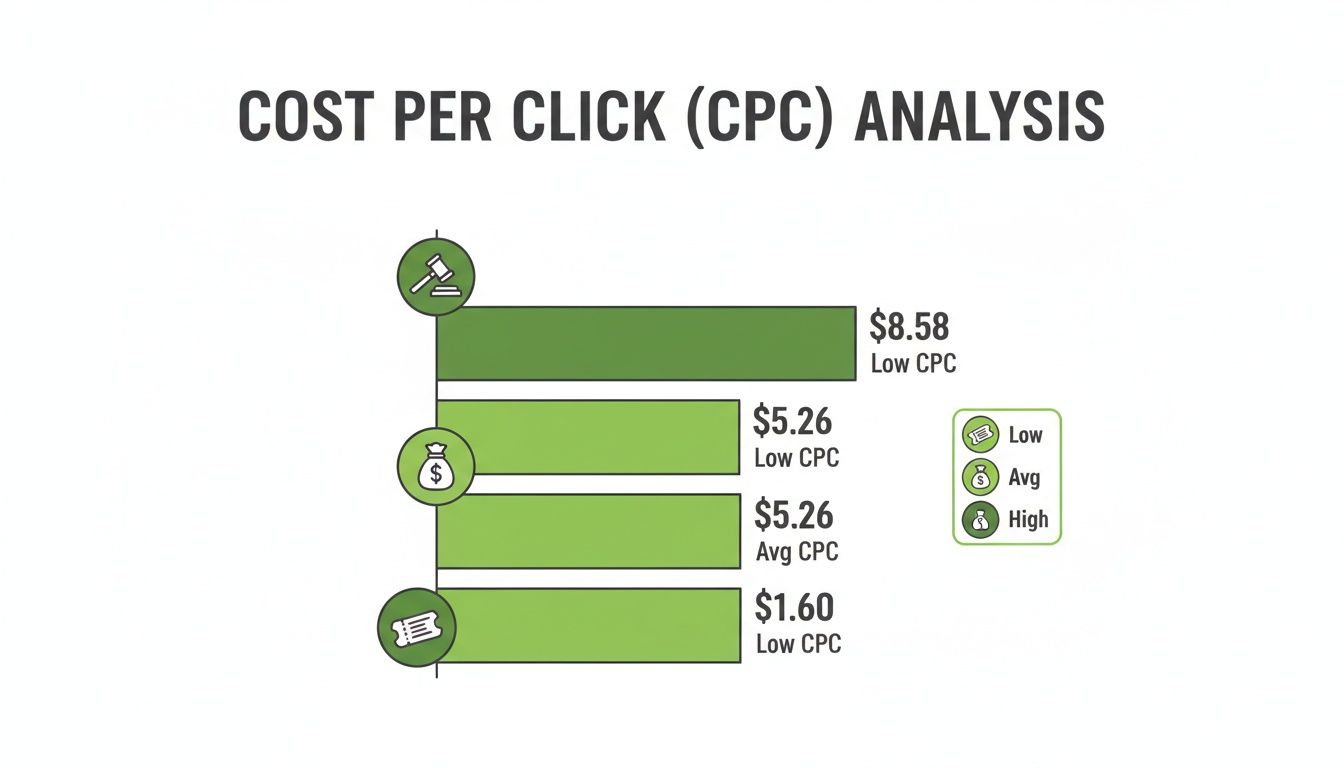
As the data shows, what's average or high is completely relative. It all comes down to the potential value of the customer you're trying to attract.
2026 google ads CPC benchmarks by industry (high vs low competition)
Industry benchmarks can give you a rough starting point, but they aren't the whole story. The table below breaks down average CPCs across different industries to give you a realistic baseline for what others are paying.
| Industry | Average CPC (2026 Data) | Competition Level |
|---|---|---|
| Attorneys & Legal Services | $8.58 | High |
| Insurance & Finance | $7.15 | High |
| B2B Services | $6.40 | High |
| Real Estate | $4.90 | Medium |
| Health & Medical | $4.22 | Medium |
| E-commerce & Retail | $3.15 | Medium |
| Arts & Entertainment | $1.60 | Low |
| Hobbies & Leisure | $1.45 | Low |
The data from 2026 shows a clear pattern: high-stakes sectors like Attorneys & Legal Services are paying an average of $8.58 per click, while industries like Arts & Entertainment get by with clicks around $1.60. Competition is the driving factor here. To truly know what a good CPC means for you, however, you have to look past the click itself.
context is everything
A click is just the first step. Focusing only on CPC without seeing the whole picture is like trying to drive a car while only looking at the speedometer. You need to see the whole road ahead.
To put your CPC into perspective, you have to get a handle on related metrics. This means understanding your lead generation cost per lead and how it fits into your broader financial model. Only then will you know if your CPC is a bargain or a burn.
Ever wonder why your Cost Per Click is what it is? It’s not random. It’s a high-speed auction happening millions of times a day, and most advertisers get it wrong. They think the answer is to just throw more money at their bids, which is a fast way to burn cash.
Let's break down the Google Ads auction without the usual fluff. Think of it like trying to get into a popular nightclub with a tough bouncer—that’s Google. You can try to bribe your way past the line by offering more cash than anyone else. That’s your bid.
But if you show up looking sharp and fitting the club's vibe, you’ll not only get in for less money, but you might even get a better spot inside.
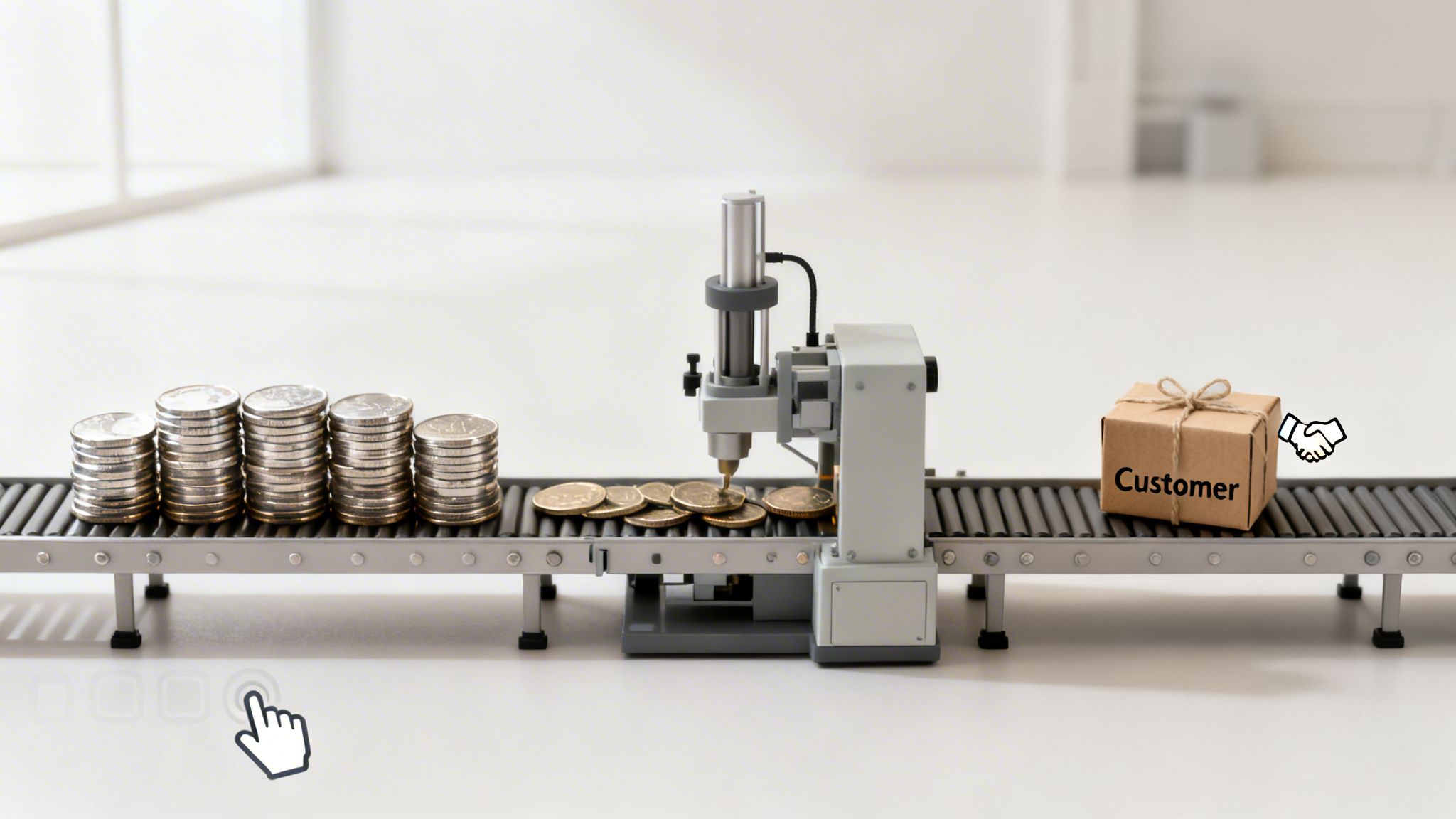
In this world, looking sharp is your Quality Score. It's Google's rating of how relevant and useful your keywords, ads, and landing pages are. Honestly, it’s the most powerful lever you have for actually lowering your CPC, and it’s something we obsessed over when building our own tech.
the ad rank formula
Your ad’s position on the page isn’t just about who bids the most. It’s decided by your Ad Rank, which is a simple but critical formula: Ad Rank = Your Maximum CPC Bid x Your Quality Score.
This formula is everything. A high Quality Score acts as a massive multiplier on your bid. It means you can actually outrank a competitor who is bidding more than you, simply because your ads are a better fit for the user. This is how you win the auction without just setting your budget on fire.
Your final CPC is also influenced by the Ad Rank of the advertiser directly below you. You essentially pay just enough to beat their score. So, a higher Quality Score doesn't just improve your position—it directly lowers the price you pay for that click.
The components that make up your Quality Score are where you should focus 90% of your energy. These are the levers you can actually control.
- Expected Click-Through Rate (CTR): How likely are people to click your ad? Google predicts this based on past performance, and it’s a huge signal of relevance.
- Ad Relevance: Does your ad copy actually match the user’s search? If they search for blue running shoes, your ad needs to talk about blue running shoes, not just athletic footwear.
- Landing Page Experience: After the click, does the page deliver on the ad's promise? Is it relevant, easy to navigate, and trustworthy?
Improving these three areas is non-negotiable. You can read more about this in our deep dive on what a Quality Score is and how to improve it.
why quality score is your secret weapon
So, what is a good cost per click? It's really just the outcome of a high Quality Score. When your CTR is high, it tells Google that your ad is a great match for what the searcher wants. The algorithm loves this because it creates a better experience for its users, and it rewards you for it.
A solid CPC benchmark ties directly to these factors. For instance, in 2026, a strong Google Ads CTR on search is around 4-6%. The average is closer to 3.17% with a CPC of $2.69. This shows that even a small lift in CTR can have a huge impact, dropping your CPC because Google's algorithm rewards you for nailing user intent. You can dig into more data on how benchmarks are shaping up for 2026 over on terrahq.com.
While building our own tech, we treated Quality Score like a core product feature. Every decision was made to maximize relevance and user experience, which in turn drove our CPCs down. This is the mindset of a builder, not just a marketer. Don’t just rent your spot on Google—earn it.
how industry competition sets your starting price
Let's be blunt: your Cost Per Click is a direct reflection of who you're up against.
It's not some random number Google dreams up. It’s the outcome of a fierce, real-time auction where your competitors are bidding for the very same eyeballs you are. The price you pay is set by the market you choose to compete in. Period.
Thinking you can just waltz into a hyper-competitive space and score cheap clicks is a rookie mistake. A lawyer pays nearly $9 for a click while a local restaurant might pay $2. This isn't just about the value of a new client; it’s about the sheer number of other lawyers also fighting tooth and nail for that exact same click.

This is exactly why understanding your industry’s competitive landscape is your first strategic move. It tells you whether you're walking into a street fight or an open field.
the three tiers of competition
I usually bucket industries into three main tiers. Knowing where you stand gives you a realistic starting point for your budget and strategy.
- High-Competition (The Red Ocean): Think legal, finance, and insurance. These are brutal, high-stakes markets where a single lead can be worth thousands. Competitors have deep pockets and are willing to pay top dollar, driving CPCs through the roof. It's a money pit for the unprepared.
- Moderate-Competition (The Growth Zone): This is where most B2B services, SaaS, and tech companies live. There's real competition, for sure, but there’s also room to outsmart others with a better strategy, not just a bigger budget. This is often the sweet spot for scalable growth.
- Low-Competition (The Volume Play): Niche hobbies, local entertainment, and some arts and crafts fall here. Clicks are cheap, but the trade-off is often lower purchase intent and smaller deal sizes. You need significant volume to make a real impact on your bottom line.
Deciding where to play is one of the most important strategic choices you'll make. The total cost of online advertising is heavily skewed by this single factor.
what the numbers tell us
So what does a good CPC actually look like across these tiers? The differences are stark.
High-competition industries like Attorneys ($8.58), Dentists ($7.85), and Education ($6.23) see an average CPC of $7.58. In contrast, moderate tiers average $4.69, and low-competition niches sit around $2.22.
The market's volatility also plays a huge role. In 2026, for example, CPCs jumped by 12.3% in January alone, showing just how quickly the battlefield can change. You can explore a deeper analysis of these industry benchmarks and their fluctuations over on focus-digital.co.
This data isn't just trivia; it's a strategic guide. If you're in a high-competition space, you can't win by just bidding higher. You have to be smarter. This means obsessing over your Quality Score, hunting for long-tail keywords your rivals ignore, and ensuring every single click lands on a hyper-relevant page. You have to find an edge because you can't afford to waste a single click.
So, should you fight in the crowded, expensive keywords, or find your "blue ocean" in less contested territory? Honestly, it depends on your ambition and your resources. Sometimes the most expensive keywords are expensive for a reason—they convert. But you'd better have a flawless funnel behind them.
For most of us building and scaling, the real opportunity is in that middle ground, where smart strategy beats brute force every time.
the metric that actually drives your business
Let’s get something straight that a lot of marketers need to hear: obsessing over your Cost Per Click is a rookie move. It feels productive, sure, but most of the time you’re just admiring a vanity metric. It’s like bragging about how cheap your raw materials are without knowing if the final product even sells. Pretty dumb, right? 🤷♂️
The real metric—the one that keeps the lights on and funds your next big idea—is your Return on Ad Spend (ROAS) or its close cousin, Cost Per Acquisition (CPA). The only question that truly matters is this: are you making more money from a customer than it cost you to get them in the door?
That’s it. That’s the entire game. Everything else is just noise.
shifting from cost-cutting to profit-driving
I’ve seen this play out dozens of times. I’ve watched campaigns with high CPCs of $15 or more turn out to be wildly profitable. They were targeting high-intent buyers ready to drop thousands. Every click was expensive, but every conversion was a huge win.
On the flip side, I've seen campaigns with low CPCs under $0.50 that were just bleeding cash. They were getting tons of cheap clicks from low-intent looky-loos who never converted. The traffic looked great on a chart, but it was completely worthless. It’s a classic case of winning the battle but losing the war.
This is where you need to shift your mindset from being a cost-cutter to a profit-driver. The goal isn't to find the cheapest clicks possible; it's to find the most profitable ones.
The moment you get comfortable paying a higher CPC—as long as the return on investment justifies it—is the moment you unlock true, scalable growth. Stop asking what is a good cost per click? and start asking what is a profitable cost per click for my business?
This mental shift is critical. It forces you to look past the top of the funnel and understand the entire customer journey. A great way to start is by figuring out the two most important numbers for your ad spend.
calculating your break-even point
To figure out if your campaigns are actually making money, you need to know your floor. What’s the absolute most you can afford to pay for a click or a new customer before you start losing money on the deal?
Let’s walk through a simple, practical way to figure this out:
- Calculate Your Break-Even CPA: First, you need to know your average profit per customer. If you sell a product for $500 and your cost of goods is $200, your profit is $300. This means your break-even CPA is $300. You can spend up to that amount to acquire a customer and not lose money.
- Set a Target CPA: You’re not in business to break even. You need a profit margin. If you want a 3x return on your ad spend, your target CPA would be $100 ($300 profit / 3). This is the number you should actually be aiming for.
- Calculate Your Break-Even CPC: Now, let's factor in your conversion rate. If your landing page converts clicks into customers at a rate of 5% (which is pretty solid), your break-even CPC is your break-even CPA multiplied by your conversion rate. So, $300 x 5% = $15. You can pay up to $15 per click and still break even.
This simple math changes your perspective completely. Suddenly, a $10 CPC doesn't look so scary, because you know it's still well within your profitable range. To get even more granular with this, check out our guide on how to calculate your cost per conversion, which dives deeper into this essential metric.
This is the foundation of building a sustainable growth engine. It's not about magic tricks to lower your CPC; it’s about solid business fundamentals. And this is where automation becomes not just helpful, but essential for true revenue optimization. Platforms that can pipe real conversion values back into Google Ads are the future, because they let the algorithm optimize for actual profit, not just lead volume.
actionable ways to lower your CPC today
Enough with the theory. It's time to get our hands dirty.
Knowing your target CPC is one thing; actually hitting it is another. Let’s talk about what you can do right now to bring your costs down without trashing your lead quality.
This isn’t going to be the usual advice you see everywhere, like improve your ads. That’s completely useless. We're digging into the specific, grounded tactics that work because they all hinge on one thing: relevance. The more intelligently your campaigns are structured, the more Google's algorithm rewards you with lower costs. It really is that simple.
These tactics are the bedrock of any high-performing account. If you want a more comprehensive look at the process, there are great resources on optimizing PPC campaigns that reinforce these core principles.
nail your campaign structure
Most CPC problems start right here. A messy, disorganized campaign structure is like trying to build a house on a swamp. It's destined to fail, and you'll burn a ton of cash finding that out.
The fix is to get granular. Extremely granular.
Your goal is to forge a rock-solid, logical link between the keyword someone searches, the ad they see, and the page they land on. When those three elements are in perfect harmony, your Quality Score shoots up, and your CPC plummets.
Here’s how you do it:
- Hyper-Specific Ad Groups: Stop cramming dozens of keywords into a single ad group. It's a lazy approach that costs you money. Instead, build tightly-themed ad groups with just a handful of very closely related keywords. This lets you write incredibly specific ad copy that speaks directly to what the searcher is looking for.
- Embrace Single Keyword Ad Groups (SKAGs): Yes, they still work wonders. A SKAG is exactly what it sounds like—one keyword, one ad, one landing page. It is the ultimate expression of relevance. You literally can't get more specific, and Google absolutely loves it. It's more work upfront, but the payoff in cost savings is huge.
hunt for long-tail keywords
Look, your competitors are all duking it out over the same obvious, expensive head terms like "CRM software." It’s a bloody red ocean. You can win by fishing in a completely different pond: the world of long-tail keywords.
These are longer, more specific search phrases like "CRM software for small real estate agencies." Sure, they have lower search volume, but the intent behind them is laser-focused. Someone searching that isn't just window shopping; they have a specific problem and are actively hunting for a solution.
Long-tail keywords are a goldmine. They are less competitive, which means they are cheaper. And because the intent is so high, they often convert at a much better rate. You’re trading a bit of volume for a massive gain in quality and cost-efficiency.
Think about it from a user's perspective. The more specific their search, the closer they are to making a decision. These are the people you actually want to talk to.
master your negative keywords
Paying for clicks that will never convert is the single fastest way to incinerate your ad budget. If you sell high-end running shoes, you don't want your ads showing up for searches like "cheap running shoes" or "running shoe repair." This is where negative keywords become your best friend.
A well-maintained negative keyword list acts as a bouncer for your campaigns, blocking your ads from showing for searches that are a total waste of money. It’s one of the simplest yet most powerful ways to cut waste and directly improve your ROI.
Here are a few quick wins:
- Regularly mine your search terms report in Google Ads to spot irrelevant queries that triggered your ads. Add them as negatives.
- Proactively build lists of negative terms around concepts you want to avoid, like price (free, cheap), intent (jobs, reviews, how to), and any competitors you don’t want to target.
- Don't just set it and forget it. A negative keyword list should be a living, breathing part of your campaign that you update constantly. If you want a deeper look, we have a whole guide on what negative keywords are and how to use them effectively.
These manual strategies are powerful, but they are also incredibly time-consuming. As a founder, my focus needs to be on strategy, not manually creating thousands of ad groups. This is where automation tools like dynares come in. They take these exact principles and execute them at a scale no human ever could, creating thousands of hyper-relevant ad-and-page combinations instantly. It’s how you take a good strategy and make it unbeatable.
why the future of PPC is automated

Alright, let's have a frank conversation. If you’re still managing your Google Ads campaigns like it’s 2018—manually tweaking bids, A/B testing a couple of ad variations, and pointing all your traffic to one generic landing page—I have some news for you.
You’re going to get left behind. In fact, you probably already are.
The game has fundamentally changed. The future of pay-per-click isn't about being the best human at tedious, repetitive tasks. It’s about building a smarter system and letting automation execute your strategy at a scale no human team could ever hope to match.
This isn’t just some trend; it's a massive shift in how value is created in marketing. While you’re spending hours trying to manage a few dozen ad groups, modern platforms are already generating thousands of hyper-relevant landing pages on the fly. They're running countless tests automatically and feeding real revenue data back into the ad platforms for truly intelligent bidding.
from manual labor to strategic architect
The job of a PPC manager is evolving. It's moving from a hands-on technician to a strategic architect. Your value is no longer in your ability to click buttons faster than the next person.
It's in your ability to think, strategize, and build a machine that runs itself.
This isn’t a sales pitch; it's a wake-up call for founders and marketers. Your focus should be on high-level decisions, not low-level execution. The real work is asking the questions that actually move the needle.
These are the strategic questions. The how—the creation of ads, pages, and bid adjustments—should be automated. It’s the only way to scale profitably and free up your brainpower for work that actually matters.
The old model was about managing complexity. The new model is about abstracting it away. Your goal shouldn't be to run better campaigns; it should be to build a system that runs the best possible campaigns for you.
embracing automation in your business
So, how do you start? Whether you're a solo founder or running an agency, the first step is to recognize where you're wasting time.
Are you manually creating landing pages for different ad groups? That’s a perfect task for automation. Are you spending hours staring at search term reports to find negative keywords? A machine can do that better and faster.
- Start small: Use Dynamic Keyword Insertion in your ads to instantly improve relevance. It’s a basic first step.
- Use smart bidding: Let Google’s own AI handle bid adjustments based on your conversion goals. It has more data than you ever will.
- Explore platforms: Look at tools like dynares.ai that are built from the ground up to automate the entire process, from ad and page creation to optimization.
This is where the industry is heading. The future belongs to those who build the smartest machines. It’s not about replacing humans with AI; it's about empowering humans with AI to achieve things that were previously impossible.
Stop tweaking and start building. That’s how you win. 🚀
frequently asked questions about CPC
Let’s wrap up with a quick-fire round. These are the most common questions that pop up about Cost Per Click, answered in a way you can actually use. No fluff, just the straight-up mechanics for your Google Ads strategy.
is a high CPC always a bad thing?
Not at all. In fact, obsessing over a high CPC is one of the fastest ways to miss the big picture.
A high CPC is only a problem if it leads to an unprofitable customer. It’s that simple. If you pay $20 for a click that turns into a $2,000 client, who cares? That’s a trade you should make all day long. The cost of the click itself is almost irrelevant.
Stop looking at CPC in a vacuum. The metrics that actually move the needle are your Cost Per Acquisition (CPA) and your Return on Ad Spend (ROAS). Focus on what you get back, not just what you spend.
how long does it take to lower my CPC?
This isn’t an overnight fix. Don't expect miracles. The main lever you have for lowering your CPC is improving your Quality Score, and that takes time.
You might see small, encouraging dips within a few weeks of sharpening your ad relevance and landing pages. But for a real, stable reduction, you’re usually looking at 1-3 months of consistent effort.
Google's algorithm needs to see a pattern of quality. It needs time to collect data, recognize that your ads and pages are genuinely better, and reward you for it with cheaper clicks. Be patient and stick with it.
should I just bid lower to get a lower CPC?
Please don't. Manually slashing your bids is a reactive, panic-driven move, and it almost always backfires.
When you do this, your ad rank plummets. You lose impression share, your ads get shoved to the bottom of the page, and your click-through rate dies. You’ve just made yourself invisible to save a few cents on a click you’ll never get anyway.
The smart, proactive approach is to earn your lower CPC by improving your Quality Score. Build better ads. Create more relevant landing pages. Give Google a reason to put you in a higher position for less money. Don't just bid less—build better. That’s how you win this game.
Ready to stop wasting time on manual campaign management and start scaling your profits? At dynares, our AI-powered platform automates the creation of thousands of high-intent ads and landing pages, driving down your CPC while boosting conversions. See how it works at https://dynares.ai.
x4
$0.18
$0.23
dynares let us go from generic pages to keyword-specific experiences without hiring developers or rebuilding our stack. Our search traffic converts at over 79% now, CPC is down, and we can test new ideas in minutes instead of weeks.

x8
-68%
+581%
dynares helped us turn paid traffic into a much more efficient lead generation engine. In just four months, we significantly increased lead volume while bringing down cost per conversion.


Create reusable, modular page layouts that adapt to each keyword. Consistent, branded, scalable.

From ad strategy breakdowns to AI-first marketing playbooks—our blog gives you the frameworks, tactics, and ideas you need to win more with less spend.
Discover Blogour platform to drive data-backed decisions.