
Let's get straight to it. If you're spending money on ads and you aren't obsessing over your Earnings Per Click (EPC), you are actively burning cash. It’s that simple.
EPC is the brutal, honest truth about how much revenue you make every single time someone clicks your ad. Forget the vanity metrics. This is the number that tells you if your campaigns are actually making money or just costing you.
Think of it as the ultimate health check for your ad spend. It’s the one metric that draws a straight line from your marketing efforts to your bank account.
What is EPC and why you should actually care
Alright, let's cut through the marketing jargon. There are a million acronyms out there, and frankly, most of them are distractions. EPC is not one of them. It's the metric that matters most for anyone spending money to make money, whether you're an affiliate marketer or running Google Ads for a SaaS company.
The idea is incredibly simple: EPC is the average revenue you generate for every single click you buy.
It doesn’t care about impressions, click-through rates, or how many people ‘engaged’ with your post. It only cares about the cash that click produced. This direct link to revenue is exactly what makes it so powerful.
The brutal honesty of EPC
Most metrics let you tell a nice story. High CTR? Our ads are so engaging! Low CPC? We're getting such cheap traffic!
But a low EPC tells a story you can't spin: we're paying for clicks that don't make us money. It forces a level of accountability that’s often missing from marketing meetings. This raw honesty is why I love it. It’s a founder’s metric.
It answers the only question that truly matters at the end of the day: is this working? If you're an agency or a PPC manager, this is how you prove your value in the starkest terms possible. EPC is the pulse of your campaign’s profitability. When it’s strong, you can scale with confidence. When it’s weak, you’re just bleeding cash one click at a time. It’s your earliest warning sign that something is fundamentally broken.
How EPC works in practice
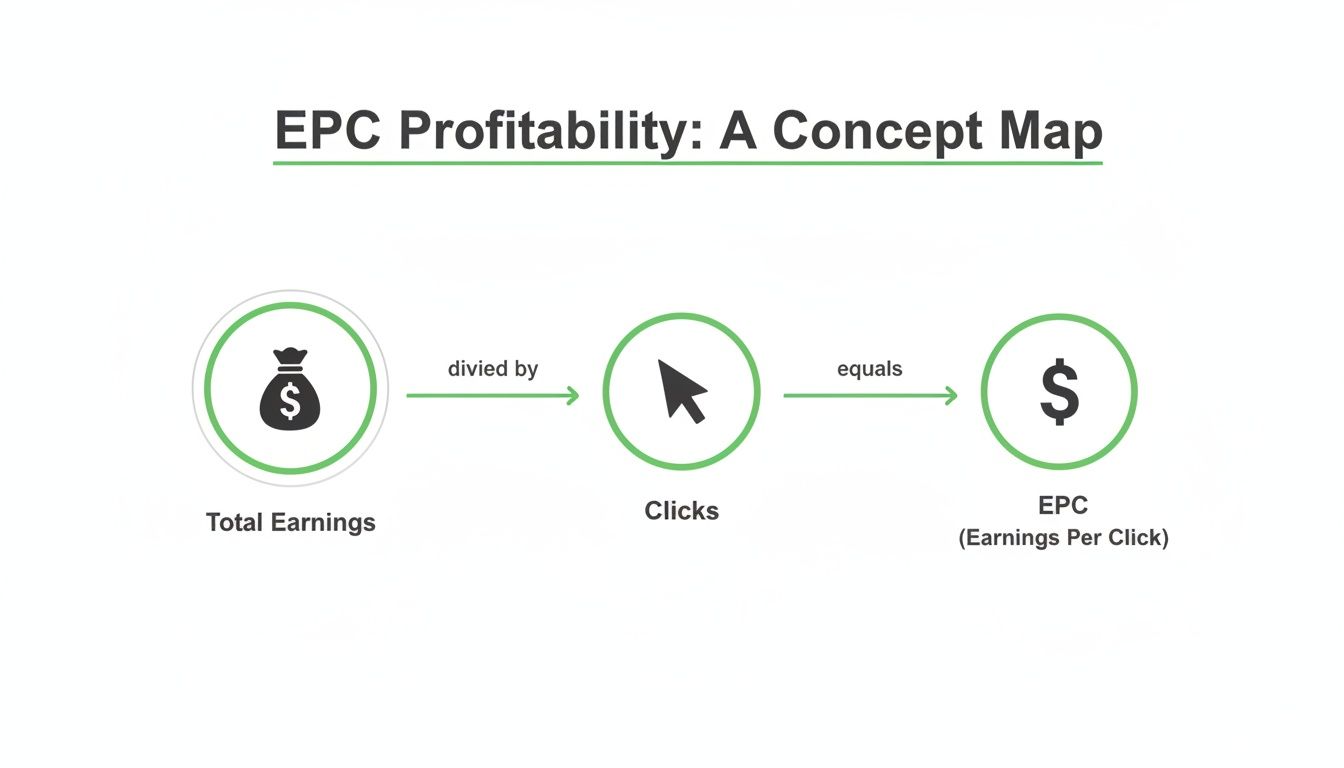
The core idea has been a foundation of performance marketing since the very beginning. The formula is just your total earnings divided by your total clicks.
So, if a campaign generates $500 in revenue from 1,000 clicks, your EPC is a straightforward $0.50. This single number is the key to your profitability, as explained by the experts at LanderLab.
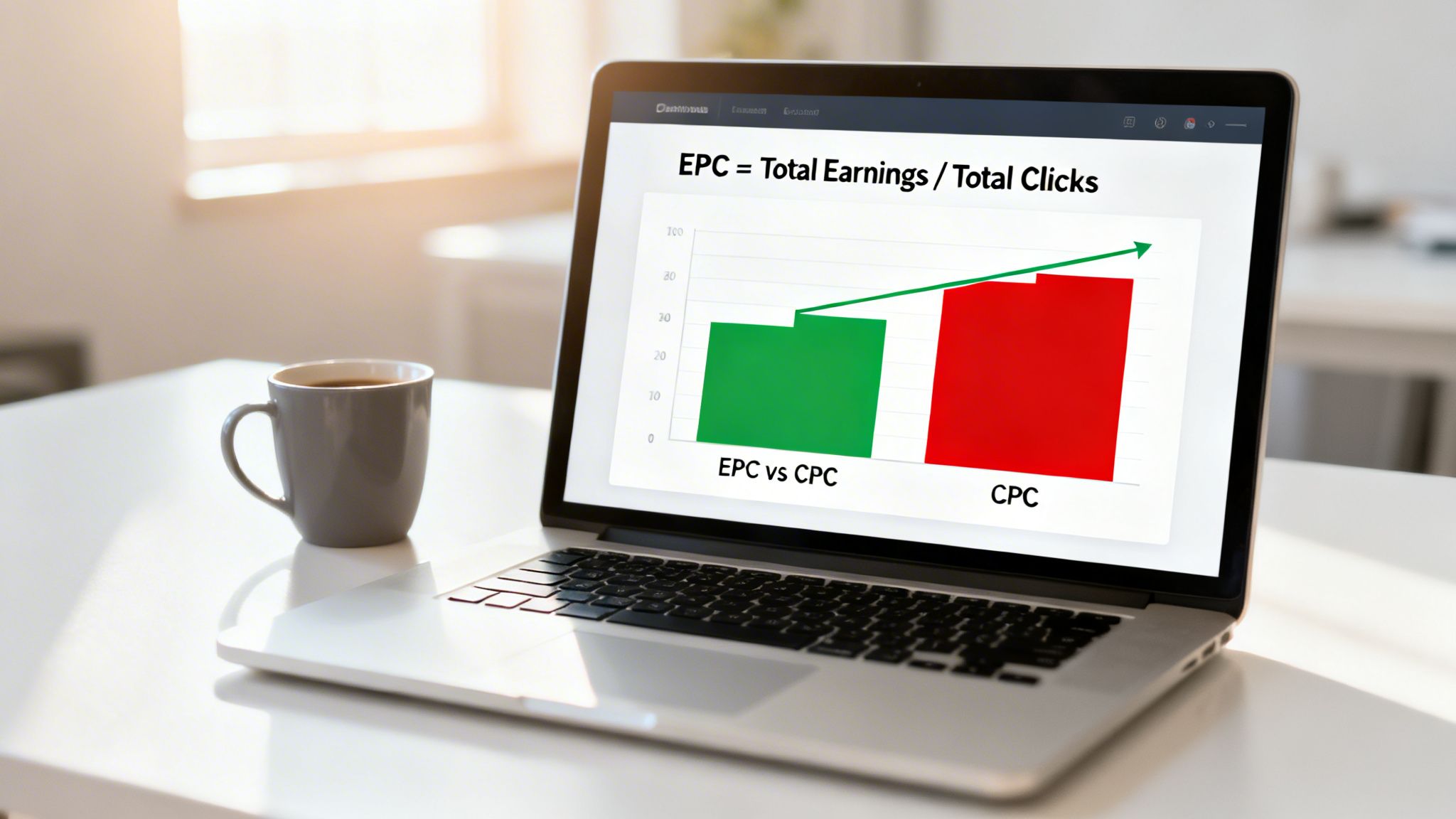
The magic really happens when you compare your Earnings Per Click (EPC) to your Cost Per Click (CPC).
- If EPC > CPC: You're profitable. Every click is making you money. Scale it. 🚀
- If EPC < CPC: You're losing money. Every click is a small loss. Fix it or kill it.
- If EPC = CPC: You're breaking even. It’s a waste of time, money, and opportunity.
This quick comparison tells you instantly whether to pour more fuel on the fire or to hit the brakes before you drive off a cliff.
EPC vs. CPC profitability at a glance
This table breaks down the simple math that determines your campaign's fate. It’s not complicated, but ignoring it is incredibly expensive.
The goal isn't just to be in the green; it's to widen that gap between EPC and CPC as much as possible. A higher profit per click means you can acquire customers more aggressively and outbid less efficient competitors.
This isn't just about individual clicks; it's about making smart decisions at scale. And while EPC is your revenue-per-click, it’s a close cousin to another critical metric. You might be interested in our guide on what is cost per conversion, which looks at the cost to acquire a paying customer.
If you’re a serious performance marketer, you know staring at a single metric is a good way to miss the bigger picture. EPC is no exception. It's a powerful number, but treating it in isolation is like trying to diagnose a car problem by only looking at the speedometer. You're missing the whole engine.
Think of your marketing funnel less like a chart and more like a system of interconnected parts. Each metric you track is a different gear, and they all have to work together smoothly.
Your Click-Through Rate (CTR) is about getting people in the door from your ads. Your Cost Per Click (CPC) is the price you pay for every one of those visitors. And your Conversion Rate (CVR) is how many of those visitors you actually turn into customers or qualified leads.
EPC ties all of that together. It's the direct result of how well those other pieces are working in sync. A problem with any one of them will drag down your EPC and torpedo your profitability.
This formula is simple, but it tells a critical story: every click costs you money, but only some of them generate earnings. This is why EPC is the ultimate diagnostic tool for finding the weak spots in your funnel.
Finding your weak spots
A low EPC is a symptom, not the disease. It’s a bright red warning light telling you something is broken somewhere in the system. The real work is figuring out what is broken. Is your ad targeting attracting the wrong crowd? Is your landing page just not convincing enough? Maybe your offer simply isn't good enough to make people act.
A critical, often-overlooked factor here is lead quality. If your clicks generate leads instead of direct sales, you have to master how to qualify sales leads effectively. Unqualified leads are a massive drag on EPC because they rarely, if ever, convert to actual revenue down the line. A high CTR with a pathetic conversion rate is a classic way to burn cash. You’re great at getting people to the party, but the party itself is a dud. Your EPC will be terrible because no one is buying.
You have to look at the whole system. A sky-high CPC will eat your profits alive, even with a great offer and a stellar conversion rate. You have to tune each part. Improve your ad creative to lift CTR, refine your targeting to lower CPC, and build better landing pages to boost conversions. For more on that last point, check out our guide on creating conversion-optimized websites.
Each small improvement makes your entire funnel more efficient, which in turn drives up your EPC. That’s how you stop chasing vanity metrics and start building a genuinely profitable growth machine.
Calculating your EPC and knowing what is good
Alright, enough theory. Let’s get into how you actually calculate your Earnings Per Click. The formula itself is brutally simple—no advanced math degree required.
EPC = Total Earnings / Total Clicks
That's it. If your campaigns brought in €1,000 from 2,000 clicks, your EPC is €0.50.
The calculation is the easy part. The real work is in figuring out what that number means and what to do about it.
First question: what exactly are ‘earnings’? Is it gross revenue or actual profit? Personally, I always push to use profit wherever possible because it gives you the truest picture of campaign health. But honestly, the most important thing is just to be consistent.
The only benchmark that really matters
So, you have your EPC. Is it good? Is it garbage?
Here’s the blunt answer: asking for a universal good EPC is a waste of time. It doesn't exist. A good EPC for a high-ticket B2B software product is worlds apart from an affiliate campaign pushing cheap headphones. They aren't even in the same universe.
There is only one benchmark that matters for your campaign: your Cost Per Click (CPC). The rule is dead simple. If your EPC is higher than your CPC, you’re making money. If it’s lower, you’re losing money on every single click you buy. End of story. Your entire job is to make the gap between EPC and CPC as wide as humanly possible.
Real-world EPC scenarios
Let’s make this concrete with a couple of quick examples.
- SaaS Lead Generation: Imagine you’re running ads for a B2B software tool. You buy 500 clicks at a €4.00 CPC and generate 25 leads. You know from your sales data that 1 in 5 leads closes, and your average customer value is €500.
- Total Earnings: (25 leads / 5) x €500 = €2,500
- EPC: €2,500 / 500 clicks = €5.00
- Result: Your €5.00 EPC is higher than your €4.00 CPC. This campaign is profitable. Good job.
- EPC: €150 / 1,000 clicks = €0.15
- Result: Your €0.15 EPC is lower than your €0.20 CPC. You are lighting €0.05 on fire with every click. This campaign is a money pit. Shut it down or fix it, fast.
Beyond this basic math, EPC becomes a powerful tool for finding your most valuable traffic. If one campaign pulls a €0.20 EPC and another only manages €0.15 at the same cost, you know exactly where to shift your budget. For a deeper look at these comparison strategies, check out these insights on affiliate marketing EPC.
For B2B and lead gen campaigns, the cost side of the equation is just as critical. You can also learn more about how to calculate cost per lead in our other guide.
Using EPC to make smarter decisions in Google Ads
Alright, we’ve defined the metric. Now for the part that actually matters: how do you use EPC to make your Google Ads campaigns more profitable?
This is where the theory ends and the real work begins. It’s how you stop guessing and start pulling ahead of the competition.
Let's get practical. Your EPC is the most direct way to guide your bidding strategy. A lot of marketers get excited about automated bidding like Target ROAS but forget one critical detail: it’s only as smart as the data you feed it.
Garbage in, garbage out.
If you’re running lead generation campaigns, Google has no idea what a lead is actually worth to your business. By assigning a realistic dollar value to each conversion—based on your real sales data and close rates—you’re basically giving the algorithm a clear, profit-driven target. That’s a total game-changer.
From managing campaigns to engineering growth
Focusing on EPC moves you beyond just managing campaigns; you start proactively engineering growth. When you treat EPC as your north star, it brings ruthless clarity to your decisions. It becomes the ultimate signal for what's working and what isn't.
This metric is now essential infrastructure for any serious performance marketing team. This is especially true for large-scale Google Ads accounts where tiny improvements in EPC multiply into massive revenue gains across thousands of clicks. As a breakdown by CloudBlue points out, this is what separates the top-tier marketers from everyone else.
Think about it: an agency managing campaigns that get 100,000 clicks a month with a $0.50 EPC can bank an extra $10,000 every single month just by lifting that EPC by $0.10. That’s the kind of impact that gets you promoted or lands you bigger clients.
Making hard decisions easy
With solid EPC data, you can confidently decide which keywords and ad groups to scale, which ones to fix, and which ones to kill. This isn’t about guesswork; it's about data-driven execution.
Here’s the playbook:
- Scale the Winners: Keywords or ad groups where your EPC is significantly higher than your CPC are your golden geese. Feed them more budget.
- Fix the Breakevens: If EPC is just hovering around your CPC, something’s off. Maybe the ad copy doesn't match the landing page, or the targeting is too broad. This is where you dig in and optimize.
- Kill the Losers: When a keyword has a consistently low EPC and is just burning cash, don’t get emotional. Pause it. Your budget is far better spent on campaigns that actually deliver a return.
Of course, trying to do this manually across thousands of keywords is a recipe for burnout and missed opportunities. It’s just not possible. This is exactly where platforms like dynares come in, automatically creating hyper-relevant ads and landing pages for every keyword to maximize your EPC from day one.
And remember, none of this works if your tracking is shaky. If your measurement is broken, all your metrics are useless. Make sure you have it locked down by following our guide on getting your Google Ads conversion tracking setup right.
Common traps to avoid when chasing EPC
Like any metric that actually matters, Earnings Per Click can be misused. In fact, if you just chase a higher EPC without thinking, you can do some serious damage to your business.
Let’s talk about a few of the biggest traps people fall into.
The most common mistake I see is focusing on short-term EPC at the expense of long-term customer value (LTV). It’s tempting to optimize for the quick win—the campaign that delivers the highest immediate return. But some of your most valuable customers might come from channels or campaigns with a lower initial EPC.
They might take longer to convert or make smaller first purchases, but they stick around for years. If you cut a campaign because its day-one EPC isn't amazing, you might be killing your most loyal future customer base. Don't be that person. You have to play the long game.
Don't let bad data drive your decisions
Another trap that drives me crazy is making huge decisions based on a tiny amount of data. Calculating an EPC from ten clicks and then killing a campaign is just dumb. You have to let data accumulate before you can trust it.
Here’s where a lot of marketers go wrong:
- Ignoring statistical significance: You need enough clicks and conversions for the EPC to be a reliable signal. A handful of clicks tells you nothing. Give your campaigns time to breathe.
- Overreacting to daily fluctuations: EPC will go up and down. A bad day doesn't mean the campaign is a failure, just like one great day doesn't mean you've found a goldmine. Look at trends over a meaningful period.
- Forgetting about conversion lag: Especially in B2B, people don't click and buy instantly. The revenue from a click might not show up for days or even weeks. If you make decisions too quickly, your EPC will look artificially low.
The attribution model dilemma
Finally, let's talk about attribution. In a complex customer journey, a person might interact with your brand multiple times across different channels before they finally convert. They might see a social media post, click a Google ad, and then get an email.
So, which click gets the credit for the earnings?
If you use a simplistic last-click attribution model, you’re giving 100% of the credit to the final touchpoint. This can give you a massively misleading EPC for your top-of-funnel campaigns that are crucial for introducing people to your brand.
Understanding what is EPC is one thing, but knowing its limitations is what separates the pros from the amateurs. You have to think critically about how you're measuring it and resist the urge to jump to simple, but wrong, conclusions. It’s about being data-informed, not data-blinded.
Where all of this is heading is pretty clear: the future of PPC is automated and driven by profit, not just clicks or leads.
The days of a PPC manager living in a spreadsheet, manually tweaking bids for a few dozen keywords, are over. To stay competitive in 2026 and beyond, your system has to manage thousands of keywords and ads, all while optimizing for pure profitability.
This is where pairing a sharp metric like EPC with the right AI platform gets really interesting. It’s the difference between just managing campaigns and building a growth engine that runs itself.
The rise of profit-driven automation
Imagine a setup that doesn't just create the right ad and landing page for every single search, but also watches the EPC for each one, 24/7. It automatically pulls budget from the losers and pours it into the winners in real-time.
You stop chasing more leads and start chasing more profitable leads.
This isn't some far-off concept; this is what smart martech platforms are being built for today. The near future is about hyper-personalization at scale, real-time budget allocation using EPC as the core signal, and predictive optimization.
As paid search moves more toward this kind of automation and profit-driven strategy, it’s worth thinking about the bigger picture of how data and AI are changing the game. You can dig deeper into the future of AI in business intelligence to see how these ideas connect across the board.
By connecting the dots from the click all the way through to actual revenue, we can finally get out of the guessing game. We can start building predictable, profitable systems that scale. That's the future I'm building for.
Frequently asked questions about EPC
When you start talking about Earnings Per Click, a few questions always pop up. People want to know how it fits with the metrics they already use and whether it even applies to their business model.
Let's clear the air on the most common ones. No fluff, just the straight answers.
How is EPC different from ROAS?
This is a classic. People see "earnings" and "return" and think they're the same thing. They're not. They're partners, but they have very different jobs.
Return On Ad Spend (ROAS) is your high-level scorecard. It tells you the total revenue you generated for every dollar you spent on ads. It's the big picture—the end-of-quarter report that tells you if your overall strategy is profitable.
EPC, on the other hand, is the diagnostic tool you use on the factory floor. It measures the value of a single click. Think of it this way: ROAS is your annual shareholder report, while EPC is the daily performance review for each individual keyword.
You don't get a good ROAS by accident. You get it by making sure your EPC is consistently higher than your CPC on as many keywords as possible. One is the cause, the other is the effect.
Can I use EPC for lead generation campaigns?
Absolutely. In fact, if you're not, you're flying blind. It just takes one small step that, frankly, most marketers are too lazy to do: assigning a value to a lead.
It's not magic. Just look at your historical data.
Let's say for every 100 leads that fill out a form, your sales team closes one deal. And let's say that average deal is worth €1,000. The math is simple: each lead is worth €10 to the business (€1,000 / 100 leads).
That €10 becomes the 'E' (Earnings) in your EPC formula. Suddenly, you've connected your top-of-funnel ad clicks to actual revenue, even if the deal doesn't close for another six weeks. This is how you stop optimizing for cheap leads and start optimizing for profitable growth. A good EPC isn't some magic number you pull from a blog post. A good EPC is simply any EPC that is consistently higher than your Cost Per Click (CPC).
Your goal isn't to hit an arbitrary benchmark someone else set. It's to find and widen the gap between what a click earns you and what it costs you. The bigger that gap, the healthier your profit engine. It really is that simple. 📈
Ready to stop guessing and start engineering profitable growth? dynares automatically creates hyper-relevant ads and landing pages for every keyword, optimizing for the metrics that actually matter—like EPC. See how it works and book a demo at https://dynares.ai.


